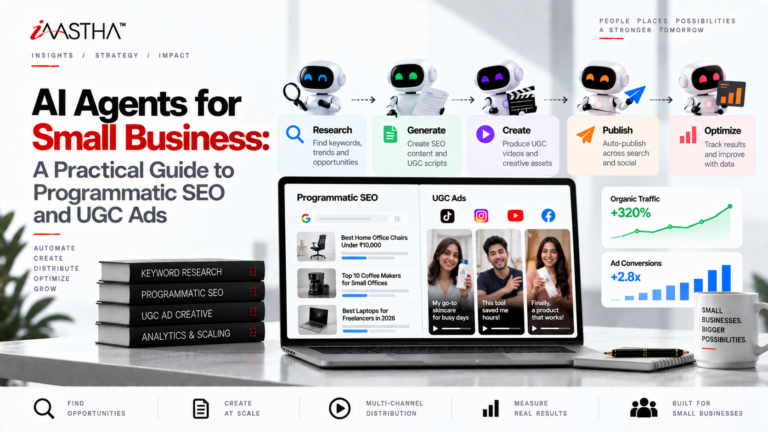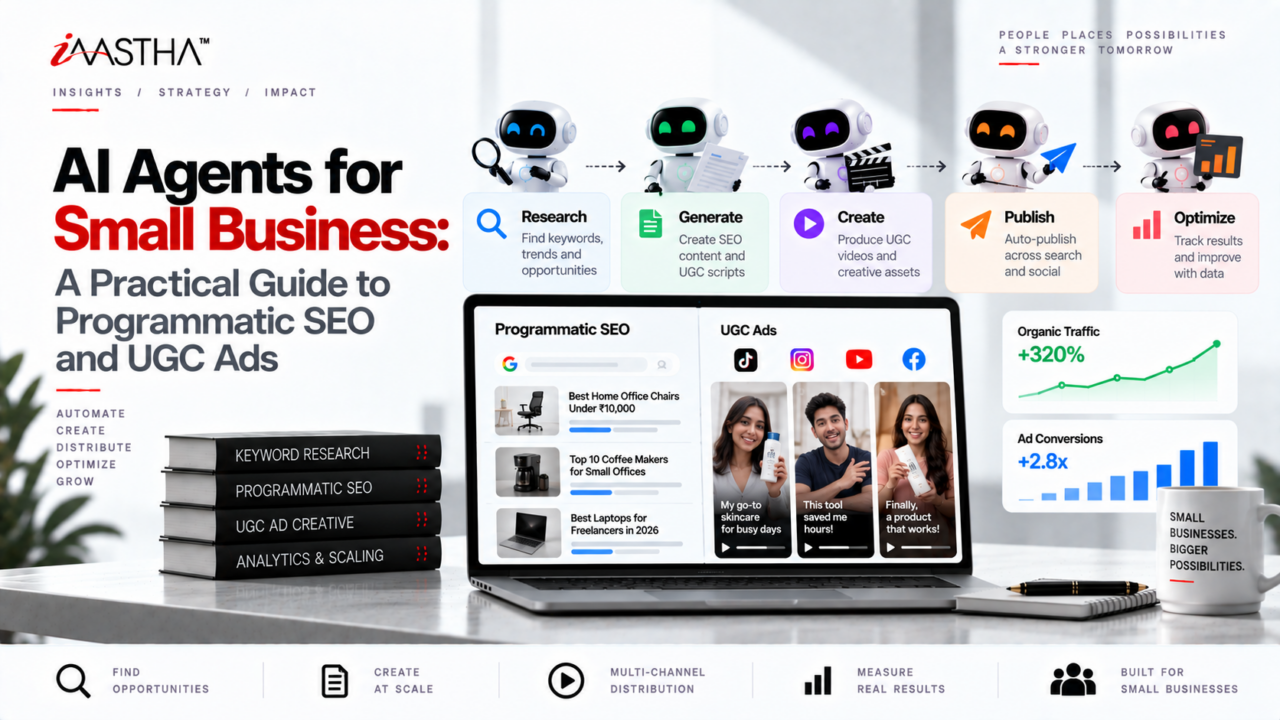
Most small businesses do not have a marketing problem. They have a capacity problem. One founder and a couple of helpers cannot write every blog post, build every landing page, film every ad and answer every lead. AI agents close that gap, and this guide shows exactly how, with a focus on programmatic SEO and UGC ad creation.
What are AI agents for small business?
An AI agent is software that takes a goal, breaks it into steps, uses tools to complete those steps, and checks its own work. A chatbot answers one question. An agent can pull keyword data, draft a page, run a quality check, publish it through your CMS and report the result.
For a small business, the useful agents are narrow. One agent handles search content. Another handles ad creative. A third triages leads. Each has a clear input, a clear output and a human checkpoint. That structure is what makes AI marketing automation for small business reliable instead of chaotic.
Programmatic SEO for small business
Programmatic SEO means building many search-focused pages from a template and a dataset, instead of writing each page by hand. Think “[service] in [city]” or “[tool] for [use case]”. Done well, it captures hundreds of long-tail searches that no single blog post could target. Done badly, it produces thin pages that search engines ignore or penalize.
Step 1: Find the keyword pattern
Start with one repeatable pattern that matches how customers search. A plumber might use “emergency plumber in [neighborhood]”. A SaaS tool might use “[product] alternative for [industry]”. An agent can pull the keyword set, then cluster it by search intent so informational, comparison and buying queries do not end up on the same page.
Step 2: Build a template with real data
The template needs dynamic fields: title, H1, intro, FAQ schema, internal links and a data block. The data block is the part that matters. Pricing ranges, inventory, reviews, opening hours, service areas and local regulations make each page genuinely different. If the only difference between two pages is the city name, do not publish them.
Step 3: Add a QA gate before anything goes live
This is where agents earn their keep. A review agent can score each page for thin content, duplicate paragraphs, missing data fields and keyword cannibalization. Pages that fail go back to the queue. Pages that pass move to a human spot check.
Step 4: Publish and interlink
Push approved pages through your CMS API, then generate the sitemap and an internal link graph so related pages point to each other. Monitor indexing and rankings weekly, and prune pages that never get impressions.
Common programmatic SEO mistakes
The biggest mistake is scale without substance. Other frequent errors include publishing hundreds of pages at once, ignoring search intent, and skipping human review of factual claims. Start with 20 to 50 strong pages, measure, then expand.
How to create UGC ads with AI
UGC-style ads look like authentic customer videos: handheld feel, natural language, a direct hook. They tend to perform well because they do not look like ads. The bottleneck has always been production. AI removes most of it.
Mine reviews and support tickets for angles
An agent can read your reviews, support tickets and sales call notes, then extract pain points, objections and the exact phrases customers use. Those phrases become your hooks. Real customer language beats clever copywriting almost every time.
Write hook and script variations
For each angle, generate 10 to 20 hook variations and short scripts in an unpolished, native voice. Keep scripts under 30 seconds. One clear problem, one proof point, one call to action.
Produce the video
Feed scripts into an AI avatar or video tool, add captions and B-roll, and export in 9:16, 1:1 and 4:5 so the same asset works across Reels, TikTok, Shorts and feed placements. Disclose AI-generated content where platform rules or local law require it.
Close the loop with tagging and testing
Tag every variant by hook, angle and CTA. When performance data returns, the agent pauses losers and writes new variants based on winners. This feedback loop is the real advantage. Instead of guessing, a small team runs a steady creative testing program.
Connecting SEO and ads into one workflow
The two systems feed each other. Search data shows which problems people care about, which becomes ad angles. Ad performance shows which messages convert, which shapes the next round of pages. A shared data store, tool calling and a human approval checkpoint are enough to run the whole thing without a large team.
Interactive tool: how many hours could agents save you?
- Hours per week on content, SEO pages and ad creative: 10
- Share of that work an agent could handle: 60%
- Your hourly value (any currency)
- About 26 hours saved per month, worth roughly 650 at your rate.
Launch checklist: your first AI agent workflow
- Pick one keyword pattern and one dataset
- Build one page template with real data fields
- Set up a QA agent for thin and duplicate content
- Export 20 customer phrases from reviews for ad hooks
- Produce 10 UGC-style variants and tag each one
- Add a human approval step before publishing
- 0 of 6 done
Risks and human oversight (E-E-A-T)
Search engines and AI answer engines reward content that shows real experience, expertise and trust. The same applies to your agent output. Have a subject expert review factual claims, keep author names and credentials visible, cite sources for statistics, and never let an agent publish pricing, legal or health claims unreviewed. Agents handle the repetitive 80%. People own the judgment.
Conclusion
AI agents will not replace your marketing judgment, but they remove the bottleneck that keeps small teams from publishing and testing at scale. Start with one programmatic SEO template and one UGC testing loop, keep a human in the approval seat, and expand only when the data says it works.