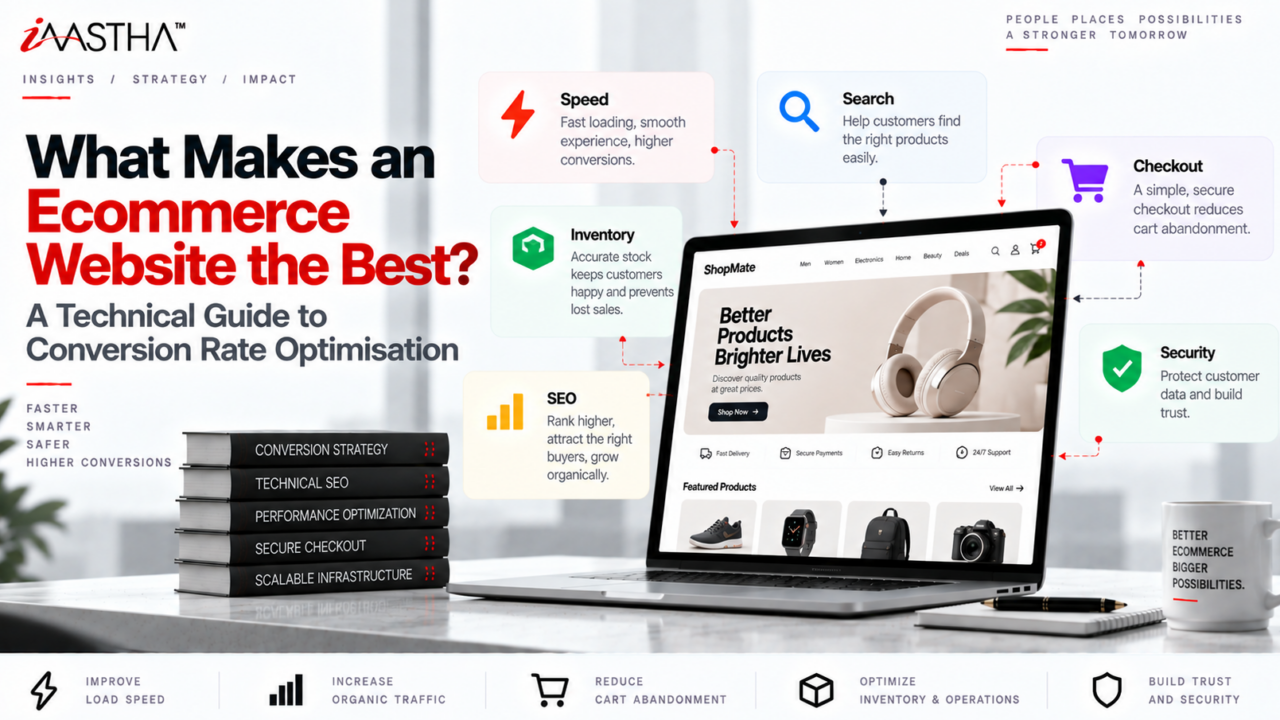
This guide is written for store owners and developers. It covers the technical layers that separate high converting stores from average ones, and it includes three interactive tools you can use as you read: a Core Web Vitals checker, a revenue calculator and a store checklist.
Speed comes first: Core Web Vitals for ecommerce
Slow pages lose customers before they see a single product. Google’s Core Web Vitals give you three measurable targets: Largest Contentful Paint (LCP) under 2.5 seconds, Interaction to Next Paint (INP) under 200 milliseconds, and Cumulative Layout Shift (CLS) under 0.1. They are judged on real user data at the 75th percentile, so a fast test run on office wifi does not count.
On a product page, LCP is usually the hero image. Serve it as AVIF or WebP with a responsive srcset, preload it, and never lazy load the first image. Put static assets and cached HTML on a CDN so a shopper in Leeds is not waiting on a server in Frankfurt. Use server side rendering or incremental static regeneration for catalogue pages, and defer third party scripts such as chat widgets and tag managers, which are a common cause of poor INP.
How to run a website speed test on an online store
Run a website speed test with PageSpeed Insights, reading field data first and lab data second. Repeat it on a product page, a category page and the checkout, not just the homepage. Test on a mid range Android phone over throttled 4G, because that is closer to your median customer than your laptop. Record LCP, INP and CLS before you change anything so you can prove the fix worked.
Core Web Vitals checker
LCP (seconds)
INP (milliseconds)
CLS (score)
Choosing a platform: WooCommerce vs Shopify for stores
There is no universally best platform, only the best fit for your team. WooCommerce gives you full control of code, database and hosting, which suits developers and complex catalogues. Shopify removes infrastructure work and includes PCI compliant hosting, which suits teams who would rather sell than maintain servers.
With WooCommerce, hosting decides whether the store is fast or slow. Look for PHP 8.x, Redis object caching, a CDN and a staging environment, and keep the plugin count low, because every plugin adds queries and potential security holes. Our WooCommerce hosting comparison lists what to check. With Shopify, cost grows through apps and transaction fees, and deep checkout customisation is limited outside Shopify Plus. A headless build with a framework such as Next.js can deliver the best speed, at the price of more engineering and a bigger maintenance load.
Checkout engineering: how Stripe payments should work
Checkout is where revenue is won or lost. Research from the Baymard Institute puts average cart abandonment at roughly 70 percent. Reduce friction with guest checkout, address autocomplete, and wallets such as Apple Pay, Google Pay and PayPal. Show total cost, including delivery, before the final step.
How to add Stripe payments to WooCommerce
Install the official Stripe plugin for WooCommerce, connect your account and enable the Payment Element or the wallet options. Then treat webhooks as the source of truth: never mark an order as paid because the browser reached a thank you page. Listen for events such as payment_intent.succeeded, verify the signature, and update the order from that event. Send idempotency keys with payment requests so a retried request cannot charge a customer twice, and make your webhook handler safe to run more than once.
3D Secure 2 and Strong Customer Authentication
UK card payments fall under Strong Customer Authentication rules, so 3D Secure 2 is both a legal and a practical requirement. Modern flows authenticate low risk payments silently and only challenge when needed, so conversion barely suffers when it is implemented properly. Stripe’s SCA documentation explains the exemptions and the flows.
Security: SSL certificate and PCI compliance
An SSL certificate (TLS) is the baseline. Without HTTPS, browsers warn shoppers and search engines trust the page less. Use TLS 1.2 or higher, enable HSTS and renew certificates automatically. Then reduce your PCI DSS scope by using hosted fields or a redirect, so card numbers never touch your server and you qualify for the simplest self assessment. The PCI Security Standards Council publishes the requirements. Add a web application firewall, rate limiting on login and cart endpoints, and strong authentication for admin users.
Inventory integrity: how to prevent overselling in ecommerce
Overselling costs you refunds and trust. Treat stock as a transactional resource. Reserve units atomically when checkout starts, release the reservation on a timer if payment does not complete, and decrement permanently only on confirmed payment. In a database, that means row level locks or a conditional update that only decrements where available stock is above zero.
For several channels or warehouses, use an event driven pipeline with a queue so order, stock and notification services stay in sync, and design for eventual consistency on purpose. If you run an order management system (OMS), make it the single source of truth for order state.
Search and structured data
Shoppers who use onsite search tend to convert at a higher rate than browsers, so treat search as a product. Use a dedicated engine such as Algolia, Typesense or Elasticsearch with typo tolerance, synonyms and faceted filters. For search engines and AI assistants, add Product and Offer structured data as JSON-LD with price, GBP currency, availability and reviews, following Google’s product structured data guidance. Use clean canonical URLs for filtered pages, and keep out of stock pages live with clear messaging instead of returning a 404. Our ecommerce SEO guide covers faceted navigation in detail.
Conversion rate optimisation: how to improve ecommerce conversion rate
Conversion rate optimisation (CRO) ties every layer above to revenue. Commonly cited ecommerce averages sit around 2 to 3 percent, though sector and traffic quality move that a lot. Start with data: funnel analytics, session recordings and real user monitoring show where shoppers drop off. Then form a hypothesis, test it with a proper A/B testing framework, and ship only changes that reach statistical significance.
Where to test first
Show delivery costs and returns information early on the product page, since UK shoppers have cancellation rights under the Consumer Contracts Regulations and clear terms build trust. Cut checkout fields to the minimum, test your free delivery threshold, and reorder payment methods by real usage. Finally, meet WCAG 2.2 accessibility standards: it widens your market and reduces legal risk.
Ecommerce website checklist
Tick what your store already does. Anything unticked is your next sprint.
0 of 8 complete
LCP under 2.5s, INP under 200ms, CLS under 0.1 on real user data
Guest checkout and wallet payments enabled
3D Secure 2 and idempotent payment requests in place
Webhooks verified and safe to retry
Atomic stock reservation, no overselling
HTTPS everywhere with HSTS and reduced PCI scope
Product structured data and clean canonical URLs
Funnel analytics and an A/B testing process running
What the experts say
These points summarise published guidance from leading sources. They are paraphrases, not direct quotes. Google’s web performance team stresses judging speed on real user data at the 75th percentile, not a single lab run. Baymard’s checkout research repeatedly finds unexpected extra costs, such as delivery and tax, among the top reasons shoppers abandon a purchase. Stripe’s engineering documentation recommends idempotent requests so network retries never create duplicate charges.
Frequently asked questions
What makes an ecommerce website the best?
Fast pages, a low friction checkout with secure payments, accurate inventory, strong search and structured data, and a habit of testing every change through conversion rate optimisation.
Is WooCommerce or Shopify better for a UK store?
WooCommerce suits teams that want full control and can manage hosting. Shopify suits teams that want managed infrastructure and built in PCI compliant hosting.
How do I improve ecommerce conversion rate?
Find drop off points with funnel analytics, fix speed and checkout friction, show delivery and returns information early, and validate each change with A/B testing.
Bringing it together
The best ecommerce websites feel effortless because the engineering behind them is relentless. Get speed, payments, security and stock accuracy right, then use conversion rate optimisation to keep improving. Start with the checklist above and fix one gap this week.