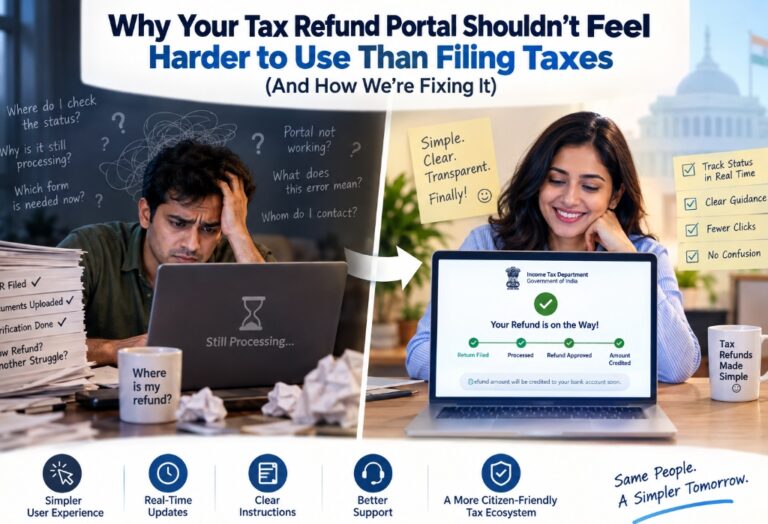
Imagine this: You have just spent hours gathering documents, double-checking numbers, and navigating the labyrinth of annual tax preparation. You hit submit. A few weeks go by, and you need to check the status of your refund—money that you are relying on to pay for groceries, fix a car, or cover rent. You navigate to your local government’s tax refund portal, hoping for a simple status update.
Instead, you are met with a digital brick wall.
The login loop keeps resetting. The language on the page is written in dense bureaucratic jargon. The links lead to dead error pages, and the “help” section simply redirects you to a phone number with a four-hour hold time.
Your tax refund portal shouldn’t feel harder to use than filing the taxes themselves. But unfortunately, that is the daily reality for millions of citizens interacting with public infrastructure. From unemployment claims to tax refunds, citizens are routinely forced to navigate clunky legacy case-management systems, disconnected back-office databases, and digital “services” that feel entirely hostile to the end user.
This isn’t just a minor inconvenience. When government technology fails, it quietly but effectively erodes public trust in the government itself.
At Iaastha, we believe this is a completely fixable problem. But the solution isn’t another flashy, superficial rebrand. It doesn’t come from a slick new logo or a fresh coat of paint on a broken website. It comes from the unglamorous, roll-up-your-sleeves work of making public systems actually function the way they are supposed to.
Here is exactly how we do it, why our approach is different, and how we are rebuilding trust in public infrastructure, one digital workflow at a time.
We Embed for the Long Haul (Because Parachuting In Doesn’t Work)
The traditional model for upgrading government technology is fundamentally broken. A massive tech consultancy wins a bid, parachutes a team of developers in, builds a flashy demo or a completely detached portal, hands over a massive instruction manual, and disappears. Six months later, the agency staff is left struggling to maintain a system they never fully understood, and the citizen experience hasn’t genuinely improved.
We don’t operate that way. At Iaastha, we embed ourselves for the long haul. We understand that improving government digital services requires more than just knowing how to write code; it requires understanding the unique, localized context of the agency we are helping.
We become an extension of the internal team. We sit next to the caseworkers, we shadow the administrators, and we learn the intricate, daily workflows that keep the department running. By understanding the historical constraints—such as why a certain process requires three separate approvals, or why data has historically been siloed—we can build solutions that actually fit the reality of the people behind the process. We aren’t just selling a product; we are partnering in a transformation.
Overhauling Legacy Case-Management Systems from the Inside Out
One of the biggest hurdles in modernizing public sector technology is the stubborn persistence of legacy platforms. Old case-management systems were almost never built for the humans using them. They were built decades ago to digitize paper forms, and over the years, they have been patched, band-aided, and bloated to the point of collapse.
More importantly, these legacy systems are almost always designed around the internal organizational chart of the agency, rather than the actual journey of the citizen. If a citizen needs a service that crosses three different departments, they are often forced to log into three different portals, re-enter their information three times, and track three separate case numbers.
At Iaastha, we overhaul these legacy platforms from the inside out by flipping the design paradigm completely. We redesign digital services around real citizen journeys. When someone comes to a tax refund portal, they don’t care whether the Department of Revenue or the Treasury processes the payment. They just want their money. We build seamless, unified front-end experiences that abstract away the complexity of the back office. The organization can keep its necessary departmental structures, but the citizen gets a single, intuitive, human-centered experience.
Treating Security and Compliance as a Core Feature, Not a Footnote
When dealing with government data—social security numbers, financial records, health information—the stakes are incredibly high. In the tech world, there is often a temptation to “move fast and break things.” In the public sector, breaking things means exposing sensitive citizen data or violating strict federal and state regulations.
Too many tech vendors view security protocols and complex data-residency laws as annoying constraints they have to work around. They build a product and then try to bolt compliance onto it at the last minute, leading to brittle systems that fail audits and put citizen data at risk.
At Iaastha, security is woven into the very fabric of our development process. Operating inside complex data-residency laws isn’t a hurdle to us; it is a discipline we build into every single decision from day one. By prioritizing secure-by-design architecture, we ensure that as systems scale, they remain impenetrable. When citizens hand over their personal data to the government, they are doing so under the assumption of absolute safety. We view it as our primary responsibility to honor that assumption.
Automating the Bureaucracy No One Misses
Let’s talk about the people on the other side of the screen: the government caseworkers. When citizens are frustrated by slow response times, they often blame the civil servants. What they don’t see are the caseworkers drowning in manual data entry, toggling between five different legacy applications just to process a single claim, and fighting against software that crashes on a daily basis.
The truth is, government employees don’t want to spend their days doing mindless, repetitive data entry any more than citizens want to wait months for a response. The tedious, manual, and highly error-prone steps are what slow everyone down.
This is where targeted, intelligent automation comes in. We look at the entire lifecycle of a citizen’s request and identify the friction points. By automating government bureaucracy—such as data validation, document routing, and simple status updates—we drastically reduce the administrative burden on agency staff. We automate the bureaucracy that no one misses.
The result? Caseworkers are finally freed from the chains of copy-and-pasting data. They can actually pick up the phone, handle complex outlier cases, and focus their energy on helping people, rather than managing paperwork. Technology should elevate human empathy, not replace it.
Usability is Not a Luxury
When we put all of these pieces together—deep organizational embedding, citizen-centric design, uncompromising security, and smart automation—the result is something far more profound than just a better-looking web portal.
It becomes a government service that citizens can actually trust again. It becomes an infrastructure that respects a user’s time, protects their deeply personal data, and honors their patience.
For too long, usability in public technology has been viewed as a luxury—a “nice to have” feature that is quickly cut when budgets get tight. But as we have seen with tax portals, health benefit applications, and emergency relief funds, poor usability actively prevents people from accessing the services they are legally entitled to.
Usability isn’t a cosmetic upgrade. It is the fundamental difference between a citizen who gives up in frustration and a citizen who successfully gets the help they need.
At Iaastha, we are committed to doing the hard, unseen work required to bridge that gap. We aren’t here to offer a quick fix. We are here to rebuild the digital foundation of public trust, ensuring that the services meant to support our communities actually work for the people living in them.