The Linguistic Reality That Text Interfaces Could Never Fully Serve
Once upon a time, in a nation of 1.4 billion people speaking 22 official languages and hundreds of dialects, technology mostly spoke English or demanded typed text. Smartphones spread rapidly, yet for farmers in Maharashtra villages, dairy producers in Gujarat, shoppers in Tier-2 and Tier-3 towns, and millions more, the digital world remained locked behind literacy barriers and English-first interfaces. Call centres absorbed the overflow with long waits and rising costs, while apps quietly excluded vast populations who preferred speaking over typing.
The Daily Friction of a Text-First Digital World
Every day the friction compounded. Nearly 80% of Indians do not use English as their primary language. Around 65% of internet users already preferred voice search, generating over a billion monthly queries, yet most systems still failed on real Indian speech. Background noise from traffic or kitchens, narrowband 8 kHz telephony audio, strong regional accents, and constant code-switching — Hinglish, Tanglish, or seamless mixing of Hindi and English mid-sentence — turned promising tools into frustrating dead ends. Businesses watched customer-service costs climb while missing the chance to reach the next 300 million digital users. Global models trained largely on clean, high-resource languages produced high word error rates on Indian audio, sometimes exceeding 30% on code-switched speech, and responses often felt robotic or delayed.
The Moment Voice AI Became Inevitable
One day the shift became impossible to ignore. Startups, research labs, and government initiatives began treating voice as the natural interface rather than an afterthought. Companies such as Gnani.ai, Sarvam AI, Navana.ai, and platforms powered by Bhashini and AI4Bharat started building specifically for India’s linguistic reality. Public deployments like MahaVISTAAR for farmers and Sarlaben for Amul dairy producers showed that a simple phone call in the caller’s own language could deliver timely advice, status updates, or scheme information. Enterprises in banking, e-commerce, logistics, and insurance moved voice AI from pilot projects into production, handling tens of millions of interactions daily. What had once struggled with dialects now promised to make digital services as natural as speaking.
Technical Requirements That Separate Demos from Production Systems
Because of that progress, the conversation quickly turned technical. Real production systems demanded far more than basic speech-to-text and text-to-speech. Automatic speech recognition (ASR) had to handle 8 kHz telephony audio, packet loss, rural noise, and code-switching without collapsing. Text-to-speech (TTS) needed native-sounding voices that maintained consistent prosody across language switches rather than stitching mismatched accents. End-to-end latency — from the moment a caller paused to the first audio response — had to stay under roughly 500–800 milliseconds (ideally closer to 300 ms on India-region infrastructure) to feel conversational rather than laggy. Data residency under the Digital Personal Data Protection Act and sector rules from RBI and TRAI required careful decisions about where audio and transcripts lived. These technical requirements separated impressive demos from systems that could actually scale affordably at Indian price points of roughly ₹2–4 per minute all-in.
Voice Quality and Context Handling: The Two Capabilities That Matter Most
Because of that deeper focus, two capabilities rose to the centre: voice quality and context handling. Voice quality is measured not only by traditional Mean Opinion Score (MOS) naturalness ratings — targets often sit above 4.0–4.3 — but by expressiveness, emotional appropriateness, prosody consistency, and identity stability across long turns. A voice that sounds clear yet flat, or that shifts unnaturally when the language mixes, feels uncanny to Indian listeners. Modern systems now evaluate pitch variation, jitter, spectral balance, and the ability to convey empathy or assertiveness appropriate to collections, support, or advisory calls. Indian-tuned models and high-quality multilingual TTS engines prioritise these dimensions so that a response in Tamil or Marathi carries the right cadence and warmth rather than a generic international accent.
Context handling proved equally decisive. A voice agent that forgets what the caller said two minutes earlier or loses track of an earlier verification step breaks trust immediately. Effective systems layer static instructions (persona, compliance rules, tone), dynamic customer state retrieved from CRM or backend systems, recent conversation history, and a rolling summary of earlier turns. Techniques include sliding windows that retain only the most relevant recent exchanges, automatic summarisation of longer histories to stay inside the model’s context window, and milestone-based resets once key steps such as identity verification are complete. In multi-turn calls that involve tool use — checking balances, confirming orders, or updating records — the agent must maintain continuity while keeping latency low. Conversation memory that persists across sessions (when privacy rules allow) further strengthens the experience so callers do not have to repeat themselves.
The Transformation Toward Inclusive Digital Access
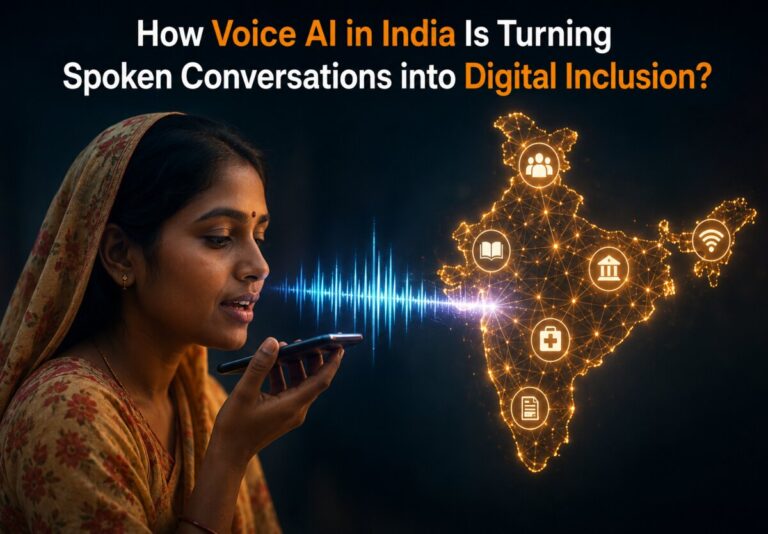
Until finally, Voice AI in India is rewriting the relationship between technology and everyday life. What began as a response to exclusion is becoming an inclusion engine. Farmers receive timely advice, citizens navigate government services, customers resolve issues in their preferred language, and businesses operate more efficiently while staying compliant. Open models such as SraVaani (covering 65 Indian languages and dialects) and Indic foundation models from Sarvam continue expanding reach to previously unsupported communities. The remaining challenges — further reducing word error rates on long-tail dialects, refining expressiveness across more languages, and optimising for the lowest possible latency on variable networks — keep driving innovation. Yet the direction is clear: when systems meet the real technical requirements of high voice quality and robust context handling, spoken conversation becomes the most natural bridge to digital opportunity for hundreds of millions of Indians. The next chapter of Indian AI will not only be written — it will be spoken.