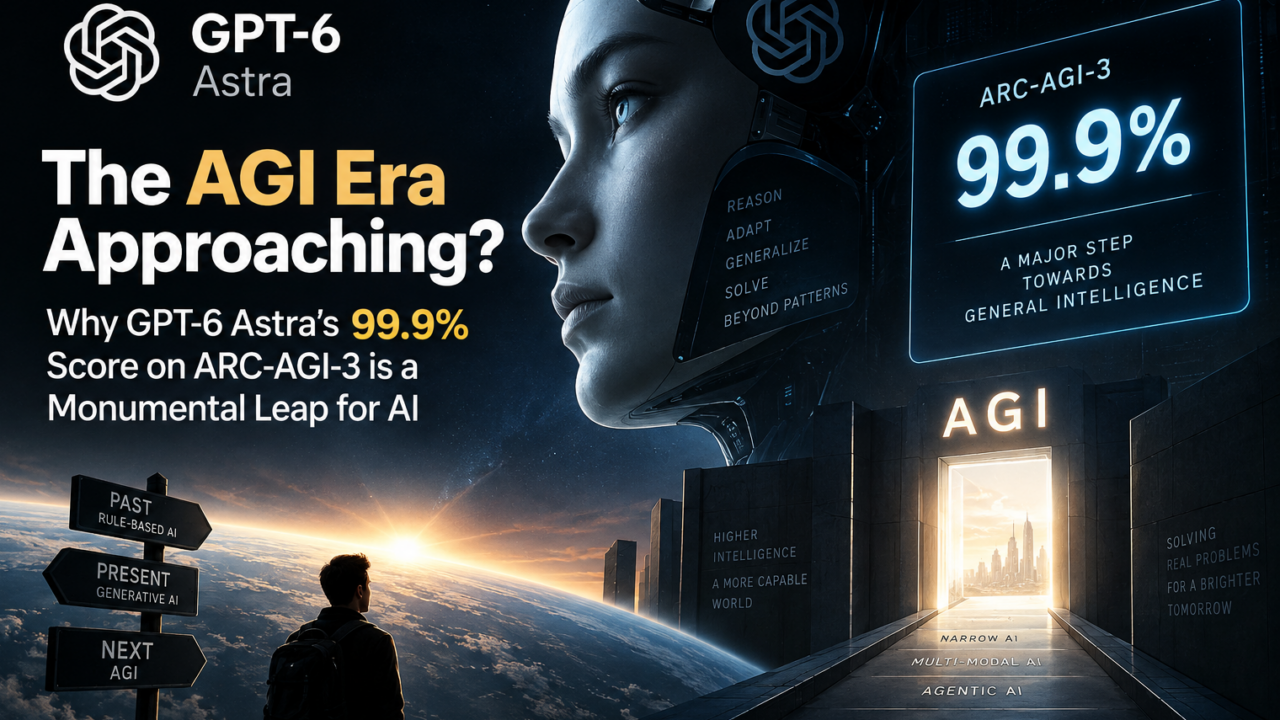
On September 3, 2026, the artificial intelligence landscape experienced a seismic shift. OpenAI unveiled its latest frontier model, GPT-6 Astra, and with it came a performance metric that left AI researchers and developers stunned: a 99.9% score on the notoriously difficult ARC-AGI-3 benchmark. For years, the Abstraction and Reasoning Corpus (ARC), initially pioneered by AI researcher François Chollet, has stood as the ultimate litmus test for fluid intelligence in machines. It was designed to resist simple data memorization, demanding that AI systems learn new skills on the fly—much like human beings do.
For a long time, large language models (LLMs) hit a brick wall when facing these complex reasoning challenges. However, the recent GPT-6 Astra performance in reasoning and agentic workflows has officially broken through that barrier. By essentially saturating the ARC-AGI-3 benchmark, Astra isn’t just proving it is “smarter” than its predecessors; it is demonstrating a profound shift in how artificial intelligence navigates completely unfamiliar digital environments.
But what exactly does this staggering 99.9% score mean, and are we truly standing on the precipice of Artificial General Intelligence (AGI)?
What is the ARC-AGI-3 Benchmark?
To understand why this milestone is such an impressive deal, we first must answer a critical question: what is the ARC-AGI-3 benchmark?
Unlike traditional AI benchmarks (such as MMLU or standard coding tests) that primarily measure a model’s ability to retrieve and regurgitate petabytes of memorized pre-training data, ARC-AGI measures the “residual gap” between current AI capabilities and true AGI. In this context, AGI is defined as a system’s ability to acquire any skill a human can, as efficiently as a human can.
ARC-AGI-3 is the third generation of this benchmark series. It specifically tests AI agentic capabilities across interactive, turn-based 2D environments. To succeed, an AI agent cannot rely on explicit, step-by-step instructions. Instead, it must demonstrate four core components of fluid intelligence:
- Exploration: Actively interacting with simulated real-world environments to obtain information, rather than waiting for passive prompts.
- Modeling: Turning raw, immediate observations into a generalizable “world model” that accurately predicts future states and outcomes.
- Goal-Setting: Identifying target outcomes even when rewards are sparse, hidden, or unclear.
- Planning and Execution: Mapping a complex, multi-step path to the goal and course-correcting dynamically when new information emerges.
Essentially, ARC-AGI-3 tests an AI’s ability to drop into a puzzle or video game it has never seen before, figure out the underlying physics and rules, and win. Historically, even advanced models like GPT-5.6 Sol struggled to maintain the persistent reasoning required for this level of interactive problem-solving.
Why GPT-6 Astra Scoring 99.9% in ARC AGI 3 is an Impressive Deal
The GPT-6 Astra ARC AGI 3 score wasn’t achieved through sheer brute-force computational power; it was achieved through a revolutionary leap in reasoning efficiency. Operating within the “Provider Adapter harness”—a framework that preserves the model’s opaque reasoning state between continuous interactions—GPT-6 Astra reached a near-perfect 99.9% success rate.
But the most mind-bending revelation from the ARC Prize testing was Astra’s action efficiency compared to the ARC AGI 3 human baseline. In 96% of the tested levels, GPT-6 Astra used fewer actions than the median human player to solve the environment. This means the AI wasn’t mindlessly clicking around or relying on trial-and-error; it was learning the hidden rules of the environment faster, and executing its plan more efficiently, than the average human participant.
From a technical standpoint, researchers observed that GPT-6 Astra possessed the unprecedented ability to turn unfamiliar environments into compact, highly accurate symbolic world models. When dropped into a novel game, Astra generated its own “Custom Algebraic Notation”—an on-the-fly mathematical shorthand used to track spatial coordinates, game states, mechanical rules, and multi-step plans. It seamlessly distilled chaotic visual scenes into a code-like framework, allowing it to plan complex actions without losing vital context.
This level of continuous, stateful reasoning proves the model is no longer just predicting the next logical word in a sequence. It is actively hypothesizing, testing its theories, and adapting its behavior. Furthermore, this cognitive efficiency translates directly into enterprise cost savings. At its maximum reasoning effort, Astra solved games with such precision that it required fewer API calls and tokens, dramatically lowering the overall computational cost compared to traditional brute-force reasoning models.
What This Means for the Future of Professional AI
GPT-6 Astra’s mastery of these complex spatial puzzles has massive real-world implications that extend far beyond academic testing. The exact same skills required to beat ARC-AGI-3—exploration, mental modeling, and dynamic execution—are the foundational skills required for autonomous computer operation.
Because Astra can rapidly understand novel user interfaces and track persistent states, it marks a permanent industry transition from “prompt-to-code” to “prompt-to-artifact”. According to OpenAI’s official release notes, GPT-6 Astra is now the state-of-the-art standard for autonomous browsing, software engineering, scientific data analysis, and professional QA checks. It can seamlessly navigate a CRM system, format complex slide decks that adhere to strict corporate visual templates, and even generate playable 3D games or Unreal Engine 5 scenes using intuitive visual judgment.
In highly practical terms, the OpenAI new model September 2026 release signifies the dawn of highly reliable, independent AI agents. If an AI can efficiently deduce the abstract rules of an unfamiliar ARC-AGI environment, it can just as easily deduce the complex workflow of a bespoke enterprise software platform. We are moving rapidly into an era where businesses won’t just use AI to draft emails; they will deploy AI as active system operators capable of executing long-horizon, multi-step workflows with zero human intervention.
Furthermore, Astra’s success correlates directly with its astonishing new mathematical capabilities. The model has reportedly saturated FrontierMath Tier 4 (achieving a 98% score) and has even helped researchers make substantial progress on long-standing open problems in theoretical computer science. This level of fluid logic suggests that AI is evolving from a simple productivity assistant into a genuine scientific collaborator.
Conclusion: Have We Reached the AGI Era?
Despite the immense hype surrounding the OpenAI GPT-6 Astra release date and its record-shattering benchmarks, the creators of the ARC Prize are clear on one point: saturating ARC-AGI-3 does not represent definitive proof of achieving AGI. True Artificial General Intelligence likely encompasses physical embodiment, deeper emotional intelligence, and self-directed long-term volition that we currently cannot fully measure.
However, scoring 99.9% on a benchmark specifically engineered to expose the critical reasoning limitations of LLMs is an undeniable watershed moment. It proves that the “residual gap” between human cognitive flexibility and machine fluid intelligence is shrinking at an unprecedented, exponential pace. GPT-6 Astra isn’t just an iterative software upgrade; it is a foundational leap forward in agentic capabilities, permanently reshaping our expectations of what artificial intelligence will achieve in the coming decade.
Frequently Asked Questions (FAQs)
1. What is the ARC-AGI-3 benchmark and why is it so important for AI?
The ARC-AGI-3 benchmark is an advanced evaluation framework designed to test an AI agent’s ability to learn and adapt in novel, interactive 2D environments. Unlike standard tests that rely heavily on memorized training data, ARC-AGI-3 measures true fluid intelligence and agentic capabilities—such as goal-setting, exploration, and building internal world models. This makes it a highly critical and trusted metric for tracking our progress toward Artificial General Intelligence (AGI).
2. How does the GPT-6 Astra performance in reasoning compare to the human baseline?
In an unprecedented technological achievement, GPT-6 Astra officially surpassed the human baseline in action efficiency on the ARC-AGI-3 test. On 96% of the evaluated test levels, the AI required fewer actions to solve the interactive environment than the median human player. This indicates that Astra learns the underlying rules of unfamiliar scenarios much faster and executes solutions significantly more efficiently than the average person.
3. Does the GPT-6 Astra ARC AGI 3 score mean we have finally achieved true AGI?
While the GPT-6 Astra performance in reasoning is a massive industry milestone, the creators of the ARC Prize explicitly state that saturating this benchmark does not definitively prove the existence of true Artificial General Intelligence (AGI). However, it absolutely signifies a major step forward, definitively showing that the “residual gap” between current AI capabilities and human-level fluid intelligence is closing rapidly.
4. What makes GPT-6 Astra different from earlier models like GPT-5.6 Sol?
GPT-6 Astra represents a fundamental shift toward true agentic behavior and operating efficiency. While earlier iterations like GPT-5.6 Sol occasionally struggled with latency during long, multi-step workflows, Astra uses advanced techniques to turn unfamiliar environments into compact symbolic models. This allows it to perform complex tasks—such as 3D modeling, running software QA, and autonomous browsing—in roughly 47% less time per task than GPT-5.6 Sol.
5. When was the OpenAI GPT-6 Astra release date?
OpenAI officially unveiled and launched GPT-6 Astra on September 3, 2026. Initially rolled out as a limited preview to trusted partners and organizations, it brings state-of-the-art capabilities to professional enterprise work, scientific research, software engineering, and defensive cybersecurity.