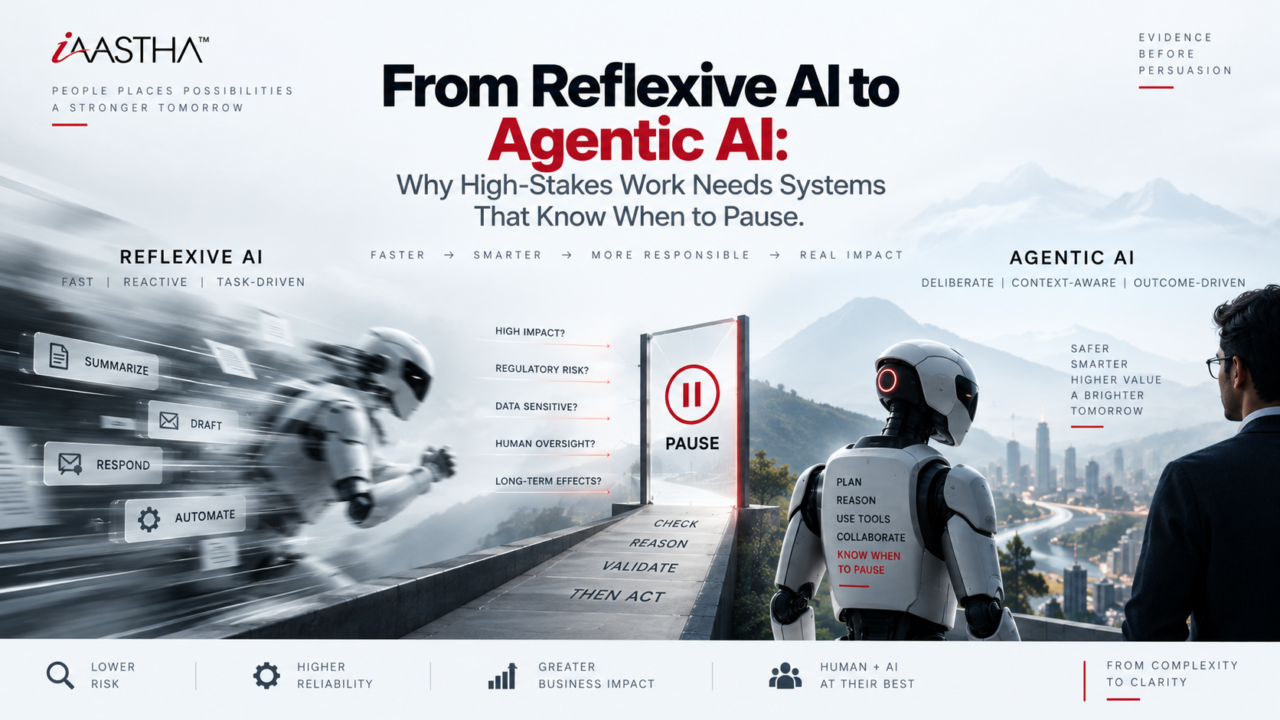
Traditional artificial intelligence has revolutionized how we process information. It is incredibly fast, capable of analyzing massive datasets in a fraction of a second. However, this impressive speed comes with a significant downside. Traditional AI is often confidently wrong, especially when handling complex documents or nuanced clinical decisions.
In high-stakes environments, relying on reflexive language models is an unacceptable risk. A reflexive model generates answers based on immediate pattern recognition rather than step-by-step logic. This often leads to hallucinations, which can have disastrous consequences in heavily regulated industries. Speed without accuracy is a liability, not an asset.
The future of enterprise technology is Agentic AI. These are sophisticated networks designed to reason, consult predefined rules, and recognize their own limitations. Unlike traditional systems, Agentic AI architectures do not just predict the next word. They execute complex operational workflows with a high degree of reliability and verifiable logic.
Agentic systems solve the hallucination problem by embedding deep reasoning loops directly into your operational processes. They pause, analyze the context, and cross-reference their intended actions against enterprise policies. This structured approach ensures that AI behaves responsibly, especially when human well-being or financial security is on the line.
When these advanced agents encounter an ambiguous edge case, they do not guess. Instead, they gracefully pause and escalate the context to a human operator. This human-in-the-loop escalation ensures maximum efficiency without sacrificing safety, bridging the gap between automation and critical human oversight.
The Hidden Risks of Reflexive AI in High-Stakes Sectors
To understand the need for Agentic AI, we must first examine the limitations of current generative models. In clinical settings, AI is increasingly used for diagnostic support and patient data analysis. However, a reflexive AI might misinterpret a complex medical history, leading to potentially dangerous treatment recommendations.
The medical field demands unwavering accuracy and strict adherence to clinical guidelines. When an AI confidently provides incorrect clinical decisions, it undermines the trust of healthcare professionals. It creates a scenario where doctors must spend more time verifying AI output than they would have spent doing the work manually.
Similarly, mitigating AI risks in finance is a top priority for global institutions. Financial analysts rely on AI to process complex compliance documents, assess loan risks, and detect fraudulent activities. A reflexive model might overlook a critical regulatory nuance, exposing the firm to massive regulatory fines and reputational damage.
In these sectors, there is zero tolerance for confident errors. Enterprises need systems that prioritize safety and accuracy over sheer speed. This is where the principles of Experience, Expertise, Authoritativeness, and Trustworthiness (E-E-A-T) become critical in AI deployment.
Agentic AI systems inherently support E-E-A-T guidelines by citing their sources and relying on curated, authoritative databases. They do not invent facts; they synthesize verified information. This fundamental shift from generating to reasoning is what makes them suitable for enterprise AI compliance guidelines.
Embedding Deep Reasoning Loops in Artificial Intelligence
At the core of Agentic AI architectures is the concept of the deep reasoning loop. Instead of producing an immediate, one-shot response, the AI breaks down a complex query into smaller, logical steps. It acts like an experienced professional, analyzing the problem from multiple angles before reaching a conclusion.
During a reasoning loop, the AI generates a hypothesis, tests it against a set of constraints, and refines its answer. This iterative process allows the system to catch its own mistakes before presenting them to the user. It is a vital mechanism for ensuring accuracy in complex document analysis.
For example, when reviewing a commercial loan application, an Agentic AI will cross-reference the applicant’s data against current market regulations. It will verify financial ratios, check compliance checklists, and flag any discrepancies. The reasoning loop ensures no stone is left unturned during the evaluation.
Agentic AI transforms artificial intelligence from a stochastic parrot into a diligent, methodical assistant that respects operational boundaries.
These deep reasoning loops in artificial intelligence are fully transparent. Enterprise users can inspect the AI’s logic trace to understand exactly how it arrived at a specific conclusion. This transparency is crucial for auditability and regulatory compliance in modern enterprise environments.
By embedding these loops directly into operational workflows, organizations can automate complex tasks with confidence. The AI takes on the heavy lifting of data synthesis, while strictly operating within the guardrails defined by organizational leadership.
Navigating Strict Compliance and Enterprise Policy Alignment
Deploying AI in healthcare and finance requires more than just smart algorithms; it requires absolute compliance. Agentic AI is designed to continuously verify its intended actions against your enterprise policies and strict compliance guidelines. This guarantees that every action remains within legal bounds.
In healthcare, this means adhering to HIPAA regulations and ensuring patient data is never compromised or hallucinated. The AI must understand patient confidentiality rules and apply them rigorously to every interaction. Agentic architectures are pre-configured to respect these boundaries without exception.
In the financial sector, regulations like FINRA, GDPR, and SEC mandates dictate how data must be handled. Agentic AI incorporates these enterprise AI compliance guidelines into its core reasoning engine. If an action violates a policy, the AI blocks the action immediately.
This level of policy alignment is impossible with traditional, off-the-shelf language models. Reflexive models require constant prompt engineering and external filtering to remain compliant. Agentic AI, conversely, has compliance baked into its fundamental architecture and decision-making processes.
Furthermore, these systems generate comprehensive audit trails. Every decision, verification step, and policy check is logged. If auditors require proof of compliance, the enterprise can easily provide a step-by-step breakdown of the AI’s reasoning, demonstrating full accountability.
Bridging the Gap: Human-in-the-Loop Escalation
Despite their advanced capabilities, AI systems will inevitably encounter situations they cannot resolve. These are known as edge cases—highly ambiguous, unprecedented, or complex scenarios that fall outside established rules. How an AI handles an edge case defines its safety profile.
Traditional AI often attempts to guess the answer in these situations, leading to catastrophic errors. Agentic AI takes a radically different approach. When it detects high ambiguity or conflicting rules, it gracefully pauses its operation and triggers a human-in-the-loop escalation.
This escalation hands the ambiguous decision over to a human operator, accompanied by a rich context brief. The AI explains what it has analyzed so far, where the ambiguity lies, and what rules are conflicting. This empowers the human to make an informed, rapid decision.
By escalating edge cases, Agentic AI ensures maximum efficiency without sacrificing safety. Routine tasks are fully automated, while complex, high-risk decisions remain firmly under human control. This synergy between human expertise and machine scalability is the ultimate goal of enterprise technology.
This cooperative model also creates a feedback loop. When the human operator resolves the edge case, the Agentic AI learns from the decision. This continuous learning process helps the system handle similar scenarios more autonomously in the future, steadily increasing operational throughput.
The Future of Operational Workflows with Agentic AI
The transition from reflexive to Agentic AI represents a paradigm shift in operational workflows. Organizations are no longer just deploying chatbots; they are integrating autonomous, rule-bound agents into their core processes. This shift promises unprecedented gains in productivity and risk management.
We are moving toward an era where human professionals act as supervisors to swarms of intelligent agents. A single doctor or financial analyst will be able to oversee the work of dozens of specialized AI assistants. This will dramatically multiply the output of highly skilled human workers.
To prepare for this future, enterprises must start auditing their current operational workflows. Identifying bottlenecks that require deep reasoning is the first step toward successful Agentic AI deployment. It is not just about technology; it is about redesigning work itself.
Investing in robust data governance and enterprise AI compliance guidelines is also essential. Agentic AI architectures are only as effective as the rules and data they operate upon. Clean, authoritative data is the fuel that powers accurate, reliable reasoning loops.
Ultimately, Agentic AI restores trust in artificial intelligence. By acknowledging its limitations and working collaboratively with human operators, it transforms AI from a risky novelty into an indispensable enterprise asset. The future belongs to systems that know when to act and when to ask for help.
Frequently Asked Questions
What are Agentic AI architectures and how do they differ from traditional AI?
Agentic AI architectures are systems designed to execute complex, multi-step workflows using logic and reasoning. While traditional AI reflexively guesses the next word based on patterns, Agentic AI utilizes deep reasoning loops to verify its actions against predefined rules before providing an answer.
Why is Agentic AI crucial for clinical decisions in healthcare?
In healthcare, confident but incorrect AI outputs can harm patients. Agentic AI mitigates this risk by cross-referencing medical guidelines and stopping to ask for human help when data is ambiguous. This ensures that clinical decision support systems remain safe, highly reliable, and trustworthy.
How do deep reasoning loops in artificial intelligence improve accuracy?
Deep reasoning loops force the AI to break a problem into smaller steps. It proposes a solution, tests it against strict enterprise constraints, and refines its answer. This iterative self-correction catches hallucinations and logic errors before the final output is delivered to the user.
What is human-in-the-loop escalation in edge cases?
When Agentic AI encounters a situation that is too ambiguous or falls outside its confident operational parameters, it pauses. It then hands the context over to a human expert to make the final call. This process maintains operational safety and ensures complex edge cases are handled with human nuance.
How does Agentic AI ensure adherence to enterprise AI compliance guidelines?
Agentic systems are built with compliance layers natively integrated into their workflows. Before executing any action, the AI verifies the step against regulatory frameworks (like HIPAA or FINRA). It also generates detailed audit trails, providing total transparency into how every decision was reached.
Related Reading
- The Machine That Learned to Pause: Why Large Reasoning Models Almost Certainly Can Think
- Enterprise RAG Solutions with Source Citations: How to Build AI Your Team Can Trust
- Autonomous Remediation: When AI Stops Just Watching and Starts Fixing
- Artificial Intelligence Agents: How Clustered AI Workflows Scale Digital Work