Your teams ship faster than ever, yet every new service still takes weeks to reach production. Pipelines differ by team. Engineers file tickets to get a database. Someone suggests building an internal developer platform, and the debate begins: do we need platform engineering, or do we just need better DevOps?
This guide answers that question without hype. You will learn what platform engineering is, how it compares with DevOps and SRE, when an internal developer platform pays off, and when it only adds overhead. A short quiz at the end helps you place your own team.
What Is Platform Engineering?
So, what is platform engineering? It is the practice of building and running an internal platform that gives product teams self-service access to the tools, environments and workflows they need to ship software. The platform team treats other engineers as its customers.
The output is usually called an internal developer platform, or IDP. It bundles things such as templates for new services, deployment pipelines, infrastructure provisioning, secrets handling and observability behind a simple interface. Instead of learning ten tools, a developer picks a “golden path” that already has security and compliance baked in.
The aim of platform engineering is not control. It is to reduce cognitive load, so product teams spend their energy on customer problems instead of infrastructure plumbing.
Expert perspective (paraphrased): In Team Topologies, Matthew Skelton and Manuel Pais argue that a platform should be as thin as possible while still helping teams move faster, and that it should be run like a product with real users and feedback.
Source: Team Topologies, IT Revolution Press
Platform Engineering vs DevOps
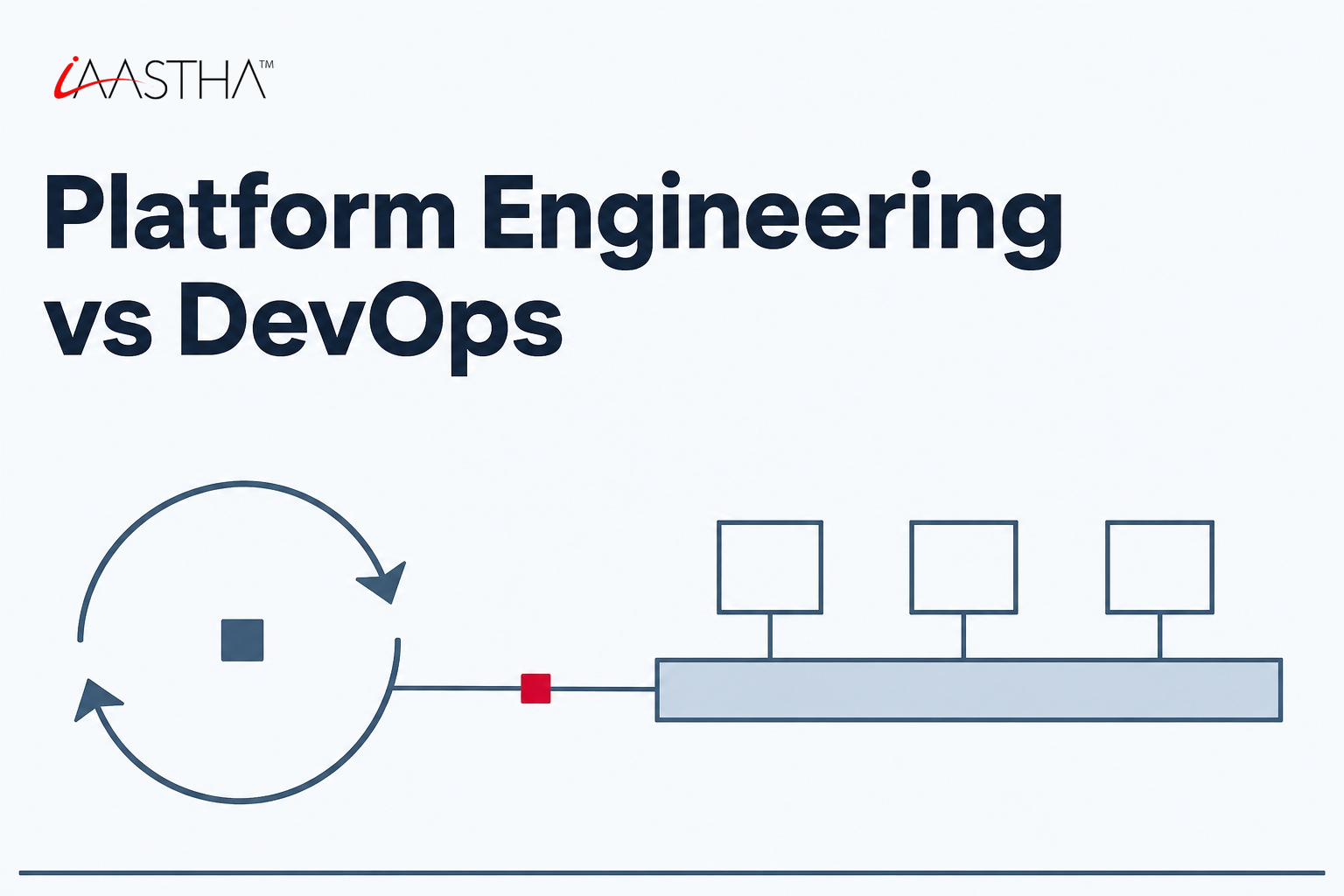
The platform engineering vs DevOps debate is often framed as a rivalry. It is not. DevOps is a culture and set of practices: shared ownership, automation, fast feedback and continuous delivery. Platform engineering is one way to put those practices to work at scale.
Think of it this way. DevOps says that teams should own what they build and run. Platform engineering asks a follow-up question: how do we make owning it easy when fifty teams are doing it at once?
Without a platform, each team solves the same problems alone. One builds its own pipeline, another writes its own Terraform modules, a third wires up its own dashboards. The result is duplicated effort, uneven security and a hard time for new hires. Platform engineering gathers the repeated work into shared, supported building blocks.
It is also fair to say platform engineering can fail when it ignores DevOps values. A platform that is mandatory, rigid and built without developer input recreates the old ticket queue under a new name.
DevOps vs SRE vs Platform Engineering
The DevOps vs SRE question comes up in the same conversation, so it helps to separate three roles that often overlap.
| DevOps | SRE | Platform engineering | |
|---|---|---|---|
| Main focus | Culture and delivery practices | Reliability of running services | Self-service tools and paved paths |
| Customer | The whole delivery team | Users of the service | Internal developers |
| Success measure | Delivery speed and quality | SLOs and error budgets | Adoption and developer productivity |
| Typical output | Pipelines, shared ownership | Runbooks, alerting, incident process | An internal developer platform |
Google’s SRE approach applies software engineering to operations, using service level objectives and error budgets to balance reliability against speed. SRE protects production. Platform engineering speeds up the path to production. Many mature organizations run both, and they work well together: the platform bakes in the reliability defaults that SRE defines.
What an Internal Developer Platform Includes
An internal developer platform is not one product you buy. It is a set of capabilities, often stitched together from open source and cloud services. Common building blocks include:
- Service templates: starter repositories with CI, security checks and logging already set up.
- Self-service infrastructure: request a database or queue in minutes, within guardrails.
- Deployment pipelines: one standard way to release, roll back and promote changes.
- An internal developer portal: a catalog where engineers find services, owners, docs and runbooks. Backstage is a popular open source choice.
- Observability and cost views: logs, metrics and spend by team, ready on day one.
Start with the capability that removes the most waiting. For many teams that is environment provisioning or a standard pipeline, not a full portal.
When Platform Engineering Pays Off, and When It Adds Overhead
Signs an internal developer platform will pay off
- Many teams (often seven or more) ship independently and repeat the same setup work.
- New services take weeks to reach production because of manual steps.
- Every team uses different tools, so security and compliance reviews are slow.
- Engineers spend noticeable time on infrastructure tickets instead of features.
- Onboarding a new developer takes too long to become productive.
Signs it will add overhead
- You have a handful of engineers and one or two products. A shared pipeline template is enough.
- Your stack is simple and uniform, so there is little to standardize.
- No one can own the platform full time. A neglected platform is worse than none.
- You want a platform to fix a culture problem. Tools do not replace shared ownership.
Expert perspective (paraphrased): Gartner has predicted that by 2026, most large software engineering organizations would set up platform teams as internal providers of reusable services and tools. The prediction signals a trend, not a rule that every company needs one.
Source: Gartner, platform engineering predictions
A useful rule of thumb: if the pain is repeated setup and inconsistent tooling across many teams, build a platform. If the pain is slow collaboration or unclear ownership, fix DevOps practices first.
Quiz: Which Does Your Team Actually Need?
Answer five questions to see where your team sits. It is a starting point for discussion, not a verdict.
Platform engineering fit quiz
1. How many engineers do you have?
- Under 20
- 20 to 80
- More than 80
2. How many teams ship independently?
- 1 to 2
- 3 to 6
- 7 or more
3. How long does a new service take to reach production?
- Under a day
- A few days
- Weeks
4. How similar is the tooling across teams?
- Mostly the same
- A few variations
- Every team differs
5. How often do developers wait on infrastructure requests?
- Rarely
- Sometimes
- Constantly
Illustrative guidance based on common patterns. Your context may differ.
How to Start Platform Engineering Without a Big Rewrite
If your result points toward a platform, avoid a large upfront build. A safer approach looks like this:
1. Find the biggest source of waiting. Interview developers and map one new service from idea to production. Note every handoff and delay.
2. Build the thinnest viable platform. Solve one painful step first, such as a standard pipeline or self-service environments. Ship it to one willing team.
3. Treat it as a product. Name an owner, collect feedback, and publish a simple roadmap. Make the golden path the easiest option, not a forced one.
4. Measure adoption and outcomes. Track time to first deploy, lead time for changes, and how many teams use the paved path. Retire what nobody uses.
5. Keep DevOps culture alive. Teams still own their services. The platform removes friction, not responsibility.
Done well, platform engineering gives you consistency and speed. Done badly, it becomes a new bottleneck. The difference is usually whether the platform team listens to its users.
Common Mistakes to Avoid
- Building before listening. A platform nobody asked for goes unused.
- Making it mandatory too early. Adoption should be earned by being genuinely easier.
- Renaming the ops team. A new title without new ways of working changes nothing.
- Chasing tools. Pick capabilities first, then tools.
- Skipping measurement. Without data, you cannot prove the platform helps.
Frequently Asked Questions
What is platform engineering in simple terms?
It is building internal tools and workflows that let developers ship software on their own, safely, without learning every underlying system.
Is platform engineering replacing DevOps?
No. DevOps is the culture and practice. Platform engineering is a way to scale those practices by packaging them into shared, self-service tools.
What is the difference between DevOps and SRE?
DevOps focuses on collaboration and delivery speed. SRE focuses on reliability, using service level objectives and error budgets to guide decisions.
What is an internal developer platform?
An internal developer platform is a set of self-service capabilities, such as templates, pipelines and environments, that helps product teams build and run software consistently.
How big should a team be before it needs platform engineering?
There is no fixed number. Pain matters more than headcount: repeated setup work, slow provisioning and inconsistent tooling across many teams are the usual triggers.
Conclusion
You do not have to choose between platform engineering and DevOps. DevOps gives you the culture. Platform engineering gives that culture leverage once many teams are involved. Start by measuring where developers wait, build the thinnest platform that removes that wait, and grow it only as adoption proves its value.
Not sure where your team fits?