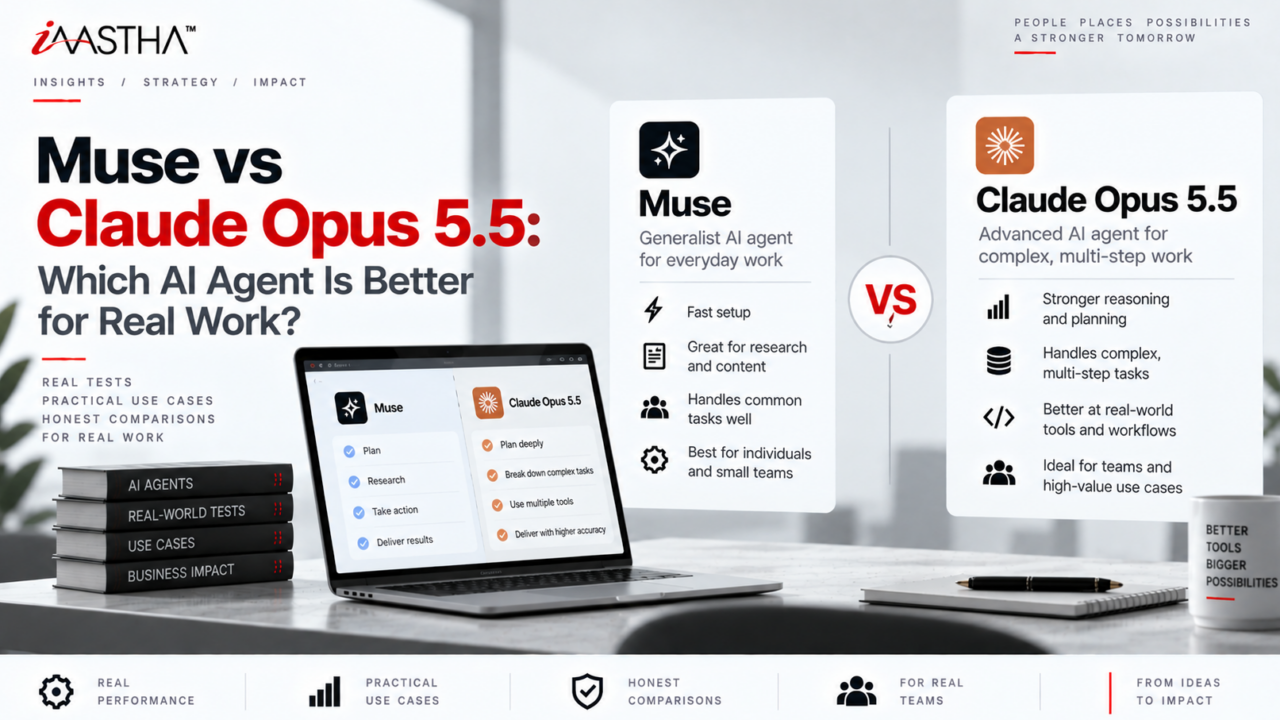
Muse and Claude Opus 5.5 are built for different jobs. Muse is an easy, chat-style personal agent for everyday tasks like booking, emailing and planning. Claude Opus 5.5 is built for long-running, complex agentic work such as coding, research and professional analysis. Pick Muse for convenience and Opus 5.5 for depth.
What Is an AI Agent, and Why Does It Matter?
A chatbot answers questions. An AI agent takes action. It can plan steps, use tools, open a browser, send messages and keep working while you do something else. If you are new to the idea, our guide on how AI agents work covers the basics.
That difference is why agentic capability is now the main battleground between AI products. The question is no longer “who writes the best paragraph?” It is “who finishes the task with the fewest corrections?” That is the lens we use for the Muse vs Claude Opus 5.5 comparison below.
What Is Meta Muse?
Meta describes Muse as a personal AI agent that does the work rather than only answering questions. It runs on a dedicated secure cloud computer with its own browser, and it works across the apps you use every day. Meta launched it on September 8, 2026.
What Muse does well?
Reviewers keep returning to one word: simplicity. Hands-on testing found it feels like a messaging app, with no workflow setup and one of the easiest onboarding flows among agent tools. Reviewers also report that it can book travel, track ticket prices and turn a saved recipe into a grocery list, and it keeps working after you close the app.
CNN’s test found it strong at planning tasks that mix searching, messaging and reservations. Its reporter had Muse book a date night, build a packing schedule for a move and email a friend about a trip.
It also asks before it acts. Muse checks with you before sending an email or making a purchase, which matters for any tool that touches your inbox and payments.
Where Muse falls short?
The limits are just as consistent. Early integrations center on Meta’s own platforms plus email and calendar, which is narrower than more developer-focused agent tools. It is US-only and 18+ at launch. One accessibility reviewer wrote that the agent felt more useful than the interface around it, citing screen reader problems and the lack of custom connectors. And an eesel AI review noted that the model behind Muse trails Opus 5 on several agent benchmarks.
What Is Claude Opus 5.5?
Claude Opus 5.5 is Anthropic’s newest flagship model, released in late September 2026. It is aimed at long-running coding agents, research and professional knowledge work, and it is available through the Claude apps, Claude Code, the Claude Platform, and the major cloud providers. You can read our Claude vs ChatGPT comparison for wider context.
What Opus 5.5 does well?
Anthropic reports that it leads its own benchmarks in agentic coding, computer use and knowledge work. On Terminal-Bench 4.0, one of the less saturated agentic coding tests, it scored 66.4% against 57.9% for the next closest competitor, according to a MindStudio analysis.
Early testers reported better context retention, better delegation to other agents and better result checking, which means fewer prompts and corrections per task. Anthropic also added a classifier that screens coding agent actions before they run, plus stronger defenses against prompt injection.
Where Opus 5.5 raises questions?
Independent evidence is thin so far. In one hands-on test, not every output impressed on first look. Anthropic claims typical workloads cost about 40% less than Opus 5, but an independent run at maximum effort recorded far more output tokens than the median model, so the savings depend on your settings. It is also a model you access through apps, Claude Code or an API, so it asks more setup effort than a plug-and-play consumer agent.
Muse vs Claude Opus 5.5: Side-by-Side Comparison
| Factor | Meta Muse | Claude Opus 5.5 |
| Best for | Everyday personal tasks | Complex, long-running work |
| Setup | Very easy, chat-style | More setup, more control |
| Integrations | Narrower at launch | Broad tool and cloud access |
| Approval before actions | Yes, for emails and purchases | Classifier screens coding actions |
| Availability | US only, 18+ | Global via apps and API |
| Main risk | Trust with Meta account access | Cost varies by effort setting |
Muse vs Claude Opus 5.5 for Marketing Tasks
Marketers should be careful here, because neither vendor markets these tools specifically for campaigns. Based on what reviewers describe, here is a reasonable way to split the work. See also our roundup of the best AI tools for marketing.
Where Muse could help
Scheduling, reminders, drafting quick emails, tracking prices and organizing your week. These are low-stakes, planning-oriented tasks, which is exactly where reviewers say it performs well.
Where Opus 5.5 could help
Multi-step research, competitor analysis, long content pipelines and any work where a wrong answer is costly. One review advises choosing Opus 5.5 when an incorrect result costs more than the model itself, and using a smaller model for quick summaries, rewriting and high-volume routine tasks.
Whichever you use, keep a human review step before anything goes live. Our guide to writing AI prompts helps you brief either tool more clearly.
Privacy and Trust: The Muse AI Agent Privacy Question
This is the biggest debate around Muse. Meta says it cannot see your passwords or payment credentials and offers an opt-out from using your data to train its models. Still, using Muse means giving Meta access to your email, calendar and browser. Analysts quoted by CNN said “privacy and trust remain key considerations for broader adoption.”
For Opus 5.5, Anthropic highlights zero data retention as an option, an auditable open-source sandbox and improved prompt injection defenses.
Pricing: What Do They Cost?
Anthropic lists Claude Opus 5.5 at $4 per million input tokens and $20 per million output tokens, which is 20% lower than Opus 5. The company estimates roughly 40% lower cost on typical workloads. Muse pricing was not clearly detailed in the reviews we reviewed, so check Meta’s page before committing.
What Experts and Reviewers Are Saying
Deloitte Consulting’s CIO, Carl Bennett, said low thinking effort matched higher settings on US consulting analysis with half the output (paraphrased from Anthropic’s launch page).
GitHub’s Chief Product Officer, Mario Rodriguez, reported that Opus 5.5 solved terminal tasks in fewer than half the steps of Opus 5 (paraphrased from launch coverage).
Bank of America analysts noted that “privacy and trust remain key considerations for broader adoption” of Muse
Final Verdict
If you want an approachable assistant for daily life, Muse is the simple choice, as long as you are comfortable with the trust trade-off. If you need an agent for complex, consequential work, Claude Opus 5.5 looks stronger on paper, though independent testing is still catching up. The smartest move is to try both on one real task and compare the results yourself.