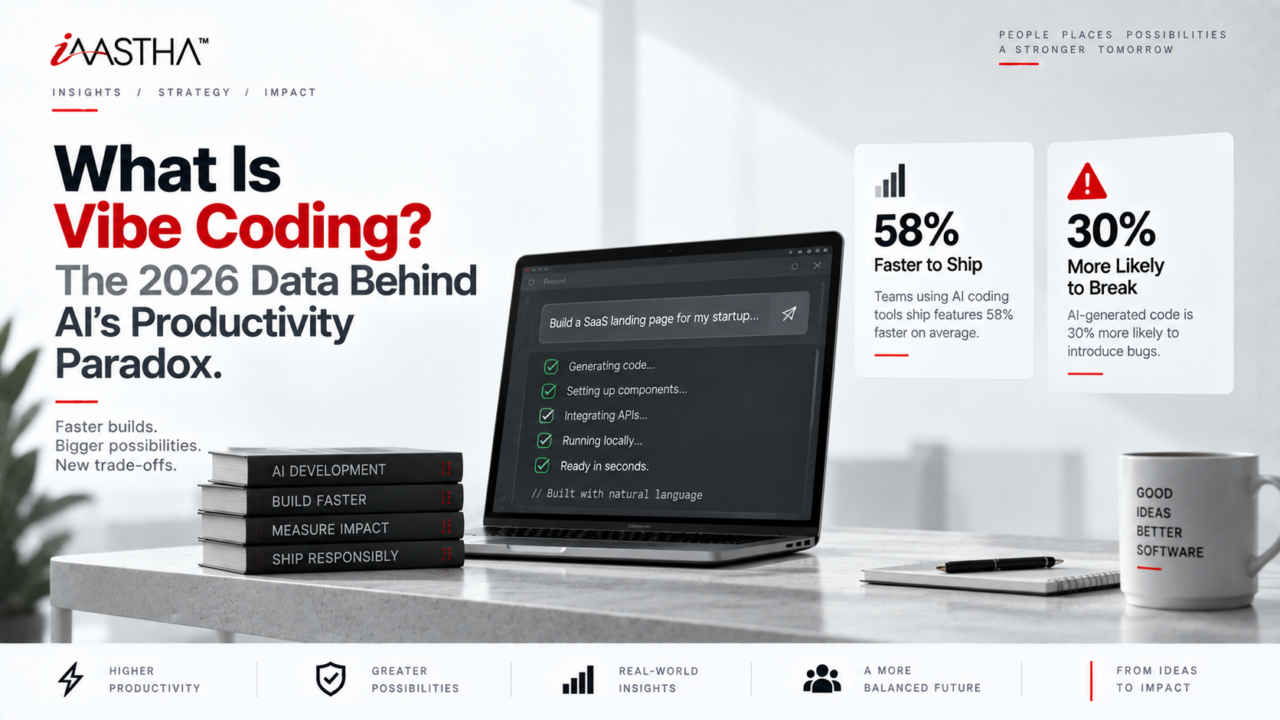
What Is Vibe Coding?
Vibe coding is a software development approach where engineers describe their intent in natural language, and an AI model or agentic tool generates the underlying code. The term was coined by former Tesla and OpenAI researcher Andrej Karpathy to describe a shift away from manually typing every line of syntax toward a more conversational, intent-driven workflow.
In simple terms: the developer supplies the “vibe” — the architecture, the goals, the constraints — and the large language model (LLM) handles the boilerplate, the syntax, and often the first draft of the logic itself.
This isn’t just a buzzword. By 2026, vibe coding has become an operational baseline across startups and enterprise engineering teams alike. But as we’ll see in the data below, “faster” doesn’t automatically mean “better” — and that gap is exactly what’s causing friction in production environments right now.
How Vibe Coding Actually Works
A typical vibe coding workflow looks like this:
- Intent definition — the developer describes the feature, bug fix, or system in plain language.
- AI generation — an LLM or agentic coding tool (like an AI pair-programmer) produces code, tests, or entire modules.
- Human review — the developer or a reviewer checks the output for correctness, security, and maintainability.
- Iteration — the developer refines the prompt or the code until it meets requirements.
The promise is speed. The risk is that step 3 — human review — is increasingly becoming the actual bottleneck, not step 2. That’s the core tension this article unpacks.
Vibe Coding Productivity Statistics: The Good News
The efficiency gains from AI-assisted and agentic coding are real and well-documented:
- AI coding tools can reduce time-to-PR (pull request) by up to 58%, according to a comprehensive analysis by Value Add VC.
- McKinsey research shows a 46% time savings on routine coding tasks when developers use AI-assisted workflows.
- In some studies, AI tools increased total coding activity by as much as 180%.
On paper, this looks like an unambiguous win for engineering velocity. Teams are shipping first drafts of features faster, automating repetitive scaffolding, and reducing the manual grind of writing tests and documentation.
But velocity in generation is not the same as velocity in delivery — and that’s where the productivity paradox begins.
The Vibe Coding Bottleneck: Why 30% of Companies Saw Output Drop
Here’s the part of the story most “AI will 10x your team” headlines leave out.
A September 2026 report covered by Livemint, citing McKinsey’s latest data, found that nearly 30% of companies actually experienced a productivity decline after adopting agentic AI tools.
Why does more AI-generated code lead to less shipped software in nearly a third of organizations? The data points to one clear culprit: review and validation overhead.
- AI-authored pull requests are sitting in code review up to 4.6x longer than human-written ones.
- Reviewers are spending more time context-switching, verifying logic they didn’t write, and catching subtle errors that a human author would have caught themselves during the writing process.
In other words: generating code is no longer the bottleneck. Managing, reviewing, and trusting that code is.
Vibe Coding vs Traditional Coding: Code Quality Comparison
One of the most telling metrics in the 2026 data is code churn — the percentage of code that gets rewritten or deleted within two weeks of being committed.
| Metric | 2020 | 2026 |
| Code churn (rewritten/deleted within 2 weeks) | 3.1% | 5.7% |
That’s nearly double. This tells us that a meaningfully larger share of AI-generated (or AI-assisted) code isn’t holding up under real-world use — it’s being reworked almost as fast as it’s written.
This is the central lesson in any honest vibe coding vs traditional coding comparison: raw generation speed without disciplined review creates technical debt at scale, not just individual bugs.
Perhaps the single most important statistic in this entire dataset is the gap between activity and actual delivery:
AI tools increased total coding activity by 180% — but shipped product releases only rose by 30%.
This is the clearest evidence yet that “lines of code generated” is a vanity metric, not a business outcome. Teams that measure success by AI output volume, rather than shipped, tested, working software, are optimizing for the wrong thing entirely.
Best Practices for Agentic AI Coding Tools in 2026
If your team is scaling vibe coding, here’s an interactive self-check to run against your current workflow:
✅ Quick Team Audit — Check Off What You Already Have in Place:
- A defined code review SLA specifically for AI-generated PRs
- Automated test coverage requirements before an AI-authored PR can merge
- A documented “prompt-to-production” workflow your whole team follows
- Regular tracking of code churn rate (not just commit volume)
- A senior engineer or architect reviewing system-level design before AI generates implementation code
- A policy on tracking “shipped features” vs. “code generated” as your real productivity metric
If you checked fewer than 4 boxes, your team is likely generating faster than it can validate — the exact pattern behind the 30% productivity decline McKinsey identified.
Core principles for sustainable vibe coding:
- Treat AI output like a junior developer’s first draft — helpful, fast, but never merge-ready without review.
- Invest in automated testing infrastructure before scaling AI code generation — it’s your safety net.
- Redefine your success metrics around shipped, working features — not tickets closed or code volume.
- Upskill engineers toward system architecture and review, since that’s where human judgment now adds the most value.
- Set explicit review gates for AI-authored code, especially in security-sensitive or customer-facing systems.
The Agentic Coding Handbook reinforces this same point: developers now need to index heavily on system design, automated testing, and rigorous validation loops — not just prompt-writing speed.
Expert Take: What This Means for Engineering Teams
“[“Vibe coding hasn’t made engineers obsolete — it’s made review and judgment the most valuable skill on the team. The teams we work with who win aren’t the ones shipping the most AI-generated code, they’re the ones who treat every AI output like a first draft, not a final answer.” .]”
— [Engineering head, Iaastha]
Vibe coding doesn’t eliminate the software engineer — it forces an evolution. The industry is moving from syntax typists to system architects and code reviewers. AI can write code faster than any human ever could, but the same standard applies as with any junior contributor: if you wouldn’t accept sloppy, unreviewed work from a person, you shouldn’t accept it from an LLM either.
The teams that win this decade won’t be the ones generating the most AI code. They’ll be the ones combining AI-driven speed with relentless, disciplined engineering standards.
Frequently Asked Questions About Vibe Coding
What is vibe coding in simple terms?
Vibe coding is when developers describe what they want in plain language, and an AI tool generates the actual code, rather than the developer writing every line manually.
Is vibe coding actually more productive?
It depends on the metric. Vibe coding can cut time-to-PR by up to 58% and save 46% of time on routine tasks — but nearly 30% of companies saw overall productivity fall due to slower code review and rising code churn.
Why does AI-generated code take longer to review?
Because reviewers didn’t write it themselves, they must reconstruct context and intent from scratch, which is slower than reviewing your own logic. Data shows AI PRs wait up to 4.6x longer in review than human-written ones.
What is code churn, and why does it matter in vibe coding?
Code churn is the percentage of code rewritten or deleted shortly after being committed. It nearly doubled from 3.1% to 5.7% in the vibe coding era — a sign of declining first-pass code quality.
How can a team avoid the vibe coding productivity trap?
By setting review SLAs, enforcing automated test coverage, tracking shipped features (not code volume) as the real success metric, and upskilling engineers into architecture and review roles.