Data doesn’t organize itself. Behind every dashboard, AI model, and business report sits a system built by someone whose job is invisible when it works and impossible to ignore when it breaks. That’s data engineering, and it has quietly become one of the most important functions in modern business.
If you’ve ever wondered what does a data engineer do all day, or why companies are hiring for this role faster than almost any other technical position, this guide breaks it down in plain language, backed by current industry data.
What Is Data Engineering, Exactly?
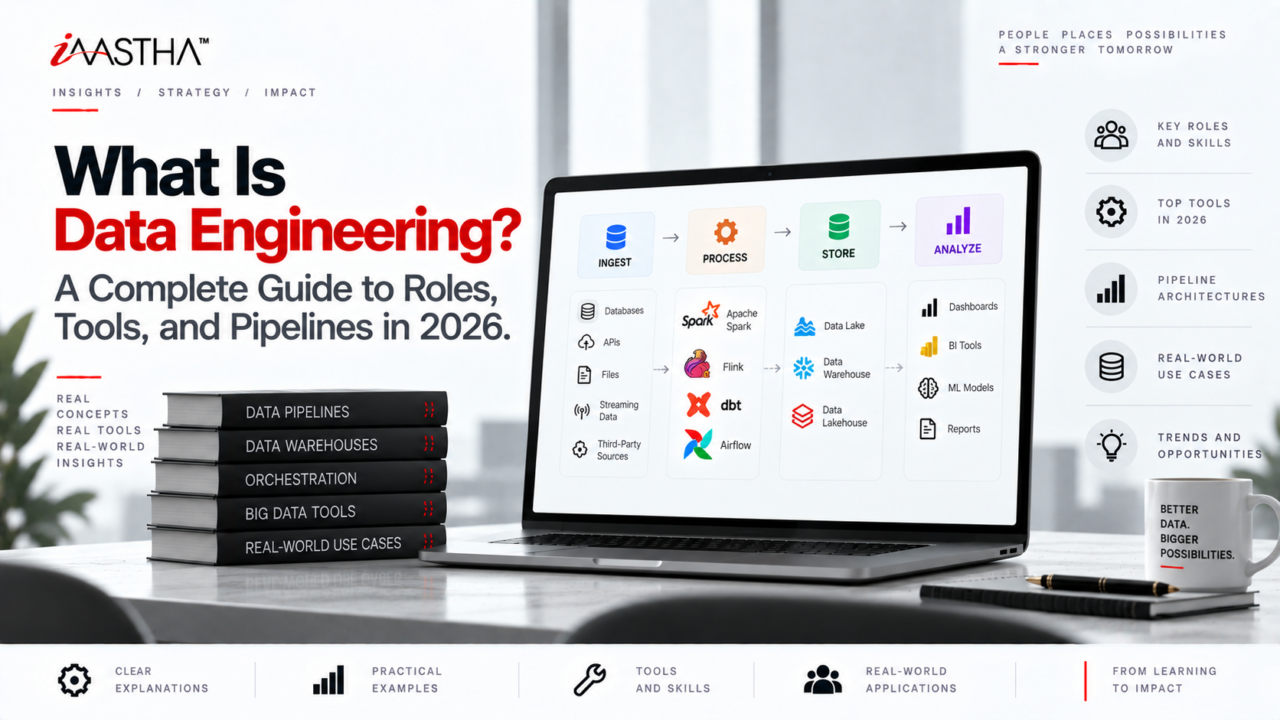
Data engineering is the practice of designing, building, and maintaining the systems that collect, move, clean, and store data so it can be used by analysts, data scientists, and business teams. Think of it as the plumbing of the data world. Data scientists build the fancy fixtures. Data engineers make sure clean water actually reaches the tap.
In practical terms, a data engineer:
- Builds pipelines that pull data from apps, APIs, and databases
- Transforms raw, messy data into clean, structured formats
- Designs storage systems (data warehouses, lakes, lakehouses)
- Automates and monitors these processes so they run reliably without constant manual fixes
- Ensures data is accurate, secure, and available when other teams need it
The scale of this work has grown fast. The global data engineering market is projected to reach roughly 105 billion dollars in 2026, fueled by cloud adoption, AI workloads, and the shift toward real-time data processing. Organizations are now putting 60 to 70 percent of their total data budgets into data engineering work alone.
That number matters because it tells you where companies believe the real value sits: not in the model, but in the pipeline feeding it.
Data Engineering vs Data Science: What’s the Difference?
This is one of the most searched questions on the topic, so it’s worth answering directly.
Data science is about extracting insights and building predictive models from data. Data scientists ask questions like “what will happen next” or “why did this happen.”
Data engineering is about making sure the data those models rely on is accurate, accessible, and arrives on time. Data engineers ask questions like “how do we get this data here reliably” and “what happens if this pipeline fails at 3 a.m.”
A simple way to remember it: data scientists build the car. Data engineers build the road, the fuel supply, and the traffic system that lets the car actually go anywhere.
Given that data engineering solutions and services on their own were valued at over 50 billion dollars in 2025 and are projected to keep growing at a strong double-digit rate through 2032, this isn’t a niche specialty anymore. It’s core infrastructure.
Why Data Engineering Has Become a Business Priority
A few years ago, data engineering was viewed as a back-office technical function. That’s changed sharply. In 2026, nearly half of organizations rate data engineering as critical to their operations, roughly double the share that said the same back in 2019. Among companies that treat AI as a core part of their business strategy, close to nine in ten now consider data engineering critical or very important.
Why the shift? Three reasons:
- AI depends on it. Machine learning models are only as good as the data feeding them. Garbage in, garbage out isn’t a cliché here, it’s the daily reality of failed AI projects traced back to poor data pipelines.
- Real-time expectations. Customers and internal teams no longer accept “the report updates tomorrow.” Streaming pipelines and near-instant data delivery are becoming the default.
- Data volume keeps compounding. More apps, more devices, more transactions mean more raw data that needs to be captured and structured correctly, at scale, without falling over.
How to Build a Data Pipeline: A Simplified Walkthrough
If you’re new to the field, here’s a simplified breakdown of how to build a data pipeline, the kind of process a junior data engineer might work on in their first few months.
Step 1: Extraction
Pull raw data from its source, whether that’s a payment API, a customer database, or website event logs.
Step 2: Transformation
Clean, filter, and reshape the data. Remove duplicates, standardize formats, fix broken records. This is where most of the unglamorous work happens.
Step 3: Loading
Push the cleaned data into a destination system, usually a data warehouse or data lake, where it’s ready for analysis.
Step 4: Orchestration
Automate the whole sequence so it runs on schedule (or continuously, for streaming pipelines) without someone manually kicking it off every day.
Step 5: Monitoring
Set up alerts so that if something breaks, a broken schema, a missing file, an API outage, someone finds out before the business does.
(Consider linking here to a related post on your site walking through a real pipeline build with code examples, and another on common pipeline failure points.)
Data Engineering Tools for Beginners
If you’re mapping out a learning path, here’s a practical list of data engineering tools for beginners, grouped by what they’re actually used for:
- Languages: Python and SQL are non-negotiable starting points
- Orchestration: Apache Airflow, Dagster
- Transformation: dbt (data build tool)
- Storage: Snowflake, Google BigQuery, Amazon Redshift
- Streaming: Apache Kafka
- Version control and collaboration: Git, dbt Cloud, or similar
You don’t need to learn all of these at once. Most working data engineers started with Python, SQL, and one orchestration tool, then expanded from there as projects demanded it.
Data Engineer Career Path 2026: What It Actually Looks Like
For anyone mapping out a data engineer career path in 2026, the typical progression looks something like this:
- Junior Data Engineer – builds and maintains existing pipelines, learns the company’s data stack
- Data Engineer – designs new pipelines independently, owns specific data domains
- Senior Data Engineer – architects systems, mentors juniors, makes tooling decisions
- Staff/Lead Data Engineer or Data Architect – sets data strategy across teams, decides on platform-level tools
What’s notable is how much this role now overlaps with AI infrastructure work. With roughly 90 percent of AI and machine learning projects depending directly on data engineering pipelines, engineers who understand both data infrastructure and how models consume that data are becoming some of the most sought-after hires in tech.
What Experienced Data Engineers Say About the Job
“The hardest part of this job isn’t writing the pipeline. It’s designing for the day it breaks, because it will, and making sure that when it does, the failure is loud, fast, and easy to fix.” This is a common sentiment echoed by senior engineers across the industry, and it captures something textbooks tend to miss: resilience matters more than elegance.
Common Mistakes Companies Make With Data Engineering
- Treating it as an afterthought. Building the dashboard first and the data pipeline later almost always leads to rework.
- Skipping data quality checks. A pipeline that runs successfully isn’t the same as a pipeline that produces correct data.
- Underestimating maintenance. Pipelines aren’t “set and forget.” APIs change, schemas drift, and volume grows.
- Hiring too late. Many teams bring in a data engineer only after their existing systems are already buckling under data volume.
Quick Self-Check: Is Your Data Infrastructure Ready to Scale?
Ask yourself these questions:
- Do you know exactly where your data breaks first when volume spikes?
- Can your team detect a pipeline failure within minutes, not days?
- Is your data documented well enough that a new hire could understand it without asking five people?
- Are your dashboards built on data you’d trust enough to make a six-figure decision from?
If you answered “no” or “not sure” to more than one of these, that’s usually a sign it’s time to invest in dedicated data engineering support.
Final Thoughts
Data engineering isn’t the flashiest part of the data world, but it’s the part everything else depends on. As AI adoption accelerates and real-time data becomes the norm rather than the exception, the teams that invest early in solid data infrastructure will be the ones able to move fast without breaking things.
Whether you’re a business trying to figure out where to invest first, or someone considering this as a career path, the core idea stays the same: good data engineering is invisible when it’s working, and invaluable when you finally see what it prevents.