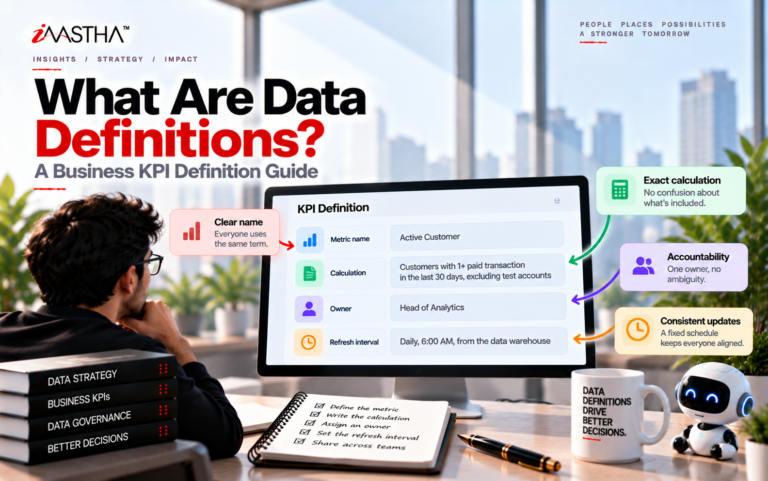
Ask two teams what an “active customer” is, and you will often get two confident answers. Both teams have a dashboard to prove it. Neither dashboard is wrong, and that is exactly the problem. This guide explains how to fix it with clear, shared definitions, and it includes a free tool so you can write your first one before you finish reading.
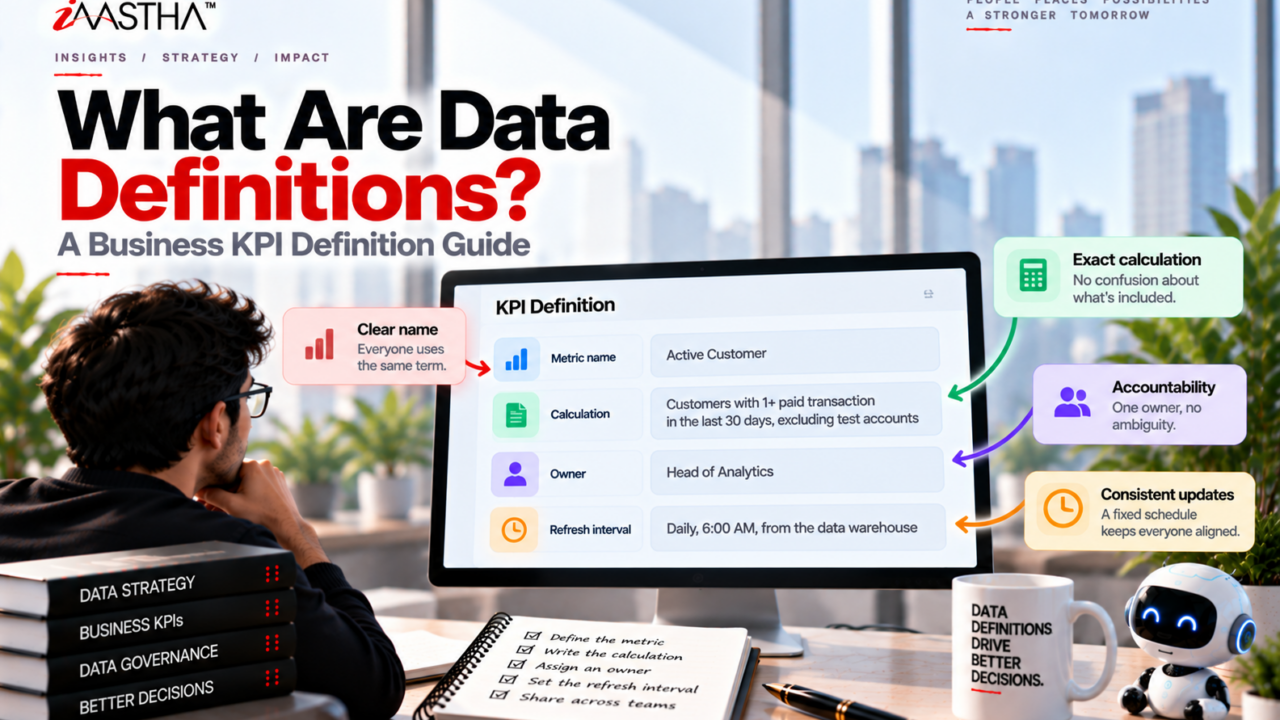
Data definitions are the documented meaning of a data field or metric: its name, how it is calculated, who owns it, and how often it refreshes. A good business KPI definition fits on one page and is agreed by every team that uses the number.
What are data definitions?
Data definitions describe what a piece of data means and how it is produced. For a field, that might be its type and allowed values. For a metric, it goes further: the exact formula, the filters, the source system, the person accountable, and the schedule on which it updates.
So, what are data definitions in practice? They are the agreement that sits behind every chart. Without that agreement, a number is only an opinion with a decimal point.
Data definitions vs data dictionary vs glossary
These three terms overlap, which causes confusion. Here is a simple way to separate them.
| Term | Main audience | What it answers |
| Data definitions | Business and data teams | What does this metric mean, and how is it calculated? |
| Data dictionary | Engineers and analysts | What columns and types exist in this table? |
| Business glossary | Everyone | What do we mean by common terms like “customer”? |
Frameworks such as DAMA-DMBOK treat this work as part of metadata management and data governance. You do not need a heavy program to start, though. One page per metric is enough to remove most of the confusion.
Why one metric ends up with two meanings
Definitions drift for ordinary reasons. Sales counts a customer when a contract is signed. Finance counts a customer when the first invoice is paid. Product counts a customer when someone logs in. Each rule is sensible inside its own team, and each produces a different total.
A pattern that shows up often in data and AI projects is that the dispute is never about arithmetic. It is about unwritten assumptions. Someone excluded test accounts, someone else did not. Someone used UTC, someone used local time. The fix is to write the assumptions down once, in one place.
This matters even more when AI enters the picture. A model trained or prompted on an ambiguous metric will repeat the ambiguity at scale. Clean definitions are the cheapest data quality investment a team can make.
The four parts of a business KPI definition
A weak business KPI definition says “revenue growth” and stops. A strong one answers four questions. Think of them as the fields on a card.
1. Name
Use plain words that match how people talk. “Monthly Active Customers” is better than “MAC_v2_final”. If two names mean the same thing, pick one and retire the other.
2. Calculation
State the formula, the time window, and every exclusion. Anyone with access to the data should be able to reproduce the number without asking you. This is the part most definitions skip, and it is where most disagreements start.
3. Owner
Name one accountable person, not a team. The owner approves changes and answers questions. A metric definition business leaders can trust always has a name attached to it.
4. Refresh interval
Say when the number updates and from which source. “Daily at 6:00 AM from the warehouse” prevents the classic argument where two people look at the same metric at different times of day.
A data definitions example: Active Customer
Here is a data definitions example you can adapt today.
| Name | Active Customer |
| Calculation | Count of unique customers with at least one paid transaction in the last 30 days, excluding test accounts and refunded orders. |
| Owner | Head of Analytics |
| Refresh interval | Daily at 6:00 AM, from the data warehouse. |
This data definitions example works because each line closes a loophole. The calculation names the window and the exclusions. The owner settles disputes. The refresh interval tells readers how fresh the number is. Notice that nothing here requires special software.
How to build a data definitions document in five steps
A data definitions document is the shared home for every card. Keep it short, searchable, and easy to edit.
- Pick the disputed metrics. Start with the three to five numbers that cause the most debate in reviews.
- Draft one card each. Use the four parts above. Ask the owner to write the first version.
- Run a joint review. Put both teams that read the metric differently in the same room. Resolve one definition at a time.
- Publish in one place. Store the data definitions document where people already work, such as your wiki or data catalog, and link to it from dashboards.
- Add a change log. Record who changed what and why. When a number shifts, the log explains it.
Review the document on a schedule, such as quarterly. Definitions are living agreements, and a data definitions document that nobody updates quietly becomes another source of confusion.
What a shared definition changes for your team
None of this requires a large governance program. It requires the habit of writing things down and agreeing on them before the next review, which is a far smaller investment than months of reconciling conflicting reports. Once definitions are written and agreed, the benefits show up quickly.
Faster reviews
Meetings that used to open with ten minutes of reconciling numbers can start with the decision. When the card is the source of truth, nobody needs to defend a private spreadsheet.
Safer AI and automation
Models, agents, and automated reports read metrics literally. If the definition is vague, the output is vague. A tight metric definition business teams have already approved gives your analytics and AI work a stable base to build on.
Easier onboarding
New hires learn how the company measures itself by reading a handful of cards instead of chasing colleagues. A metric definition business wide, stored in one place, shortens that learning curve noticeably.
Clear accountability
When a number looks wrong, the owner named on the card knows where to look first, and the change log shows what moved and when.
Common mistakes to avoid
Writing definitions nobody can find
A metric definition business users cannot find is the same as no definition at all. Link it from the dashboard itself, not from a folder three clicks away.
Naming a team as owner
“Data team” is not an owner. A person is. When something breaks, you need a name to call.
Skipping the exclusions
Test accounts, refunds, internal users, and time zones are where numbers split apart. List them every time.
Treating the card as finished
Business rules change. Review each card when the underlying process changes, and log the update.
Frequently asked questions
What are data definitions?
Data definitions are the documented meaning of a data field or metric: its name, how it is calculated, who owns it, and how often it refreshes.
What is a business KPI definition?
A business KPI definition is a one page record of a key performance indicator. It states the name, exact calculation, owner, and refresh interval so every team reads the number the same way.
Can you show a data definitions example?
Yes. See the Active Customer card above, or load it into the builder and edit it for your own metric.
What goes in a data definitions document?
List each important metric with its name, calculation, owner, refresh interval, and data source, plus a change log that records every edit.
How many metrics should I define first?
Start with the three to five metrics that cause the most disagreement in reviews, then expand as the habit sticks.
Make your numbers agree before you scale AI on them
If your teams still read key metrics differently, a short working session can settle the first few definitions. iAastha helps CTOs and data leaders turn shared definitions into reliable analytics and AI foundations.