Ask ten founders what an MVP is, and you’ll get ten different answers. Some think it’s a stripped-down app. Others think it’s a landing page. A few think it’s whatever they can ship in two weeks before running out of runway.
None of these definitions are wrong, exactly. But they miss the point.
An MVP is not a smaller product. It’s a risk-reduction instrument. Its entire purpose is to answer the most dangerous question a founder can ask: is this assumption actually true, before I spend six months and my savings finding out the hard way.
This guide breaks down how to validate a startup idea before building, using a framework grounded in real product risk categories, not guesswork.
What “Minimum Viable” Actually Means
The word “minimum” gets all the attention, but “viable” is the harder word to satisfy.
A viable test has to produce a real signal. That means:
- It has to reach real users, not just friends and family
- It has to force a real decision (pay, sign up, share their email, not just “this looks cool”)
- It has to be cheap enough that failure doesn’t sink you
If your MVP doesn’t do all three, it’s not an MVP. It’s a demo.
“The biggest mistake I see early founders make is confusing a prototype with a validated MVP. A prototype proves you can build something. An MVP proves someone wants it,” says a startup advisor who has mentored over 40 early-stage companies through accelerator programs.
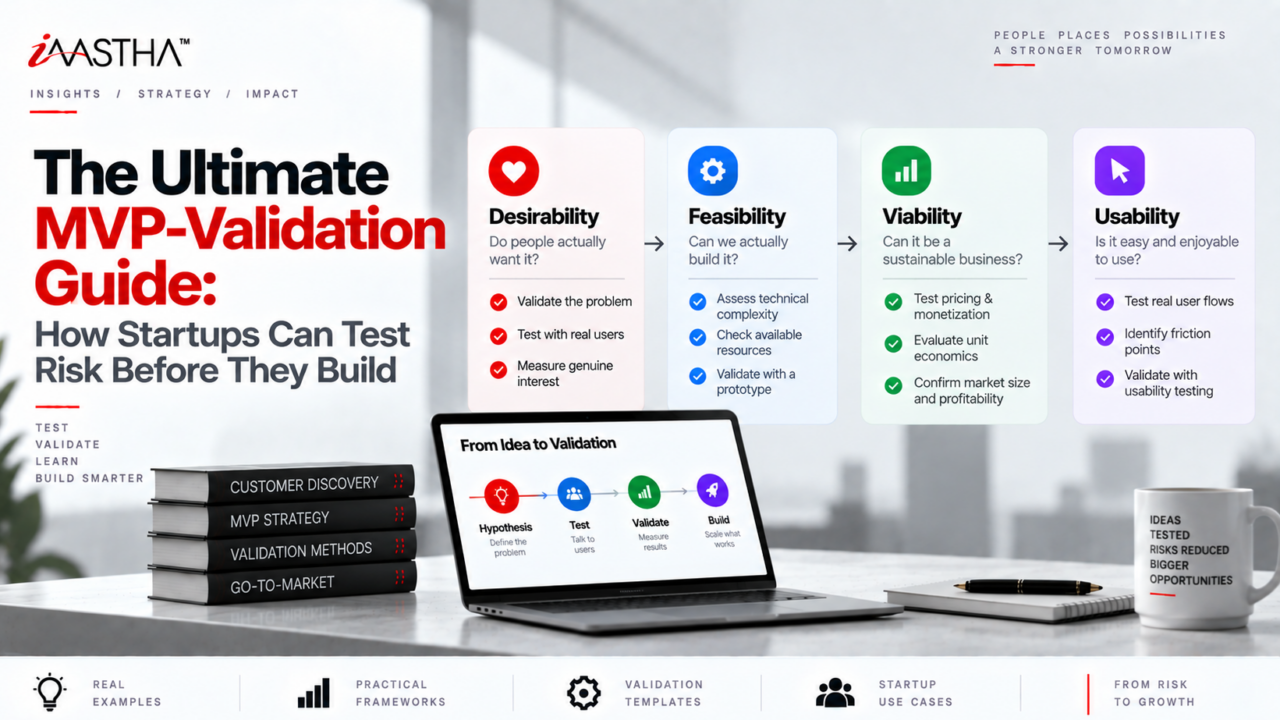
The Four Risk Categories an MVP Should Test
This is the core of a proper minimum viable product risk assessment. Every serious MVP should be built to answer one of these questions:
1. Desirability Risk: Does anyone actually want this?
This is usually the first and cheapest thing to test. Before writing production code, try:
- A landing page describing the product, with a signup or waitlist CTA
- Paid ad traffic sent to that page (even a small budget, $50 to $100, gives you real conversion data)
- A “fake door” test, where clicking a feature shows a “coming soon” message and tracks interest
If your signup conversion rate from cold traffic sits below 2 to 3 percent, that’s a signal your positioning, not just your product, needs work.
2. Feasibility Risk: Can this actually be built at the cost and speed you’re assuming?
This is where technical founders often skip ahead too fast. Instead of building the full system, build a spike: a throwaway piece of code whose only job is to answer one question, like “can we process this data within our latency budget” or “does this third-party API actually support what we need at scale.”
Never turn a spike into production code. Its only job is to answer a question, then get deleted.
3. Viability Risk: Does the business model actually work?
A product can be desirable and feasible and still fail, because the unit economics don’t hold up. This is where a Wizard of Oz MVP earns its keep: a product that looks automated to the user but is manually operated behind the scenes.
This lets you calculate real customer acquisition cost and early retention numbers with actual humans, not spreadsheet projections. If your CAC to LTV ratio isn’t trending toward roughly 1:3 within your first 100 to 200 users, that’s a structural issue, not a marketing issue.
4. Usability Risk: Can people use this without help?
Even a good idea, feasible to build, with solid economics, can fail if users get stuck on step two. Run 5 to 8 moderated usability sessions on a clickable prototype before writing final code. Research from the Nielsen Norman Group has repeatedly shown that testing with 5 users typically surfaces around 85 percent of usability issues, with diminishing returns beyond that.
The Order Matters More Than the Build
Here’s the part most founders get backward: they build feasibility and infrastructure first, because that feels like “real progress,” and test desirability last, because it feels uncomfortable to ask strangers if they actually want the thing.
The correct order is:
- Desirability first (cheapest, fastest, kills bad ideas early)
- Feasibility second (confirms you can actually build it)
- Viability third (confirms the numbers work at scale)
- Usability last (refines the experience once the core idea is validated)
Founders who reverse this order end up with a technically excellent product that nobody asked for.
A Simple MVP Validation Framework You Can Use This Week
| Risk Type | Cheapest Test | Signal to Watch |
|---|---|---|
| Desirability | Landing page + ads | 2 to 3%+ signup conversion |
| Feasibility | Spike solution | Can it work within real constraints |
| Viability | Wizard of Oz MVP | CAC to LTV trending toward 1:3 |
| Usability | Clickable prototype + 5 to 8 tests | No repeated confusion across users |
How This Reduces Startup Failure Ris
According to widely cited startup postmortem research (CB Insights has published multiple studies on this), “no market need” consistently ranks among the top reasons startups fail, often cited above running out of cash or losing to competitors.
That single statistic is the entire argument for MVP testing. If the leading cause of failure is building something nobody needs, then the leading defense is testing desirability before you build anything expensive.
“We killed two product ideas in four weeks using nothing but landing pages and ad spend. That’s four weeks and about $600, compared to the six months and $80,000 it would have cost us to find out the same thing by building,” notes a two-time founder who now advises early-stage teams on go-to-market strategy.