Picking an IT outsourcing company is a decision you will live with for years. A weak choice shows up later as missed releases, security surprises and a contract that is painful to leave. A strong choice feels almost boring: the work ships, the reports arrive on time and nobody argues about who owns what.
To choose an IT services partner, define the work first, send a structured request for proposal, score every shortlisted vendor on the same weighted criteria (delivery model, security, communication, NDA and IP terms, service levels and exit plan), and record the result in a service level agreement. Use the interactive scorecard below to do the scoring.
What IT outsourcing services actually include
IT outsourcing means handing defined technology work to an external team. The scope of IT outsourcing services usually falls into three models:
Project based delivery
A fixed outcome, such as building a data platform or migrating an application, with a clear start and end date. This suits work you can specify well in advance.
Dedicated team
An external team that works as an extension of yours, on your roadmap, for months or years. This suits evolving products where requirements change.
Managed services
Ongoing responsibility for running something, such as infrastructure, support or monitoring, measured against service levels. This suits stable, repeatable operations.
Knowing which model you need narrows the field fast. A vendor that excels at project delivery may be a poor fit for managed services, and the reverse is also true.
Step 1: Define the work before you meet any vendor
Most failed engagements start with a vague brief. Before you contact an IT outsourcing company, write down five things:
The outcome. What business result should exist when the work is done? The boundaries. Which systems, data and teams are involved? The constraints. Budget range, timeline, regulation and security rules. Your owner. One named person on your side who makes decisions. Your success measure. How you will judge the work after 90 days.
A one page brief is enough. It forces clarity, and it makes vendor answers easy to compare.
Step 2: Run a clean request for proposal (RFP) process
A good request for proposal RFP process treats every vendor the same way. That fairness is what makes scoring meaningful later.
What to put in the RFP
Include your one page brief, the delivery model you expect, security and compliance requirements, the team structure you want, reporting expectations and the date proposals are due. Ask for named references and a sample of the reporting you would receive.
How to keep it fair
Send the same document to every vendor. Answer questions in writing and share the answers with all bidders. Keep a short shortlist, usually three to five vendors, so each gets a real evaluation.
Protect confidential details
Share sensitive architecture or data only after a mutual NDA is signed. A serious vendor will expect this. Equally, a serious vendor will tell you that client case details can only be shared once the same protection is in place.
Step 3: Score vendors with a weighted scorecard
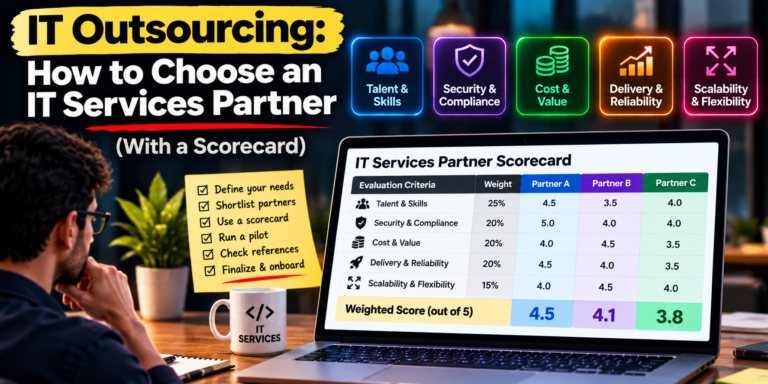
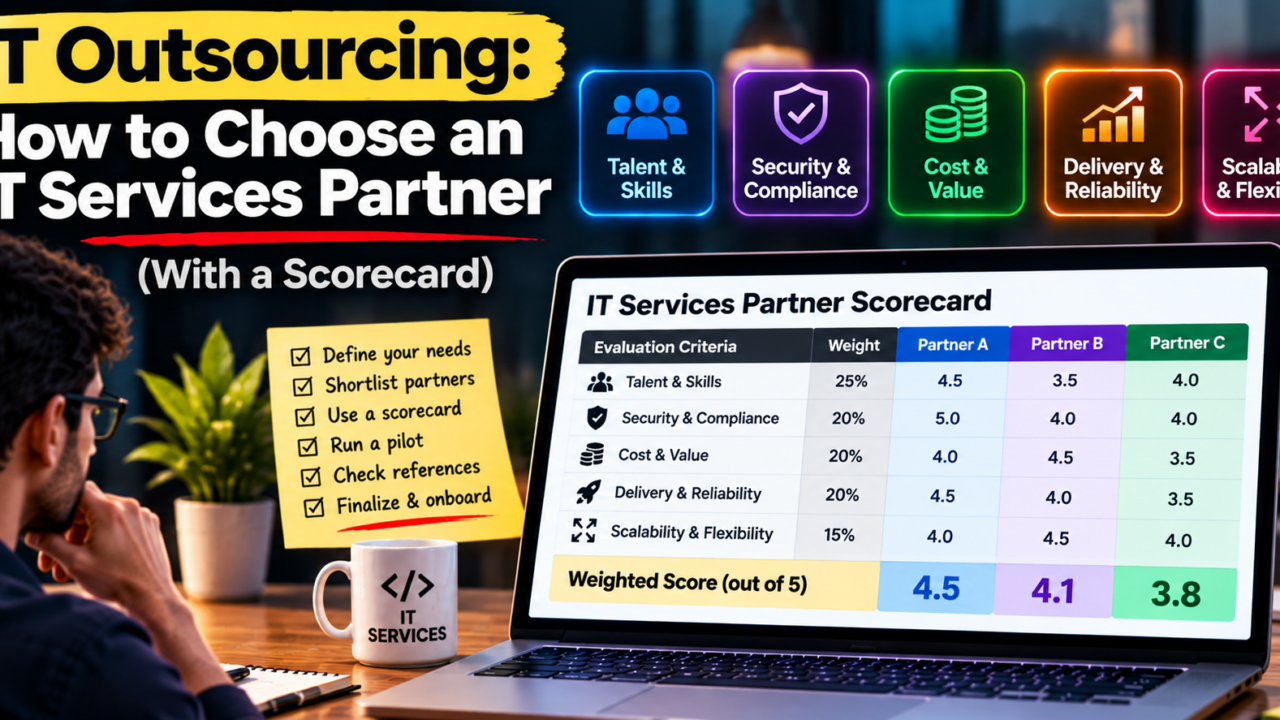
Gut feel is a poor guide when three vendors all sound confident. A weighted scorecard turns opinions into numbers you can defend to your leadership and finance teams. Rate each vendor from 1 (weak) to 5 (excellent) for each criterion. The weights below reflect common priorities for technical leaders, and you can adjust them to your situation.
| Criterion | Weight | Vendor A | Vendor B |
|---|---|---|---|
| Delivery model | 20 | Select12345 | Select12345 |
| Security | 20 | Select12345 | Select12345 |
| Communication | 15 | Select12345 | Select12345 |
| NDA and IP terms | 15 | Select12345 | Select12345 |
| Service levels | 15 | Select12345 | Select12345 |
| Exit plan | 15 | Select12345 | Select12345 |
Vendor A: 0 / 100 · Vendor B: 0 / 100
Set a score for each criterion to see which vendor leads.
Delivery model (20)
Ask how work is planned, reviewed and released. Look for clear sprint or milestone routines, code review practice, test coverage and how the team handles changes in scope. Ask who exactly will work on your account and how long they have been with the vendor.
Security (20)
Ask for evidence, not promises: independent audit reports such as SOC 2 or ISO 27001 certification, access control practice, how credentials and data are handled, and how incidents are reported to you. Strong vendors answer these questions quickly and in detail.
Communication (15)
Check time zone overlap, a named point of contact, a regular reporting rhythm and an escalation route. Poor communication is the most common reason outsourcing relationships sour, even when the technical work is sound.
NDA and IP terms (15)
Confirm that you own the work product, that the NDA covers staff and subcontractors, and that no hidden reuse of your code or data is allowed. Have your legal team review this section.
Service levels (15)
Look for measurable targets: response times, resolution times, uptime where relevant, and what happens when targets are missed. If a vendor resists measurable commitments, treat that as information.
Exit plan (15)
Ask what happens if you leave. A good partner documents everything, hands over code and credentials cleanly and supports knowledge transfer. Planning the exit at the start is a sign of confidence, not distrust.
Step 4: Lock it in with a service level agreement for IT services
The scorecard tells you who to pick. The contract makes sure you get what you were promised. Use this checklist as a service level agreement for IT services template: tick each item once it is written into your draft.
0 of 10 items coveredScope of services and what is explicitly excludedResponse and resolution times by severity levelUptime or availability targets where relevantReporting cadence and the metrics reportedEscalation path with named rolesSecurity duties and incident notification windowIP ownership and confidentiality (NDA) termsService credits or remedies when targets are missedChange request process for scope and priceTermination rights and exit support
If you reach ten of ten, your agreement covers the points that cause most disputes. Have legal counsel review the final wording, since requirements vary by country and industry.
Step 5: Vendor management after you sign
Vendor management is the ongoing work of monitoring a supplier so it keeps delivering the agreed value, quality and risk controls. Signing the contract is the start of this work, not the end.
A light but steady routine works best. Hold a weekly delivery check with your owner and the vendor lead. Review service level reports monthly. Hold a quarterly business review that revisits the scorecard: re-score the vendor, compare against the original ratings and decide what to improve. Keep a simple log of issues and decisions so nothing depends on memory.
This routine also keeps you honest about your own side. Delays in feedback, access and decisions often cause more slippage than the vendor does.
Red flags when comparing IT outsourcing companies
Watch for a vendor that will not name the people on your team, avoids sharing references, pushes you to skip the NDA, gives vague answers about security, or promises results without explaining how it will measure them. Any one of these deserves a direct question. Several together deserve a different vendor.
Frequently asked questions
How do I choose an IT outsourcing company?
Define the work, send the same structured RFP to three to five vendors, score each on the same weighted criteria, check references and then record the agreement in an SLA.
What should an SLA for IT services include?
Scope, response and resolution times, uptime targets, reporting, escalation, security duties, remedies for missed targets and termination rights. The checklist above covers all of these.
How long does the RFP process take?
Plan on roughly four to eight weeks from brief to decision, depending on how many vendors you evaluate and how quickly your legal and security teams review.
What is vendor management in IT?
It is the continuing practice of selecting, monitoring and reviewing suppliers so they deliver what was agreed. Regular reviews against the scorecard are a simple way to do it.
Conclusion
Good IT outsourcing comes down to discipline: a clear brief, a fair RFP process, a weighted scorecard, a complete SLA and steady vendor management afterwards. None of these steps is complicated, and together they remove most of the risk from the decision.