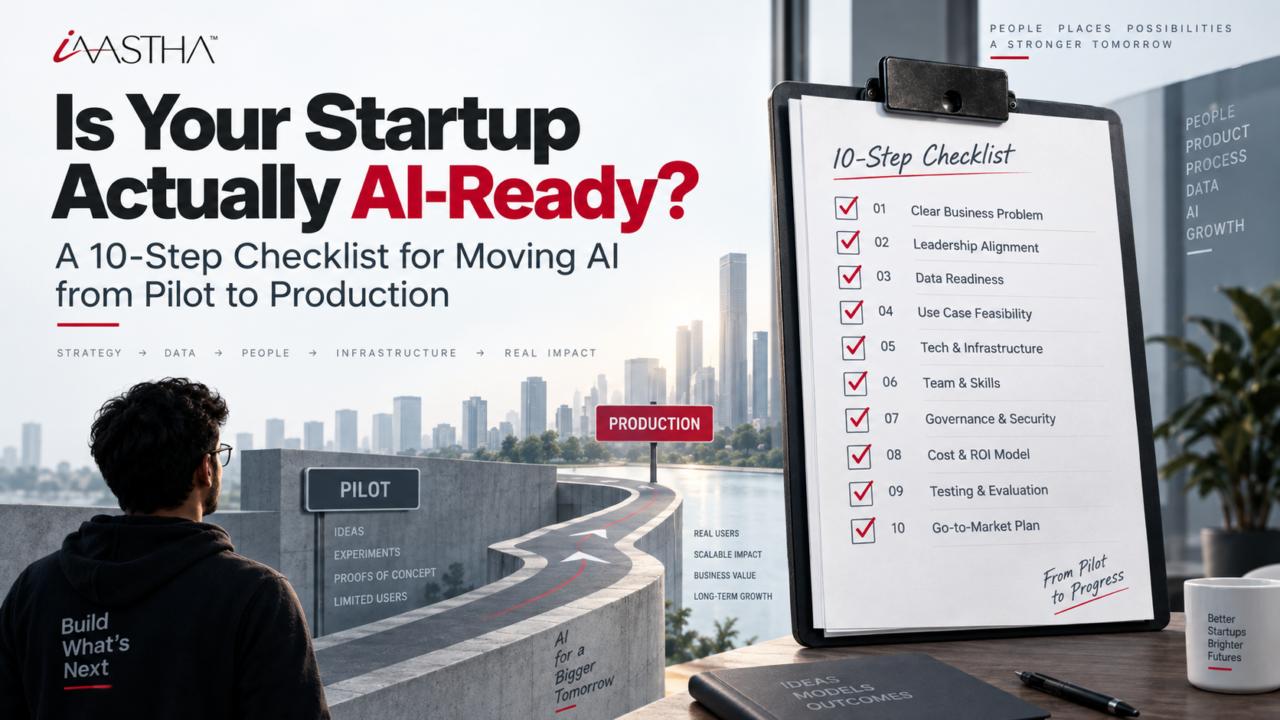
Every startup founder today wants to “add AI” to their product suite. It’s the ultimate buzzword, promising to revolutionise workflows, cut operational costs, and exponentially scale growth. But there is a massive chasm between a shiny, controlled pilot and a robust, production-ready AI feature.
Over the last five years working deeply within B2B technology startups—managing digital marketing, content strategy, and product messaging—I’ve seen exactly how these initiatives can go off the rails. A quick test yields fantastic AI outputs, and suddenly leadership pushes it live to thousands of users. That is exactly where things break.
Understanding how to make your startup AI-ready requires looking past the hype. This isn’t just about grabbing an API key and launching; it’s about infrastructure, long-term strategy, and cross-functional alignment. Before moving from a successful pilot to a full-scale deployment, you need a rigorous framework. Here is a practical, battle-tested AI production readiness checklist for startups taking that leap.
1. Clean, Structured Data: The True Foundation
AI models are only as good as the data feeding them. In the fast-paced startup ecosystem, we often move at breakneck speed, leaving fragmented data scattered across disconnected spreadsheets, half-updated CRM platforms, and random Slack exports. Feeding this chaotic data into a Large Language Model guarantees unreliable results. No amount of clever prompt engineering or generative engine optimization can fix fundamentally messy inputs. Before moving AI from pilot to production, audit your data pipelines. Ensure your inputs are clean, structured, and centralized. Your AI deployment strategy for tech startups must start with uncompromising data hygiene.
2. A Clear Problem Statement: AI is Not a Strategy
Saying “we want to use AI” is an objective, not a strategic plan. You must know exactly what workflow the AI is meant to improve. Are you automating complex B2B digital marketing campaigns, or are you building predictive analytics for enterprise clients? Define the exact problem statement. AI deployed without a focused, deeply understood use case quickly becomes an expensive distraction. Know precisely how this technology integrates into the daily lives of your users and what specific friction it is designed to eliminate.
3. Defined Success Metrics: What Does “Working” Look Like?
Before launch, decide what a successful deployment actually looks like in measurable terms. Establish strict accuracy thresholds, acceptable latency limits, maximum cost per query, and clear error tolerance levels. Document these key performance indicators meticulously. Otherwise, you will never truly know if the pilot succeeded or if you are just burning through computational credits without generating real ROI. Evaluating AI tools for business workflows requires hard data, not just positive sentiment from beta testers. If you can’t measure it, you aren’t ready to launch it.
4. A Human-in-the-Loop Fallback: Preparing for Imperfection
Production AI will make mistakes—it will hallucinate facts, misinterpret context, or generate off-brand messaging. You must have a documented process for human operators to catch, correct, and override AI outputs. This is especially critical in B2B SaaS or customer-facing interfaces where trust is your primary currency. Implementing a robust “human-in-the-loop” safeguard ensures that when the AI stumbles, your user experience doesn’t immediately crash with it. Customers forgive a flagged review process; they will not forgive an autonomous system making a catastrophic error.
5. Data Privacy & Compliance Groundwork: Protect Before Scaling
If your startup’s AI feature touches sensitive user data, you must understand your regulatory obligations before scaling. Data protection laws like GDPR and sector-specific compliance frameworks are non-negotiable hurdles. Are you inadvertently training a public model on proprietary client data? Retrofitting compliance after a data breach or a failed enterprise security audit is astronomically more expensive—and damaging to your brand—than building it securely into your architecture early on. Privacy cannot be an afterthought in your development lifecycle.
6. Cost Modeling at Scale: Beware the Hidden API Trap
A pilot program with 50 internal users easily hides the long-term costs of API calls, compute power, and cloud infrastructure. It might look incredibly cheap on day one. But what happens when you scale to 5,000 or 50,000 active users? You must rigorously model what your AI infrastructure costs look like at 10x and 100x usage. Run these financial projections before committing your product roadmap and budget to a production launch. If the cost of generating an AI output exceeds the value provided to the user, your business model will collapse under its own weight as you scale.
7. Monitoring & Observability: Don’t Fly Blind
You need comprehensive, real-time visibility into what the AI is doing once it hits a live production environment. This means logging inputs and outputs, tracking error rates, and monitoring for “model drift”—where performance steadily degrades as real-world data changes. Flying blind after launch is exactly how minor technical glitches snowball into massive PR problems or churned enterprise clients. Robust observability is a non-negotiable element. You wouldn’t launch a traditional web application without server monitoring; do not launch an AI application without model monitoring.
8. Internal Team Understanding, Not Just Vendor Trust
Someone on your technical team needs to understand how the underlying model works well enough to debug critical issues. Simply relying on a third-party vendor’s dashboard is a massive operational vulnerability. Outsourcing your understanding entirely is a long-term risk. Your internal team needs to own the technical logic, understand the strict limitations of the foundation models you are utilizing, and be capable of troubleshooting anomalies without waiting days on a vendor’s support ticket. Build internal competency alongside external APIs.
9. A Rollback Plan: The Engineering Escape Hatch
What happens if the AI feature fails spectacularly or behaves unpredictably in a live environment? You need a fast, reliable way to disable it or revert to the previous manual process without disrupting the entire software product. Feature flags and disaster recovery protocols are absolutely essential. A robust rollback plan guarantees that an AI misstep doesn’t result in total system downtime. Hope is not a strategy; prepare for the worst-case scenario so your engineering and product teams can sleep at night.
10. Buy-in Beyond the Tech Team: Cross-Functional Alignment
AI initiatives living exclusively in the engineering department rarely survive contact with the real world. Sales teams need to know how to pitch the new capabilities accurately, marketing needs to position it without overpromising, and customer support needs to know how to troubleshoot user confusion. Get absolute alignment across all departments on what the AI will and won’t do before it goes live. In the competitive B2B tech landscape, unified messaging across every touchpoint is critical to market adoption.
The Bottom Line
Moving an AI feature from a contained sandbox into a live production environment is one of the most critical transitions a modern tech startup can make. A successful pilot proves an idea works in a sterile setting. Production readiness proves it works reliably, safely, and affordably in the unpredictable real world at scale.
As startups everywhere rush to capitalize on the AI boom, the long-term winners won’t be the ones who ship the fastest—they will be the ones shipping resilient, well-architected systems. Skipping this essential checklist is exactly how startups end up rolling back highly publicized features and rebuilding them from scratch six months later. Do the unglamorous groundwork, build the foundation first, and scale your innovations with absolute confidence.