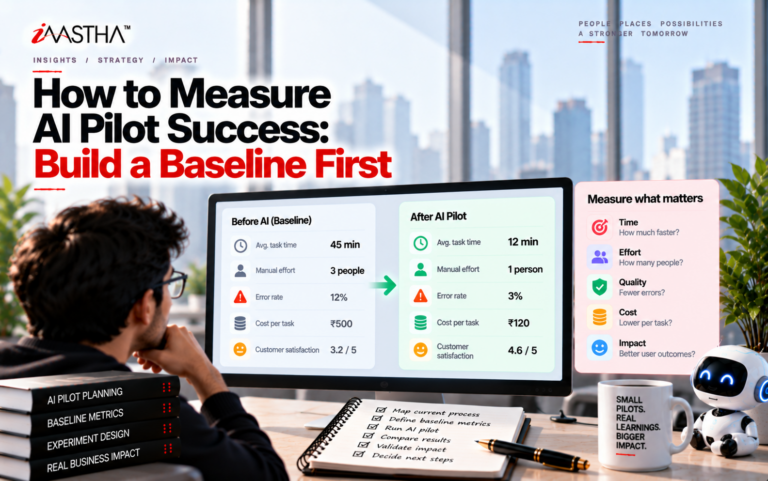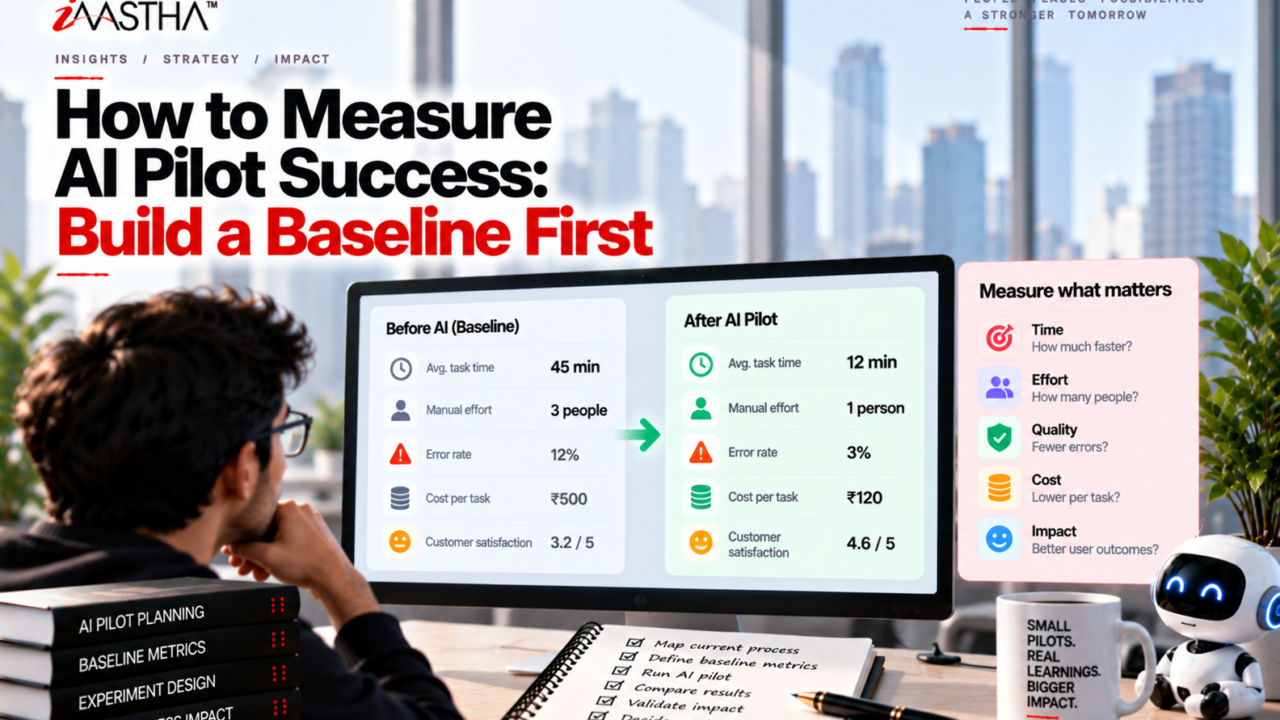
A team switches on an AI tool for a four-week trial. People say it feels quicker. A few demos go well. Then the budget meeting arrives and someone asks a simple question: “Quicker than what?”
Nobody can answer, because nobody wrote down how the work was done before. This is the most common reason pilots stall, and it is also the easiest one to fix. If you want to know how to measure AI pilot success, start before the pilot begins.
In this guide, we explain what an AI pilot baseline is, which success metrics for AI matter most, and how to run a fair comparison. You will also find a fill-in worksheet and a five-question readiness check you can use today.
Why most AI pilots get judged on a feeling
Most pilots are judged on impressions. Someone says it seems faster, a few people agree, and the pilot is either scaled or quietly dropped. Neither decision rests on evidence.
You will see plenty of discussion about the generative AI pilot project failure rate. Surveys and analyst reports regularly suggest that a large share of generative AI pilots never reach production. The exact figure varies by source and year, so check the latest report before you quote one. What matters more is the pattern behind it: many of these pilots had no agreed definition of success and no starting measurement. Without those two things, even a good pilot is hard to prove, and a weak one is hard to stop.
Try this now: Think of the last pilot your team ran. Could you state, in one sentence, how long the task took before the pilot? If not, you have just found the gap this article fixes.
What is an AI pilot baseline?
An AI pilot baseline is a recorded snapshot of how a process performs today, captured before any AI tool is introduced. It gives you a fixed comparison point so that any change during the pilot can be measured rather than guessed.
A useful baseline has four properties:
- Specific: it covers one named process, not “operations” in general.
- Measured: it uses numbers, not opinions.
- Representative: it comes from a typical sample of real work.
- Frozen: you do not change it once the pilot starts.
The role of pilot projects in AI implementation
People often ask about the role of pilot projects in AI implementation. A pilot is a small, time-boxed test that answers one question: does this AI approach improve a specific process enough to justify scaling it?
A pilot is not a demo and it is not a soft launch. A demo shows what the tool can do. A pilot shows what the tool does to your work, with your data, your people and your constraints. That is why the baseline matters so much. It is the only thing that lets a pilot answer its question honestly.
For CTOs and technical leaders, this also protects your credibility. When you bring a scaling proposal to the board, a before and after comparison on a fixed sample is far easier to defend than a collection of positive anecdotes.
Success metrics for AI: the three to measure first
There are dozens of success metrics for AI, from model accuracy to user satisfaction. For a first pilot, three operational measures give you the clearest signal with the least effort.
1. Time taken
Measure how long the task takes today, from start to finish. Use the same start and end points every time. For example, “ticket opened to ticket closed” or “document received to document approved.” Record the median as well as the average, because a few unusually long tasks can distort an average.
2. Rework
Rework is how often the output has to be fixed, corrected or redone. Count the number of tasks that needed a second pass and divide by the total. AI can make the first draft faster while quietly increasing the number of corrections, so this measure protects you from a false win on speed.
3. Completion rate
Completion rate is the share of tasks finished end to end without stalling or being handed off. A process that is fast but often abandoned is not performing well. This measure shows whether the AI helps work reach the finish line.
Optional extras once the basics are in place
After your core three are stable, you can add cost per task, error severity (minor versus critical) and user confidence. Add them only if you can measure them the same way before and after. A metric you cannot baseline is a metric you cannot compare.
How to measure performance of AI: a step by step method
If you are wondering how to measure performance of AI in a real business setting, this six-step method works for most teams.
Step 1: Choose one process
Pick a single, well-defined process, such as invoice matching, support triage or contract review. Narrow pilots produce cleaner evidence.
Step 2: Record the current performance
Capture time taken, rework and completion rate for the process as it runs today. Do this before anyone configures the AI tool.
Step 3: Choose a consistent sample
Compare like with like. Use the same type of work and a similar volume before and after. If the baseline sample was 100 routine cases, do not compare it with 20 complex ones.
Step 4: Set the review date in advance
Write down when you will review the results and who will attend. Setting the date early stops anyone from reinterpreting the results after seeing them.
Step 5: Run the pilot without changing the measures
If you change what you track halfway through, the comparison stops meaning anything. Keep definitions identical from the first day to the last.
Step 6: Compare, decide and document
At the review, put the baseline and pilot figures side by side. Decide whether to scale, adjust or stop, and record the reasoning. This record becomes useful evidence for your next pilot.
How long should a pilot project last?
Teams often ask how long should a pilot project last. There is no single right answer, but a practical rule is this: run it long enough to collect your full sample, and no longer.
For many operational processes, that means somewhere between four and twelve weeks. Shorter pilots risk testing only the easy cases. Longer ones tend to drift, as scope creeps in and the original question gets forgotten. Decide the duration and the review date together, in writing, before you start.
Quick self-check: is your pilot ready to start?
Answer yes or no to each question. Give yourself one point for every yes.
- Have you named one specific process to test?
- Do you know today’s time taken for that process?
- Do you know how often its output needs rework?
- Have you fixed the sample and the review date?
- Have you agreed that the measures will not change mid-pilot?
Your score:
- 5 points: You are ready. Start the pilot.
- 3 to 4 points: Close. Fill the gaps first, then begin.
- 0 to 2 points: Pause. Without a baseline, you would be measuring a feeling, not a result.
Common mistakes that weaken a pilot
- Starting the tool before recording the baseline. Once the process changes, the old numbers are gone.
- Measuring only speed. Fast output with high rework is not an improvement.
- Changing the sample. A different mix of work makes the comparison unfair.
- Reviewing with no agreed date. Open-ended pilots tend to end by fatigue, not by decision.
- Relying on opinions. Feedback from users is valuable, but it should sit beside the numbers, not replace them.
FAQ: how to measure AI pilot success
How do you measure AI pilot success?
Record the current process first, then compare it with the pilot using the same sample and the same measures. For most teams, the core measures are time taken, rework and completion rate, reviewed on a date fixed in advance.
What is a good baseline for an AI pilot?
A good baseline is specific to one process, based on a representative sample of real work, and frozen before the pilot starts. It should include time taken, rework and completion rate at a minimum.
Which success metrics for AI should a first pilot use?
Start with three operational measures: time taken, rework and completion rate. Add cost per task or error severity later, once you can measure them consistently before and after.
Can you measure AI pilot success without a baseline?
Not reliably. Without a starting point, you can only report impressions. A baseline is what lets you say that rework fell or completion rose over the same sample.
How long should an AI pilot run before you decide?
Long enough to collect your full sample, typically four to twelve weeks for many operational processes. Set the review date before the pilot begins.
Conclusion: measure first, then scale
Knowing how to measure AI pilot success comes down to one habit: record where you are starting from. A clear baseline, a consistent sample, a fixed review date and unchanged measures turn a hopeful experiment into a decision you can stand behind.
At iAastha, we help technical teams design AI pilots that produce evidence, not just enthusiasm. If you are planning a pilot and want a second pair of eyes on your baseline, book a 20-minute call with our team.
Your turn: Which of the three measures, time taken, rework or completion rate, is hardest to capture in your process today? Tell us in the comments or on LinkedIn, and we will share tips on measuring it.