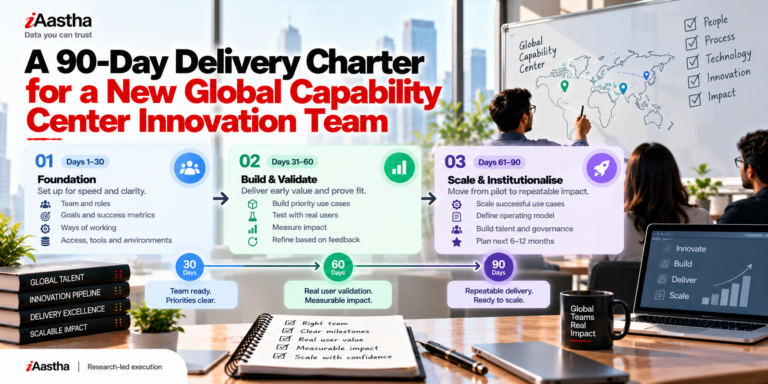
A new global capability centre (GCC) innovation team usually starts with energy and ends up in a fog. The mandate is broad, access is slow, and nobody has agreed on who can say yes. Ninety days later, leadership asks what was delivered and gets a deck about intent.
A delivery charter fixes this. It is a short, signed agreement that sets scope, decision rights, sponsorship and acceptance criteria before work starts, and it splits the first quarter into three phases. This guide covers each part and includes interactive tools you can adapt to your own GCC.
Key takeaways
- Split the first quarter into three phases: mandate and access, first delivery, then outcome review and knowledge transfer.
- Name one decider for every decision type, with a time limit.
- Give the innovation team a business sponsor who owns the problem, not only a GCC head who owns the center.
- Write three to six testable acceptance criteria before building anything.
- End Day 90 with a recorded sponsor decision: go, adjust or stop.
What is a GCC delivery charter?
A global capability centre is a unit owned by an enterprise, often offshore or nearshore, that delivers technology, data, engineering or business capability back to the parent organisation. NASSCOM’s report Forging Ahead: Strategic Partnerships Between GCCs and Service Providers looks at how these centers work with external partners, which is exactly where unclear charters create friction.
A delivery charter is a close cousin of the classic project charter, but it covers a team rather than a single project. It answers four questions: what are we here to do, who decides, who sponsors, and how will we know it worked. Think of it as the project charter example your innovation team can keep on one page and reread every Friday.
The 30/60/90 day plan: three phases
A 30/60/90 day plan is only useful if each block ends with a gate, a check that must pass before the next block starts. Select a phase below to see its goal, actions and exit gate.
Phase 1
Days 1 to 30: Mandate and access
Phase 2
Days 31 to 60: First delivery
Phase 3
Days 61 to 90: Outcome review and knowledge transfer
Phase 1: Mandate and access (Days 1 to 30)
Goal: turn the mandate into a written scope and remove the blockers to real work. In month one, the innovation team should not build anything customer visible. It should secure what it needs to build safely.
- Sign the charter and name the business sponsor and the GCC head as co-owners.
- Confirm access: environments, data sets, security approvals, tooling and a named contact in each parent function.
- Choose one delivery candidate using four filters: real business pain, available data, measurable result, and a user who will take your call.
- Capture a baseline for the metric you will be judged on.
- Write the acceptance criteria for the candidate and get them signed.
Exit gate: access confirmed, one candidate chosen, criteria signed. If one is missing, extend the phase rather than start Phase 2 on hope.
Decision rights: settle who decides before the first sprint
Decision rights are explicit statements of who can make, approve or veto a type of decision. They matter in a new innovation team because most delays are not technical. They are waiting for someone to say yes.
Use four roles: business sponsor, GCC head, innovation lead and, where you use one, a service partner. For each decision type, name one person who decides and list who must be consulted. Pick a decision to see a sample setup.
Decision type: Scope change; Tool or vendor choice; Release to pilot users; Stop or continue after Day 90
Decides: Business sponsor
Consulted: GCC head, innovation lead
Escalates to: Executive steering group
Time limit: 3 working days
These are illustrative, so adapt them to your governance model. The time limit is the part teams skip. A decision without a deadline is a delay with a polite name.
Business sponsorship: who owns the problem
A business sponsor is the person in the parent organization who owns the problem and the budget line behind it. The GCC head owns the center. The sponsor owns the outcome. When these are the same person, say so in the charter. When they are different, write down where one role ends and the other begins.
What a sponsor does
Defines the business outcome, clears access with parent functions, attends the weekly decision review, and accepts or rejects the delivery against the signed criteria.
What a sponsor does not do
Assigns work directly to individual engineers, or changes scope outside the change log. Both quietly break the charter, and both feel helpful in the moment.
Acceptance criteria: an example for your first delivery
Acceptance criteria are the conditions a delivery must meet to be accepted. They turn “done” into a yes or no. Good ones are specific, testable and written from the user’s side, often in Given, When, Then form. Choose a candidate to see an example of acceptance criteria.
First delivery candidate Invoice exception triage assistantCustomer data quality dashboardInternal knowledge search
Criterion 1: Given an invoice with a mismatch, when the assistant reviews it, then it labels the exception type and suggests a next step.
Criterion 2: Given a labeled exception, when a reviewer disagrees, then the correction is recorded for review.
Criterion 3: Given the pilot group, when a batch is processed, then handling time is measured against the Phase 1 baseline and reported at [agreed interval].
Keep it to three to six criteria. Tie each one to the Phase 1 baseline, replace every bracket with a value the sponsor agrees to, and get the sponsor’s signature before Phase 2 begins.
Project charter example: the one-page version
Here is a compact structure you can copy. If it does not fit on one page, the scope is probably too wide for a first 90 days.
| Purpose | One sentence on why the innovation team exists this quarter. |
| Scope in and out | The single delivery candidate, plus what is explicitly excluded. |
| People | Business sponsor, GCC head, innovation lead, receiving owner. |
| Decision rights | Decision types, deciders, consulted roles, time limits. |
| Phases and gates | Days 1 to 30, 31 to 60, 61 to 90, each with an exit gate. |
| Acceptance criteria | Three to six signed, testable statements. |
| Baseline and review | The metric, its starting value, and the Day 90 review date. |
| Risks | Top three, each with an owner. |
Charter readiness check
Tick what is already true for your innovation team. Your score updates as you go.
A business sponsor is named and has agreed to attend weekly reviews
The GCC head and sponsor roles are written down separately
Access to environments and data is confirmed or has a dated plan
One delivery candidate is chosen, not three
A baseline for the success metric is captured
Decision rights name one decider and a time limit per decision type
Three to six acceptance criteria are signed
A receiving owner is named for the Day 90 handover
0 of 8 ready. Not ready yet. Start with sponsor, access and baseline.
Common mistakes
- Starting with three candidates. One candidate gets finished. Three get demoed.
- Skipping the baseline. Without a starting value, Day 90 becomes an opinion contest.
- Treating access as a Phase 2 problem. Waiting for data or approvals mid-build burns the schedule.
- Letting the charter go stale. Review it at each gate and record changes.
Frequently asked questions
What is a GCC delivery charter?
It is a short agreement that sets scope, decision rights, sponsorship, acceptance criteria and a phased plan for a new global capability center team, so work can start with shared expectations.
How is a 30/60/90 day plan different from a charter?
The plan describes what happens when. The charter adds who decides, who sponsors and how acceptance works. The plan is one section of the charter.
Who should sign the charter?
At minimum the business sponsor, the GCC head and the innovation lead. Add the receiving owner if the work will be handed to another team.
How many acceptance criteria are enough?
Three to six for a first delivery. More than that usually signals that scope is too large for 90 days.