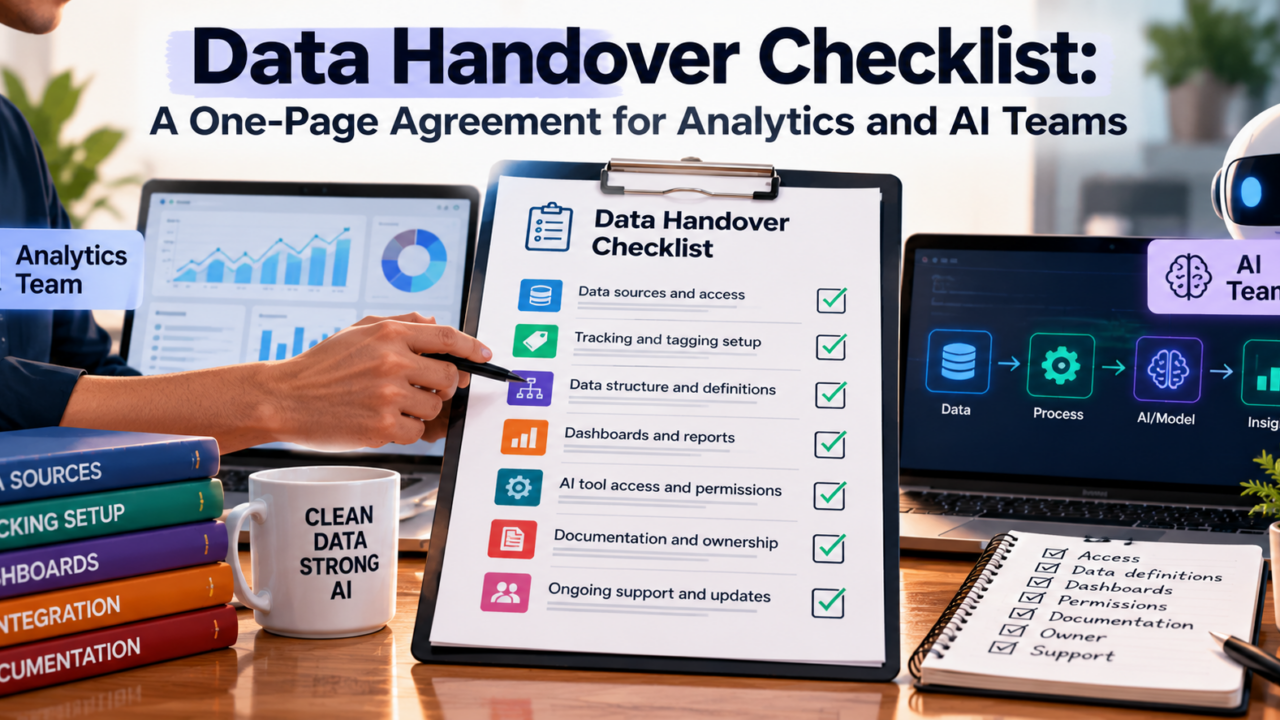
A data handover checklist is a one-page agreement between the team that produces a dataset and the team that uses it. It records six things: the dataset owner, the consumer, the definition, the refresh expectation, the quality checks and the escalation route. When both teams sign off on these six fields before data moves, analytics and AI work stops breaking in silence.
You do not need a data mesh, a new platform or a governance committee to use it. You need one page, one meeting and two people willing to write things down.
Why data handovers fail
Most handover problems are not technical. A pipeline runs, a table lands, and a model or dashboard starts using it. Then something changes upstream: a column is renamed, a refresh slips by a day, a definition of “active customer” quietly shifts. The consuming team finds out when a number looks wrong in a meeting.
The pattern is the same each time. Nobody was clearly named as the owner. Nobody wrote down what the data was supposed to mean. Nobody agreed on how fresh it had to be, or who to call when it broke. The data moved, but the responsibility did not.
This is the gap a data handover agreement closes. It turns an informal “here is the table” into a short, shared commitment.
What is a data handover agreement?
A data handover agreement is a short written record of what a producing team promises and what a consuming team can rely on. Think of it as the human-readable cousin of a data contract. A data contract is often a machine-readable schema file that tools can validate. A handover agreement is the plain-language version that people sign off on first, and that can later be turned into a contract if you want to automate it.
The idea draws on two principles from Zhamak Dehghani’s work on data mesh: that data should be owned by the people closest to it, and that data should be treated as a product with real consumers. In her article on data mesh principles, she describes a domain data product owner who is responsible for measures such as data quality, lead time and user satisfaction. She also notes that <b>accountability of data quality shifts upstream</b> toward the source. A handover agreement applies the same thinking at the smallest possible scale.
You can borrow those principles without adopting a full data mesh. Ownership and product thinking work fine in a company with two teams and one warehouse.
The six fields every handover needs
Here is what each field means and what a good entry looks like.
1. Dataset owner
The owner is one named person, not a team alias and not “the data team.” This person answers questions, approves changes and is accountable for the commitments on the page. If you are wondering how this differs from a steward, the short version is that the owner is accountable for the dataset, while a steward helps maintain its quality and documentation day to day. Many small teams combine the roles. Write down which person holds which.
A good entry: a name, a backup name and a contact channel.
2. Consumer
The consumer is the team or system that depends on the data, plus one named person who speaks for them. List the use case in a sentence: “weekly churn model retraining” tells the owner far more than “analytics.” Knowing the use case helps the owner judge which changes are safe and which are not.
A good entry: team, named contact, and the downstream use.
3. Definition
The definition says what each important field means, what one row represents and what is deliberately excluded. This is where most silent disagreements live. Write the grain of the table (for example, one row per customer per day) and define the two or three fields people most often misread. Link to a fuller data dictionary if you have one, but keep the essentials on the page.
A good entry: grain, key fields with plain definitions, known exclusions and a link to the schema.
4. Refresh expectation
The refresh expectation covers how often the data updates, by what time, and what happens when it is late. Be specific: “updated daily by 06:00 UTC, with a delay notice sent by 07:00 if it will miss” is a commitment. “Updated daily” is a hope. For AI teams, also note how much history is retained, because model retraining depends on it.
A good entry: frequency, deadline, time zone, late-data behavior and retention window.
5. Quality checks
Quality checks list what the producer verifies before the data is released and what the consumer verifies on arrival. Keep the list short and testable: row count within an expected range, no nulls in key fields, no duplicate keys, values within agreed bounds. Name who runs each check and what happens when one fails.
A good entry: three to six checks, each with an owner and a threshold.
6. Escalation route
The escalation route says who to contact, in what order, and how fast they should respond. Include a first line (the owner), a second line (a manager or backup) and a clear definition of severity. A broken feed that blocks a customer-facing model is not the same as a cosmetic naming issue, and the response times should differ.
A good entry: contact order, response time per severity, and the channel to use.
Try it: your handover readiness checklist
Before you draft the agreement, tick off what you already have. Copy this list into your own notes and check items as you go.
- I can name one person who owns this dataset
- I can name one person who speaks for the consuming team
- The use case for the data is written in one sentence
- The grain of the table is documented (what one row means)
- The two or three most misread fields have plain-language definitions
- A refresh time and a late-data rule are agreed
- At least three quality checks are defined, each with an owner
- There is a named first and second contact for problems
- Severity levels and response times are written down
- Both teams have read and agreed to the page
Score yourself: 9 or 10 ticks means you are ready to hand over. 6 to 8 means you are close, so fix the gaps in your next meeting. 5 or fewer means data is likely moving on trust alone, which is exactly when problems surface late.
The one-page template
Copy this table, fill in the right-hand column and have both teams sign off. It is original to this article and designed to fit on a single page.
| Field | Agreement |
|---|---|
| Dataset name and location | [Table, view or file path] |
| Dataset owner | [Name, backup, contact channel] |
| Consumer | [Team, named contact, downstream use case] |
| Definition | [Grain, key field definitions, exclusions, schema link] |
| Refresh expectation | [Frequency, deadline with time zone, late-data rule, retention window] |
| Quality checks | [3 to 6 checks with thresholds, who runs each, what happens on failure] |
| Escalation route | [First contact, second contact, severity levels, response times] |
| Change notice | [How many days of warning before schema or definition changes] |
| Review date | [When both teams will revisit this agreement] |
| Sign-off | [Owner name and date] / [Consumer name and date] |
The last three rows are small additions that pay off. A change notice period stops surprise renames. A review date keeps the page alive instead of letting it rot in a folder.
A worked example: how two teams agree on it
Here is an illustrative scenario showing how the page gets filled in. The teams and details are invented for demonstration.
The situation: The Customer Data team produces a table of daily customer activity. The AI team wants to use it to retrain a churn prediction model every week. Until now they have shared the table informally.
The meeting: The two leads meet for 30 minutes with the blank template on screen. They fill it in together.
| Field | Agreement |
|---|---|
| Dataset | customer_activity_daily in the analytics warehouse |
| Dataset owner | Priya (Customer Data), backup: Marcus |
| Consumer | AI team, contact: Elena, use case: weekly churn model retraining |
| Definition | One row per customer per day. “Active” means at least one logged session. Test accounts are excluded. |
| Refresh expectation | Daily by 06:00 UTC. If late, owner posts a delay notice in the shared channel by 07:00. Twenty-four months of history retained. |
| Quality checks | Producer: row count within 5 percent of the 7-day average, no duplicate customer-day keys. Consumer: no nulls in customer ID, activity count never negative. Failure: the checking team posts in the shared channel and the load is paused. |
| Escalation route | Severity 1 (blocks model retraining): Priya, then Marcus, response within 2 hours. Severity 2 (cosmetic or non-blocking): shared channel, response within 2 working days. |
| Change notice | 10 working days before any schema or definition change |
| Review date | End of next quarter |
What changed because of the meeting: The AI team learned that “active” excluded test accounts, which would have skewed their training data. The Customer Data team learned that the model needed 24 months of history, so they stopped trimming old partitions. Neither problem would have shown up until the model underperformed.
Notice what the agreement is not. It is not a legal document, and it does not demand new tooling. It is a record of a conversation that both sides can point to later.
How to run the handover meeting in 30 minutes
- Send the blank template a day ahead. Ask both leads to come with a draft of their own fields.
- Start with the definition. Disagreements here are the most expensive, so surface them first.
- Settle refresh and quality checks next. Push for numbers, not adjectives.
- Finish with escalation. Agree who gets called and how fast.
- Name the review date. Put it in both calendars before you leave.
- Store the page where both teams can find it. A page nobody can find does not exist.
Common mistakes to avoid
- Naming a team instead of a person. Teams do not answer messages. People do.
- Writing promises you cannot keep. A 99.99 percent freshness promise is worse than an honest 95 percent one.
- Skipping the use case. Without it, the owner cannot judge which changes are safe.
- Treating it as a one-time document. Data and teams change, so the review date matters.
- Waiting for a perfect governance framework. A rough one-page agreement today beats a polished framework next year.
Frequently asked questions
What should a data handover checklist include?
It should include the dataset owner, the consumer, the definition, the refresh expectation, the quality checks and the escalation route. Adding a change notice period and a review date makes it more durable.
How is a data handover agreement different from a data contract?
A data contract is usually a machine-readable specification that tools can enforce automatically. A handover agreement is a plain-language page that two teams agree on first. Many teams start with the agreement and convert it into a contract later.
Do I need a data mesh to use this?
No. The agreement borrows ideas about ownership and data as a product from data mesh, but it works in any organization with a producing team and a consuming team.
Who should be the dataset owner?
The person closest to the source of the data who can make decisions about it. This is usually someone on the team that produces the data, not on the team that consumes it.
How often should the agreement be reviewed?
At least once per quarter, and any time the schema, definition or use case changes significantly.
What is the difference between a data owner and a data steward?
The owner is accountable for the dataset and its commitments. The steward supports the owner by maintaining quality, documentation and day-to-day care. Small teams often have one person doing both.
Key takeaways
- A data handover checklist fits on one page and covers six fields: owner, consumer, definition, refresh, quality checks and escalation.
- Most handover failures come from unwritten assumptions, not from technology.
- Name people, not teams, and write numbers instead of adjectives.
- A 30 minute meeting with the template on screen is enough to start.
- Review the page on a schedule so it stays true.
Next step
Pick one dataset that another team depends on today. Copy the template above, book 30 minutes with the consumer and fill it in together. If you find gaps, you have just saved yourself a future incident.