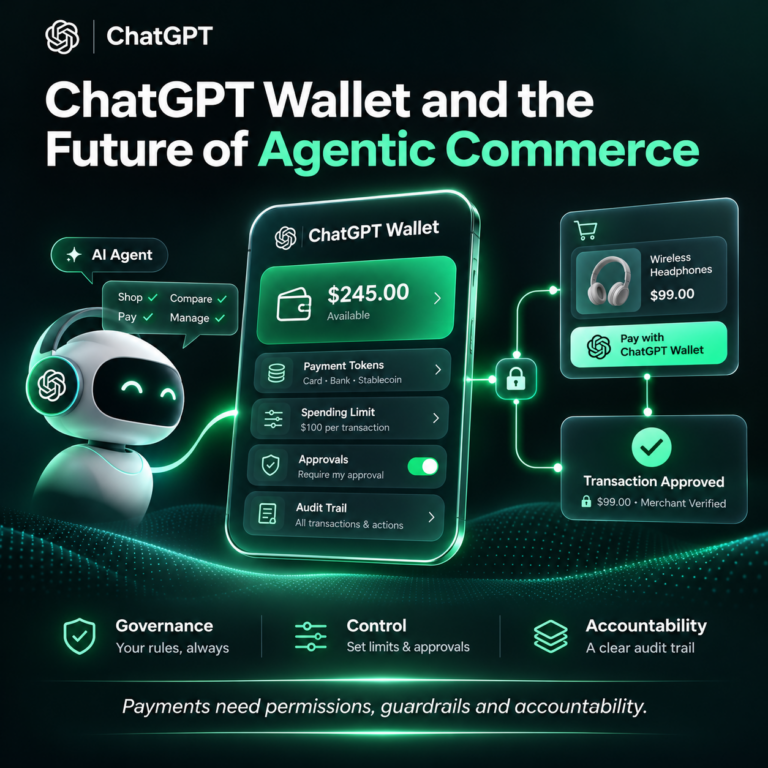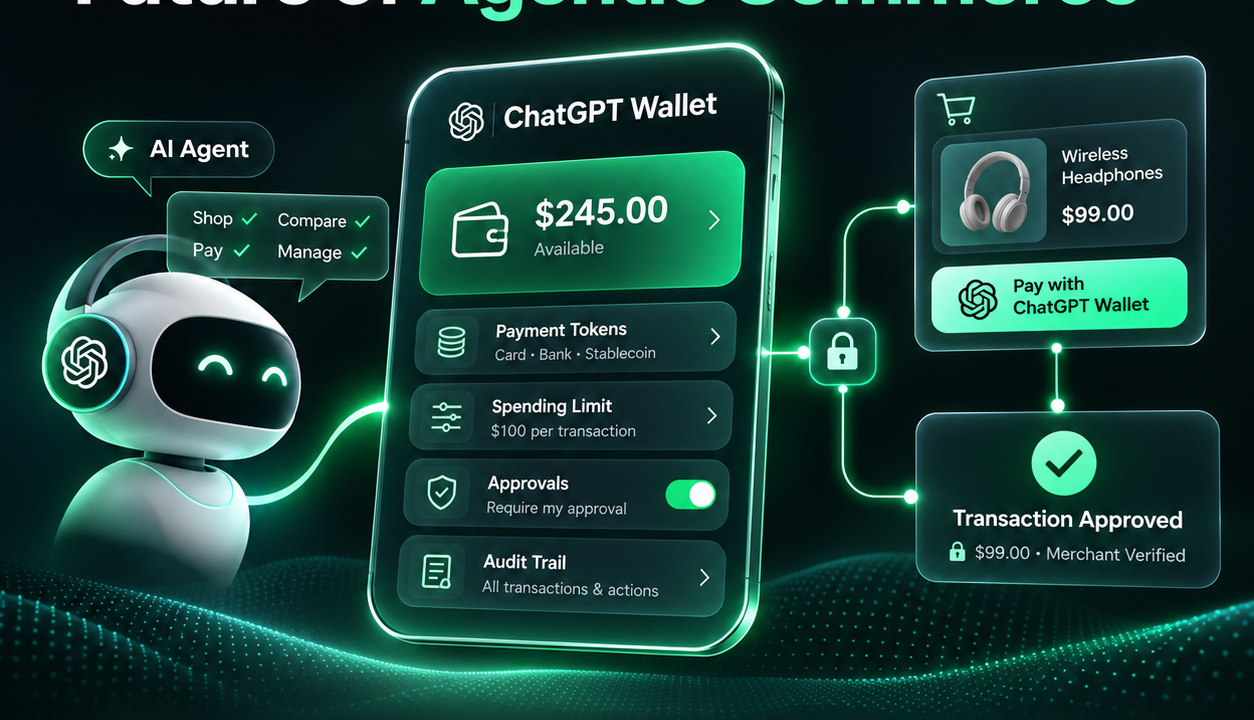
ChatGPT Wallet lets OpenAI’s agents pay for purchases you approve, using payment tokens instead of your real card details. It is the clearest early signal of where agentic commerce is heading: agents that search, compare and prepare a purchase, with a human holding the final say. Today every purchase needs biometric approval. Tomorrow, rules and spending limits may replace some of those taps.
Key takeaways
Delegated spending within limits is a stated future direction, not a live feature. Teams should design guardrails now.
OpenAI introduced ChatGPT Wallet on November 13, 2026, initially for eligible US ChatGPT Pro users through its dots agents. It is not available in India yet.
Each purchase needs Face ID or a fingerprint, and the agent never sees the real card number.
What Is ChatGPT Wallet?
ChatGPT Wallet is a payment layer inside ChatGPT. Think of it as a digital wallet app built for AI agents rather than for people tapping a phone at a counter. OpenAI built it with American Express, Mastercard and Visa, so it runs on existing card networks instead of replacing them.
The flow is simple. You add a card once, ask a dot to help with a purchase, then approve it. OpenAI says the rollout will stay limited while it works with merchants, banks and payment networks on compatibility and reliability.
What Are Digital Wallets, and How Is This One Different?
Digital wallets store card credentials so you can pay without typing them in. Apple Pay and Google Wallet are familiar examples. Most digital wallet app designs assume a person is standing at the checkout.
ChatGPT Wallet flips that assumption. The agent does the legwork: finding products, comparing options and preparing the cart. The person only approves. So the wallet itself is not the real news. The delegation is. That shift is what makes agentic commerce a different problem from ordinary online shopping.
How Tokenized Payments and Biometric Approval Work
Step 1: You register a card once
The card is added to the wallet one time. After that, you do not paste card details into each chat or store.
Step 2: Your dot prepares the purchase
You ask an agent to find and prepare an order. The agent can do the research and the checkout navigation, but it cannot finish the payment alone.
Step 3: You approve with biometrics
Before any money moves, you see an approval prompt showing the merchant, the items, the total and the selected card. You confirm with Face ID or a fingerprint.
Step 4: A token stands in for the card
After approval, the payment network issues a payment token with its own card number, security code and expiry date. Neither the merchant nor the agent sees your actual card details.
OpenAI describes the design simply:
agents pay without access to your actual card details.OpenAI launch messaging, as reported by ETV Bharat
Network tokens of this kind are designed to be scoped, which limits what a leaked credential can do. That is why tokenization matters more for autonomous AI agents than for human shoppers: the agent is another system that handles money, so it should hold as little sensitive data as possible.
What “Approval for Every Purchase” Means Today
For now, each order needs a biometric check. OpenAI has said each approval creates a record of the purchase you authorized, which gives you a basic audit trail from day one. The company also says it expects to let users delegate purchases within set spending limits, categories or time periods later. That is a plan, not a feature you can assume today.
Friction also exists on the merchant side. Merchants need to make sure their sites do not accidentally block AI agents, and their payment and risk systems must recognize legitimate agent-initiated transactions. Fraud tools may still flag genuine agent purchases and cause declines. Retailers also decide whether to accept agent orders at all.
In agentic commerce, trust has to be built on both sides of the checkout: the buyer must trust the agent, and the seller must trust the transaction.
| Question | Today | Stated direction |
|---|---|---|
| Who approves a purchase? | You, by biometrics, every time | You, through preset rules |
| What does the agent see? | A token, not your card | Unchanged |
| Who can use it? | Eligible US Pro users | Wider, as merchants and banks align |
Where Autonomous Spending Is Heading
The next stage is rule-based autonomy. Instead of approving each order, you would set a budget, a category and a time window, and the agent would act inside them. That is when autonomous AI agents stop being research assistants and become buyers.
The agentic commerce protocol race
The wider market is still sorting out its standards. The Agentic Commerce Protocol (ACP) is an open specification that OpenAI and Stripe announced on September 29, 2025, alongside Instant Checkout. It defines how an agent and a merchant exchange product data and run a checkout. In March 2026, OpenAI shifted its emphasis toward product discovery, which shows how fast the approach is changing.
ACP is not alone. Google introduced its Universal Commerce Protocol in January 2026. Visa launched Intelligent Commerce Connect in April 2026 to accept several protocols through one integration, and Mastercard runs Agent Pay. No single agentic commerce protocol has clearly won. One analyst described the current moment as early protocol experimentation around a bigger shift
, according to MindStudio’s coverage.
The unresolved question: who handles disputes?
One analysis of the launch notes that nobody has yet said who refunds a wrong or disputed purchase. Treat that as an open question until the networks, OpenAI and merchants publish clear rules.
Agentic AI Examples You Can Picture in Business
These are illustrative scenarios, not features of ChatGPT Wallet today. They show why governance matters.
- SaaS renewals: an agent flags an expiring subscription and prepares the renewal for approval.
- Software licenses: an agent buys seats inside a monthly cap and a list of approved vendors.
- Vendor invoices: an agent pays an invoice only after it matches a purchase order, and never pays the same invoice twice.
- Travel booking: an agent receives a credential valid only for one airline and one trip window, a pattern described for Visa’s agent tokens.
Each of these agentic AI examples needs the same foundation: limits, approvals, allowed merchants and a log.
Try It: Is Your Team Ready to Delegate Spending?
Tick every guardrail you already have in place. Nothing is stored or sent anywhere.
Spending limits: per-transaction, daily and monthly caps the agent cannot change.
Approval thresholds: a human signs off on large or unusual purchases.
Merchant rules: an approved list of vendors and purchase categories.
Audit trail: who authorized it, what was bought, the amount and the reason.
Emergency stop: permissions can be revoked immediately.
Duplicate detection: no repeated payments or retries of paid invoices.
Frequently Asked Questions
What is agentic commerce?
Agentic commerce is online buying in which an AI agent finds, compares and prepares purchases for you, and may pay within limits you set. Today a human still approves each purchase.Is ChatGPT Wallet available in India?
No. It is initially available through dots to eligible ChatGPT Pro users in the US.
Can AI agents spend money on their own with ChatGPT Wallet?
Not yet. Every purchase currently needs biometric approval. OpenAI expects to add delegated spending within limits later.
What is an agentic commerce protocol?
It is a shared set of rules that lets an AI agent and a merchant exchange product data, run a checkout and pass a scoped payment credential. ACP from OpenAI and Stripe is one example.
The Bottom Line
ChatGPT Wallet shows that agentic commerce is moving from demos to real checkout, one approved purchase at a time. The technology is ready for supervised buying. Unsupervised spending is where governance matters most. Build the limits, approvals, merchant rules and logs first, and autonomy becomes a controlled step instead of a leap.