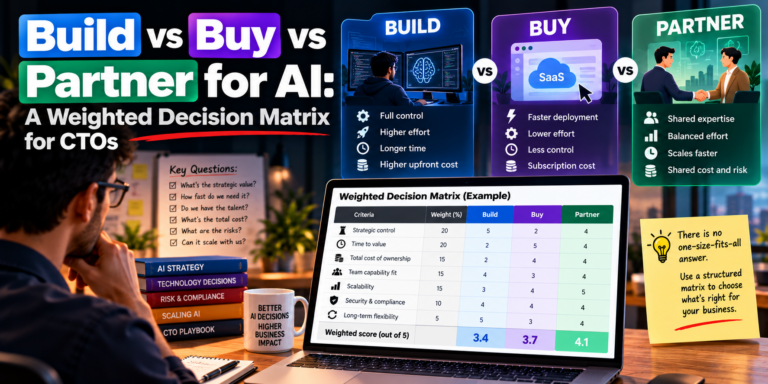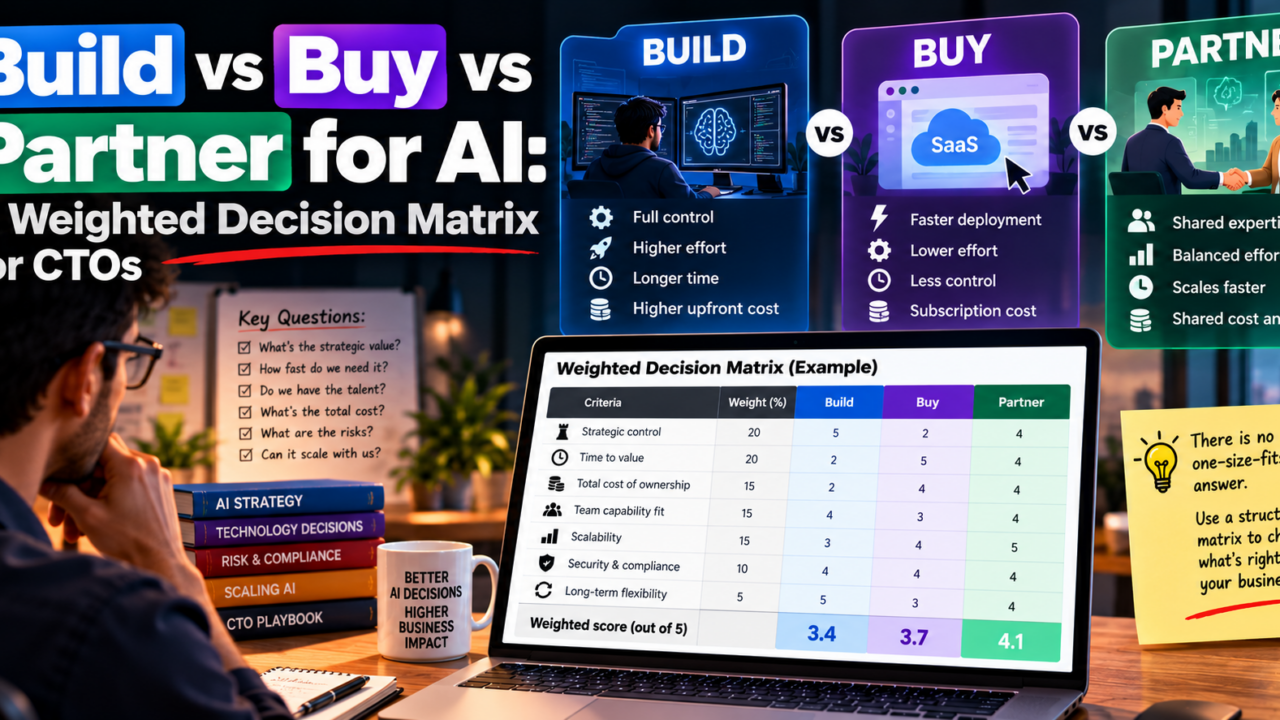
Every CTO eventually faces the same meeting. A team wants to build an AI capability in house, a vendor demo looks impressive, and an outside partner promises speed. Each option has a champion, and the debate drifts toward whoever argues loudest. A decision matrix gives that debate a structure. It makes the criteria visible, the trade-offs explicit and the final choice easy to defend later.
This guide shows how to make a decision matrix for an AI build vs buy vs partner choice. You will learn the decision matrix method in five steps, how to set decision matrix weights without bias, and how to run your own scores in the interactive calculator below.
Quick answer
- Build when the capability is a core differentiator and you own the talent and the data.
- Buy when the need is common, speed matters and the vendor’s product already fits.
- Partner when the capability is strategic but your team lacks time or specialist skills.
- Agree on weights before anyone scores an option. That single habit prevents most bad decisions.
What is a build vs buy vs partner decision?
The classic make or buy decision comes from operations and procurement. A company asks whether to produce a part itself or purchase it from a supplier. In software, the same logic became build vs buy: write the system or license it.
AI adds a third path and a new constraint. The third path is partnering, where a service provider builds, runs or co-develops the capability with you. The new constraint is data. Your data, your users and your regulators shape the choice more than the model does.
- Build: your team designs, trains or integrates the capability and owns it end to end.
- Buy: you license a finished product or platform and configure it.
- Partner: an external team delivers with you, with clear ownership, handover and knowledge transfer.
Why use a decision matrix for AI choices?
A decision matrix is a table that lists your options in columns and your criteria in rows. Each option gets a score for each criterion. A weighted decision matrix goes one step further: every criterion carries a weight, so an issue that matters more moves the result more.
For AI capabilities, this format helps in three ways.
- It forces the team to name criteria such as data control and time to value instead of arguing in generalities.
- It exposes disagreement early. If engineering scores “talent” as a 5 and the sponsor scores it as a 2, you have found the real conversation.
- It leaves an audit trail. A year later, you can show why the group chose to buy or partner.
It also has limits. The scores are judgments, not measurements. A matrix does not replace a proof of concept or a security review. Treat it as a way to organize thinking, not as an oracle.
The decision matrix method in five steps
Step 1: Define the capability and the boundary
Be specific. “AI for customer support” is too broad. “A system that drafts first replies to support tickets from our knowledge base” is a decision you can score. Write the scope, the users and the data involved in two or three sentences.
Step 2: Choose six to eight criteria
Fewer than six usually hides a trade-off. More than eight lets minor criteria drown out the important ones. A solid starting set for AI work looks like this:
- Strategic differentiation
- Time to value
- Data sensitivity and control
- In-house talent and capacity
- Three-year total cost, including run costs
- Vendor lock-in and exit options
- Compliance and auditability
Step 3: Set decision matrix weights before scoring
This is the step teams skip. Give each criterion a weight from 1 (nice to have) to 5 (critical) before you look at any option. Do it with the sponsor, the engineering lead and security in the same room. If you weight after scoring, people quietly adjust weights until their favorite wins.
A useful rule: no more than two criteria should carry the maximum weight. When everything is critical, nothing is.
Step 4: Score each option from 1 to 5 with evidence
Score each option on each criterion, where 5 is the best fit. Attach one line of evidence to every score: a quote from a vendor contract, a hiring plan, a cost estimate or a reference call. A score without evidence is an opinion.
Step 5: Stress test the result
Multiply each score by its weight and add the results. Then change the two heaviest weights by one point each and see whether the winner changes. If it does, the decision is sensitive, and you should investigate those two criteria before committing. If the winner holds, you have a much stronger case.
Interactive weighted decision matrix: build vs buy vs partner
Set a weight for each criterion, then score each option from 1 to 5. The totals update as you go. Everything runs in your browser, and nothing is stored or sent anywhere.
| Criterion | Weight (1 to 5) | Build | Buy | Partner |
|---|---|---|---|---|
| Strategic differentiation | 12345 | 12345 | 12345 | 12345 |
| Time to value | 12345 | 12345 | 12345 | 12345 |
| Data sensitivity and control | 12345 | 12345 | 12345 | 12345 |
| In-house talent and capacity | 12345 | 12345 | 12345 | 12345 |
| Three-year total cost | 12345 | 12345 | 12345 | 12345 |
| Vendor lock-in and exit options | 12345 | 12345 | 12345 | 12345 |
| Compliance and auditability | 12345 | 12345 | 12345 | 12345 |
Build: 63 of 105 (60%)
Buy: 63 of 105 (60%)
Partner: 63 of 105 (60%)
All three options are tied. Change some weights or scores to separate them.
Reset to defaults
If you want a reusable decision matrix template, copy the table above into your own document and add one column for evidence. That column is what makes the matrix credible months later.
Ten questions to answer before you choose
Before you score anything, answer these. Where the answers are unknown, that is your first piece of work.
- Does this capability differentiate us in the market, or is it table stakes?
- What data will it touch, and who owns that data?
- Could the data legally or contractually leave our environment?
- Do we have people who can build, run and improve it for at least two years?
- How soon does the business need measurable value?
- What will it cost to run each month, not only to launch?
- If a vendor or partner disappears, how do we exit and what do we keep?
- Who is accountable when the system gives a wrong answer?
- What evidence will convince our risk and audit teams?
- What would make us change this decision in twelve months?
Worked example: a hypothetical compliance assistant
Imagine a fintech compliance team that wants an assistant to summarize regulatory updates and flag affected internal policies. This example is illustrative, not client data.
The team weights data control and auditability as 5, time to value as 4, and strategic differentiation as 2, since compliance support is not what customers buy. With those weights, buying a generic tool scores well on speed but poorly on data control. Building scores well on control but poorly on talent and time. Partnering, with a handover plan, lands in the middle on every criterion and wins narrowly.
Now the stress test. Raise the weight on strategic differentiation from 2 to 4. The gap between partner and build narrows, because a differentiating capability favors ownership. That tells the team the choice is sensitive to one question: is this assistant ever going to be a product feature? If yes, partner now and plan to bring the capability in house later. If no, the partner path is stable.
Common mistakes when you make a decision matrix
- Equal weights. Giving every criterion a 3 turns the matrix into a popularity contest among minor factors.
- Scoring after picking a favorite. The matrix then justifies a conclusion instead of testing it.
- Ignoring run costs. AI systems need monitoring, evaluation and retraining. Launch cost is only part of the story.
- Too many criteria. Past eight, the important ones get diluted.
- Treating the total as truth. A 4.1 versus a 3.9 is a tie, not a verdict. Look at the gap and at the stress test.
- Deciding once. Revisit the matrix when your talent, data or vendor landscape changes.
Expert perspective
Add a short quote here from an iAastha founder, advisor or client leader on how they approach a make or buy decision for AI. Real attributed quotes strengthen trust and credibility signals, so use someone who is willing to be named.
“[Quote from a named iAastha leader on build vs buy vs partner for AI.]”[Name, Title, iAastha]
“[Quote from an advisor or client CTO on weighing data control against speed.]”[Name, Title, Company]
Frequently asked questions
What is a weighted decision matrix?
It is a table that scores each option against agreed criteria, multiplies each score by the criterion weight and adds the results. That gives you one comparable number per option, while keeping the reasoning visible.How many criteria should a build vs buy decision matrix have?
Six to eight is a good range. Fewer can hide real trade-offs, and more tends to bury the criteria that matter.When is the decision matrix method not enough?
When the scores rest on guesses. If two options are close, run a short proof of concept or a security review on the most uncertain criterion, then update the scores.When should a CTO partner instead of build or buy?
Partner when the capability is strategic and needs control over data and outcomes, but your team lacks the talent or time to build it alone. Insist on documented handover so ownership can move to you later.
Key takeaways
A build vs buy vs partner choice for AI is easier to defend when it is structured. Define the capability tightly, choose six to eight criteria, set decision matrix weights before scoring, back each score with evidence and stress test the winner. Use the calculator above with your leadership team, and keep the evidence column.