In the highly competitive world of logistics and supply chain management, margins are rarely lost in the boardroom during high-level strategic planning. Instead, they bleed out on the warehouse floor, on congested highways, and in the sheer volume of mundane administrative tasks. They are lost in the details: an inefficient delivery route, a warehouse pick error that results in a costly return, or a frustrated customer tying up a support representative to ask, “Where is my shipment?”
For decades, the industry accepted these micro-frictions as the inevitable cost of doing business. Operators built massive teams just to manage the chaos, throwing human capital at structural inefficiencies. However, technology has fundamentally changed the physics of the supply chain.
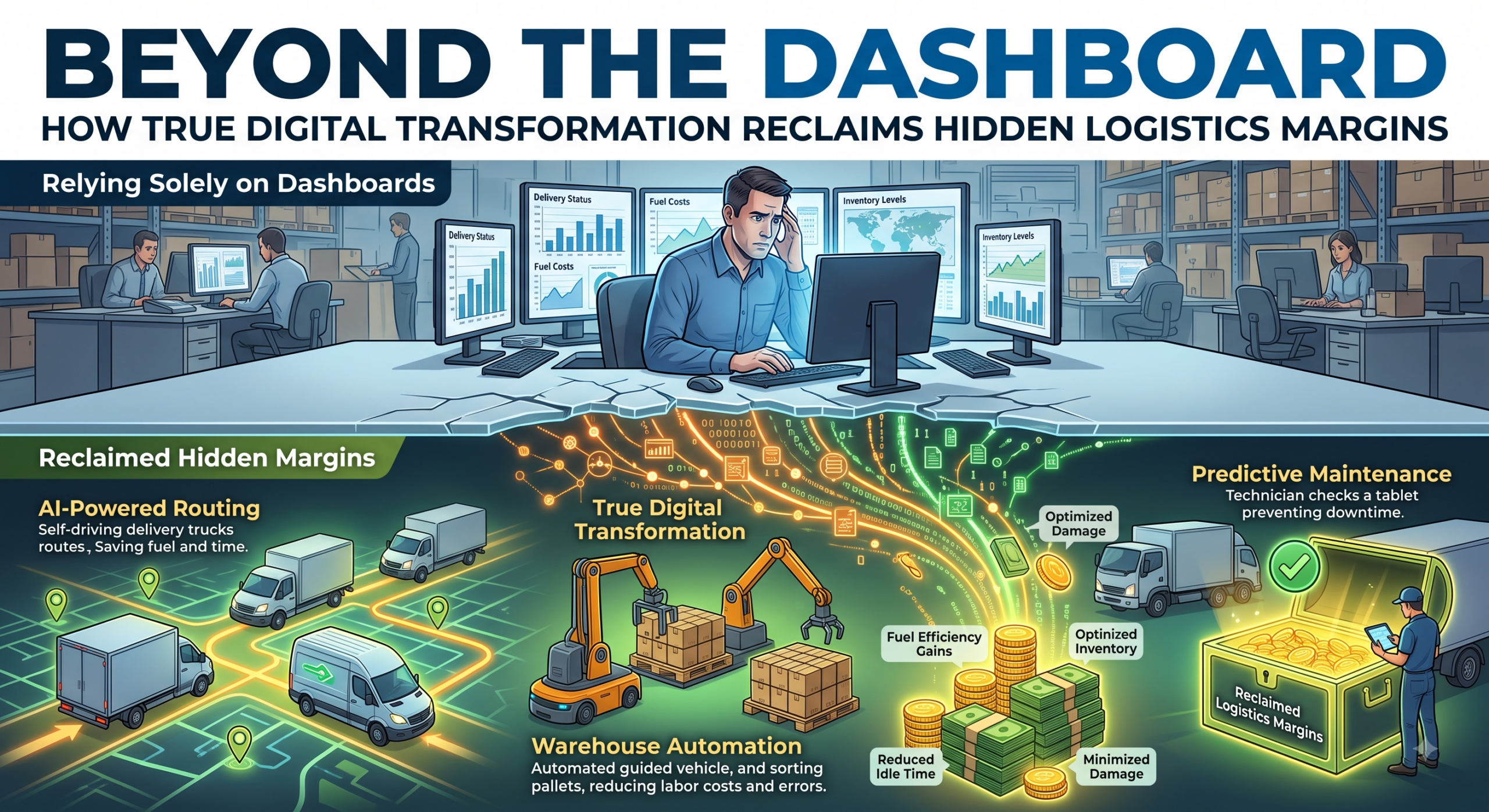
Here is the hard truth about modernizing logistics today: You cannot simply slap a sleek tracking dashboard on top of a broken, legacy process and call it “digital transformation.” Real supply chain optimization requires a foundational shift. It means designing your operational architecture around the shipment itself, rather than just building a pretty user interface for your dispatchers.
At iAastha, we partner with Third-Party Logistics (3PL) providers and enterprise shippers to move away from reactive, putting-out-fires operations. By implementing predictive models and deeply integrated technology, we help operators protect their bottom line. Here is how modern logistics technology is re-engineering the realities of the warehouse floor and the open road.
The Illusion of Surface-Level Digital Transformation
The logistics industry is rife with software solutions that promise the world but deliver only superficial improvements. Many companies invest heavily in software that digitizes their existing bad habits. If your underlying process relies on manual data entry, disconnected silos, and reactive decision-making, a new software interface will only let you make those same mistakes faster.
True digital transformation logistics requires a holistic re-evaluation of data flow. The architecture must be integrated at the API level, allowing systems to communicate instantaneously without human intervention. When a customer places an order, that data should seamlessly trigger inventory allocation, carrier selection, and route planning.
The goal is not to watch freight move more clearly on a screen; the goal is to move it faster, cheaper, and more reliably. Achieving this requires abandoning the “dashboard-only” approach and diving deep into the core operational systems that dictate how a facility and a fleet actually run.
AI-Powered Route Optimisation: Winning Before Departure
One of the most significant drains on logistics margins is transportation costs, specifically fuel consumption and vehicle wear-and-tear. Historically, route planning was a static exercise, relying on zip codes and standard maps. Today, Artificial Intelligence (AI) and machine learning have turned route optimization into a dynamic, predictive science.
AI-powered route optimization goes far beyond finding the shortest distance between two points. Modern algorithms analyze millions of data points in real-time, including historical traffic patterns, current weather conditions, delivery time windows, vehicle load capacities, and even driver Hours of Service (HOS) constraints.
By calculating the most efficient sequence of stops and dynamically adjusting them as conditions change, AI cuts fuel costs and shrinks delivery times before a truck even leaves the yard. For a fleet of hundreds of vehicles, shaving just a few miles off each route daily translates to massive annual savings and a significant reduction in carbon emissions. This is where predictive logistics shines—solving complex mathematical routing problems instantly to protect your margins.
Smart Warehouse Management Systems (WMS): Engineering Precision
The warehouse is the beating heart of any logistics operation, but it is also the site of the most costly micro-frictions. A single mispick doesn’t just cost the price of the item; it incurs the cost of reverse logistics, the labor to re-pick and re-pack the correct item, the secondary shipping fees, and the incalculable cost of a damaged customer relationship.
Smart Warehouse Management Systems (WMS) are engineered to eliminate these errors by systematizing perfection. Instead of relying on tribal knowledge or paper pick lists, a Smart WMS utilizes mobile barcode scanning, RFID technology, and optimized pick-path routing to guide workers efficiently through the aisles.
Furthermore, a modern WMS automates complex workflows to handle peak volumes effortlessly. When volume spikes during Q4 or promotional periods, operators cannot afford systems that crash or processes that bottleneck. Smart systems dynamically allocate labor, batch orders logically, and seamlessly integrate with automated material handling equipment (like conveyors and autonomous mobile robots). By engineering systems that hold up to the harsh realities of the warehouse floor, operations can scale their output without constantly adding to their headcount.
Real-Time IoT Visibility: Eradicating the “Where Is My Freight?” Call
In the era of two-day shipping, consumer and B2B expectations for visibility have skyrocketed. The “where is my freight?” phone call is the bane of the logistics industry. It ties up customer service resources, frustrates the end-consumer, and indicates a fundamental failure in proactive communication.
Internet of Things (IoT) technology has revolutionized freight tracking. Instead of relying on manual driver check calls or delayed EDI (Electronic Data Interchange) updates, IoT sensors provide granular, real-time visibility. These telematics devices track a shipment’s exact GPS coordinates and feed that data directly into a centralized platform.
But IoT visibility goes beyond just a dot on a map. For sensitive shipments, sensors can monitor environmental conditions like temperature, humidity, and shock. If a refrigerated truck begins to lose cooling, an alert is triggered immediately, allowing dispatchers to reroute the truck to a repair facility before the cargo spoils. By providing live tracking and highly accurate ETA predictions powered by machine learning, logistics companies can offer their customers peace of mind and completely eradicate the need for status-check phone calls.
Transitioning to Predictive Logistics for Scalable Growth
The ultimate objective of integrating AI routing, Smart WMS, and IoT visibility is to shift an organization’s posture from reactive to predictive. Reactive supply chains wait for a bottleneck to form, a truck to break down, or a customer to complain before taking action. Predictive supply chains anticipate these events and resolve them before they manifest in the physical world.
This transition is essential for scalable growth. As order volumes increase, the traditional model dictates hiring more dispatchers, more warehouse workers, and more customer service reps. That linear growth model destroys profitability. By leveraging technology to strip out micro-frictions, logistics operators can decouple their revenue growth from their headcount growth.
At iAastha, our mission is to build these resilient, predictive architectures. We understand that logistics operators don’t need another generic software tool; they need deeply engineered solutions that respect the complexities of the supply chain. By focusing on the structural details—optimizing the route, perfecting the pick, and illuminating the transit—we help 3PLs and shippers uncover hidden margins and build logistics networks capable of thriving in the modern era.
Ready to move beyond dashboards and reclaim the margins hiding in your operations? Explore how iAastha partners with logistics teams or talk to our team.