Hiring an AI consulting firm is easy. Hiring one that proves value before asking you to scale is much harder. Many companies sign with an AI consulting company, fund a pilot, and then find that nobody can say what the pilot actually changed. This guide explains how to choose an AI consulting firm, what to ask before you sign, and how a research-led method keeps your investment honest.
Key takeaways
- A strong AI consulting firm captures a baseline before building anything.
- Choose an AI consulting company for outcomes and an AI consulting service for defined expertise.
- Corporate AI strategy should name metrics, data owners and stop conditions, not tools.
- Responsible AI implementation belongs inside every stage of delivery.
What does an AI consulting firm actually do?
An AI consulting firm helps a business decide where AI belongs, builds the first working version, and measures whether it helped. The best ones work like an extension of your engineering and data teams, not like a slide factory. Typical work includes use case discovery, data readiness reviews, architecture choices, integration with existing systems, and a handover so your own people can run what was built.
What separates a strong AI consulting firm from a weak one is evidence. A strong one can show a baseline before the work starts (time taken, rework, completion rate) and the same measures afterwards. A weak one shows a demo and a promise.
For CTOs and technical leaders this matters because the real cost of AI is rarely the model. It is the months spent on a pilot that cannot be defended in a budget review.
AI consulting company or AI consulting service: which do you need?
The two phrases are often used interchangeably, but they point to different buying decisions.
When an AI consulting company fits
You need a team accountable for an outcome: a working system, a migration, a data platform. An AI consulting company owns delivery, staffing and risk, usually under a fixed scope or a milestone plan.
When an AI consulting service fits
You need a defined piece of expertise: an architecture review, a vendor evaluation, a security assessment or a short advisory engagement. An AI consulting service is lighter, cheaper to start and easier to stop.
A useful rule: if you can describe the deliverable in one sentence, buy a service. If the deliverable depends on many unknowns, hire a company that will investigate first. Many teams begin with an AI consulting service for discovery, then move to a full AI consulting company engagement once the evidence supports it.
Start with corporate AI strategy, not tools
Corporate AI strategy is the set of decisions that tells you which problems are worth solving with AI, in what order, and who owns each result. Without it, teams buy tools first and look for problems later.
A practical corporate AI strategy answers four questions:
- Which business metric will move, and by how much?
- Which data does the work depend on, and who owns it?
- What is the smallest build that can test the idea?
- What evidence will let leadership stop, change or scale?
Notice that none of these names a model or a vendor. A good AI consulting firm will push you to settle them first, because a corporate AI strategy built around tool choices tends to collapse when the tool changes. Keep the document short. Two pages people read beat forty they do not.
Research. Build. Prove. Scale.: a method that connects strategy to evidence
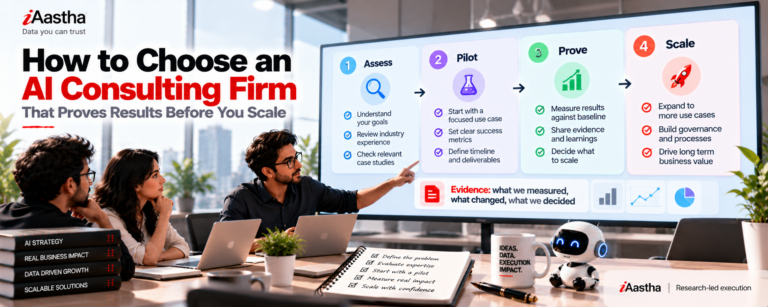
At iAastha, research and delivery sit in the same conversation. The method has four connected stages, and every transition ends with a small evidence card: what we measured, what changed, what we decided.
1 Research2 Build3 Prove4 Scale
Stage 1: Research
Investigate the problem, the data and the constraints before committing to a build. Capture the baseline here: how long the task takes today, how often it is redone, and how often it is completed. Without a baseline, no later result means anything.
Stage 2: Build
Implement against what the research found, not against assumptions. Keep the first build narrow, put it in front of real users, and record what they actually do with it.
Stage 3: Prove
Compare results to the baseline. The evidence card should read the same way to a CTO, a CFO and a delivery lead. If the numbers do not support scaling, the honest answer is to adjust or stop.
Stage 4: Scale
Expand only what the evidence supports. Add users, systems and regions in steps, and keep measuring. Scaling is where a weak pilot turns into an expensive problem, so it should be the most deliberate stage, not the most exciting one.
Responsible AI implementation is part of delivery, not an add-on
Responsible AI implementation means building systems that are safe, explainable enough for the people accountable for them, and compliant with the rules that apply to your sector. It belongs inside every stage, not at the end.
In practice, responsible AI implementation includes data access controls, human review where errors are costly, logging so decisions can be audited, and bias and failure testing before release. The NIST AI Risk Management Framework is a widely used reference for structuring this work, and a capable AI consulting firm should be able to map its delivery steps to it.
Ask how responsible AI implementation is handled on real projects, not just on a policy page. The answer shows how the firm behaves when a deadline is tight.
Interactive checklist: is your team ready to hire an AI consulting firm?
Tick everything that is already true for your team.
We can name one business metric AI should improve.
We know today’s baseline for that metric (time, rework, completion).
A named person owns the data the work depends on.
We have agreed what result would make us stop.
Security and legal reviewers know about the project.
We have budget for a pilot, not only a full rollout.
Our own engineers can take part in delivery and handover.
We have a plan for responsible AI implementation, including human review.
0 of 8 · Start with research: define your metric and baseline first.
Questions to ask any AI consulting firm before you sign
- What baseline will we capture before any build starts?
- What does your evidence card look like at each stage?
- Who from your team stays through handover, and who from ours?
- How do you handle data under NDA, and when can you share client proof?
- What would make you recommend we stop?
- How do you approach responsible AI implementation and audit logging?
Frequently asked questions
What is an AI consulting firm?
An AI consulting firm helps a business decide where AI belongs, builds the first working version, and measures whether it improved a defined business metric.
What is the difference between an AI consulting company and an AI consulting service?
An AI consulting company usually owns delivery of an outcome. An AI consulting service is a defined piece of expertise, such as an architecture review or a vendor evaluation.
Why do AI pilots fail to reach production?
Most stall because there is no baseline, no clear data owner, and no agreed condition for stopping or scaling. Fixing those three before the build removes most of the risk.
What does responsible AI implementation include?
Data access controls, human review where errors are costly, audit logging, and bias and failure testing before release.
Choose evidence over enthusiasm
Choosing an AI consulting firm is a decision about evidence, not excitement. Pick a team that investigates first, builds narrowly, proves results against a baseline, and scales only what holds up. Pair that with a short corporate AI strategy and you can defend every step to your board.
Which stage is your team working through today?