← ALL CASE STUDIES
CASE STUDY — Wiser / Quad Analytix · RETAIL · PRICE INTELLIGENCE · WEB DATA COLLECTION PIPELINE
Wiser / Quad Analytix: Price Data From 300+ Retailer Sites.
Wiser / Quad Analytix sells retail price intelligence, and every number it sells comes from a retailer's website. More than 300 of them, no two alike, many defended against bots, and any of them free to change its pages without warning. Collecting the prices was the easy part. Knowing when they had quietly gone wrong was the hard one.
300+
RETAILER SITES FEEDING ONE NORMALISED PRICE DATASET
EACH SITE WITH ITS OWN LAYOUT AND ITS OWN ANTI-BOT DEFENCES
MARKUP CHANGES CAUGHT BY FAILURE-RATE ALERTS, NOT BY BAD DATA DOWNSTREAM
QUALITY CHECKS BEFORE ANY PRICE REACHES THE ANALYSIS
01 — THE PROBLEM
Three hundred sources, and something is always breaking
The price data had to come from more than 300 retailer sites. Each had its own layout, many ran anti-bot measures, and any of them could change its pages without warning. The business needed prices fresh and reliable enough to trust, and across that many sources, something is always breaking somewhere.
02 — THE PIPELINE
One chain, from schedule to analysis
We built the collection pipeline as one chain of stages. Crawl scheduling decides what to fetch and when. A fetch layer handles proxies, rate limits and, where a site needs it, headless browsers. Extraction parses each retailer's pages. Normalisation and product matching line the same product up across retailers. Then storage, with price analytics on top.
FIG·01 — THE COLLECTION PIPELINE
03 — SILENT FAILURE
A redesign rarely throws an error
The real engineering is in the parts a diagram does not show. When a retailer changes its markup, the fetch usually still succeeds, and the parser quietly returns wrong or empty fields. So we tracked parser failure rates, with alerts on them and fallbacks behind them, so a markup change showed up as a breakage instead of turning up later as bad data. Quality checks ran before anything reached the analysis, to stop bad prices getting through.
The dangerous failure is the one that looks like a success.
FIG·02 — PARSER FAILURE RATE AROUND A MARKUP CHANGE · SCHEMATIC
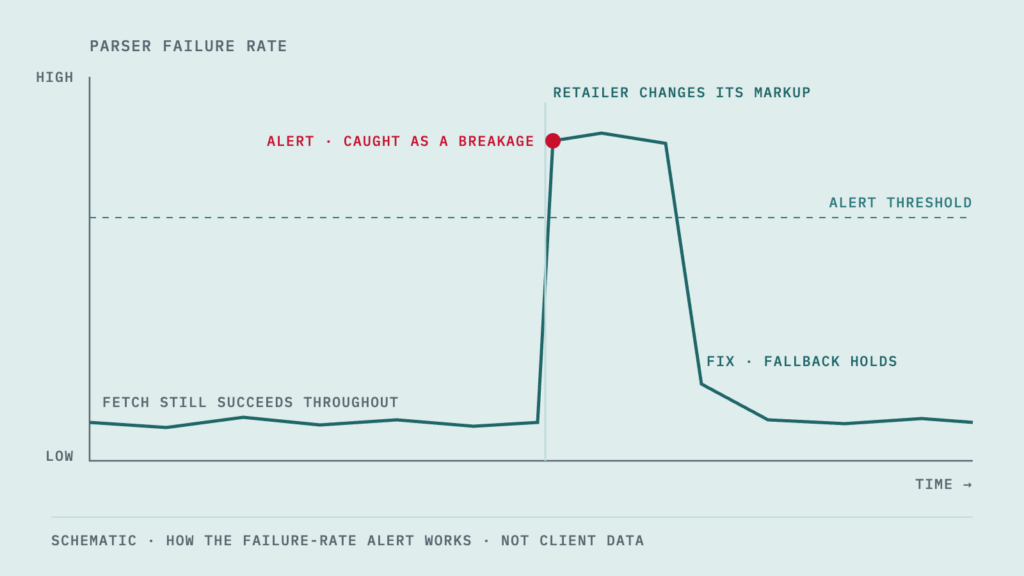
FIG·03 — CATCHING A BREAKAGE THAT THROWS NO ERROR
- 01TrackParser failure rates are measured continuously.
- 02AlertA rise in failures raises an alert.
- 03Fall backFallbacks keep collection going.
- 04CheckQuality checks stop bad prices before the analysis.
04 — THE TRADE-OFFS
Matching products, and paying for freshness
Two problems never go away. The first is matching: the same product is named and described differently on every retailer, and every price comparison depends on lining them up correctly. The second is freshness against cost. Crawling everything constantly is expensive, and crawling too rarely makes the prices stale, so the schedule balances the two. The result is one normalised price dataset across more than 300 sites, where a retailer's quiet redesign is caught before bad prices reach the analysis.
FIG·04 — FRESHNESS AGAINST CRAWL COST
✕ RULED OUTCrawl everything constantlyFresh prices, but expensive.
✕ RULED OUTCrawl rarelyCheap, but the prices go stale.
✓ CHOSENSchedule what to fetch and whenBalance freshness against crawl cost.
Relying on sites that
change without warning?
FAQ