Every Monday, someone in your company makes a decision from a number. What is Data stewardship? Revenue, churn, pipeline, inventory, risk exposure. Now ask a simple question: who is responsible for what that number means, and for whether the data behind it is right?
If the answer is “the data team, I think” or “ask whoever built the dashboard,” you have a gap. This guide explains data stewardship vs data ownership, spells out data owner responsibilities, maps the main data ownership roles, and gives you a practical data ownership matrix and data ownership framework you can use this week.
Data stewardship vs data ownership: what is the difference?
People use the two terms as if they were the same. They are not, and mixing them up is one of the most common reasons governance programs stall.
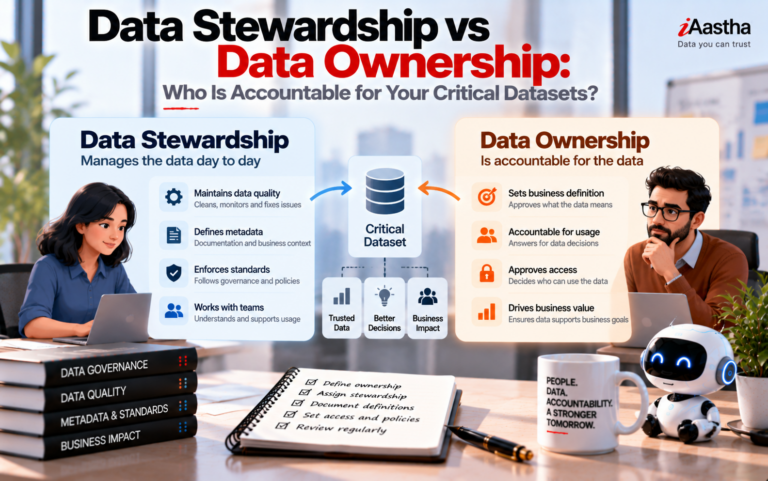
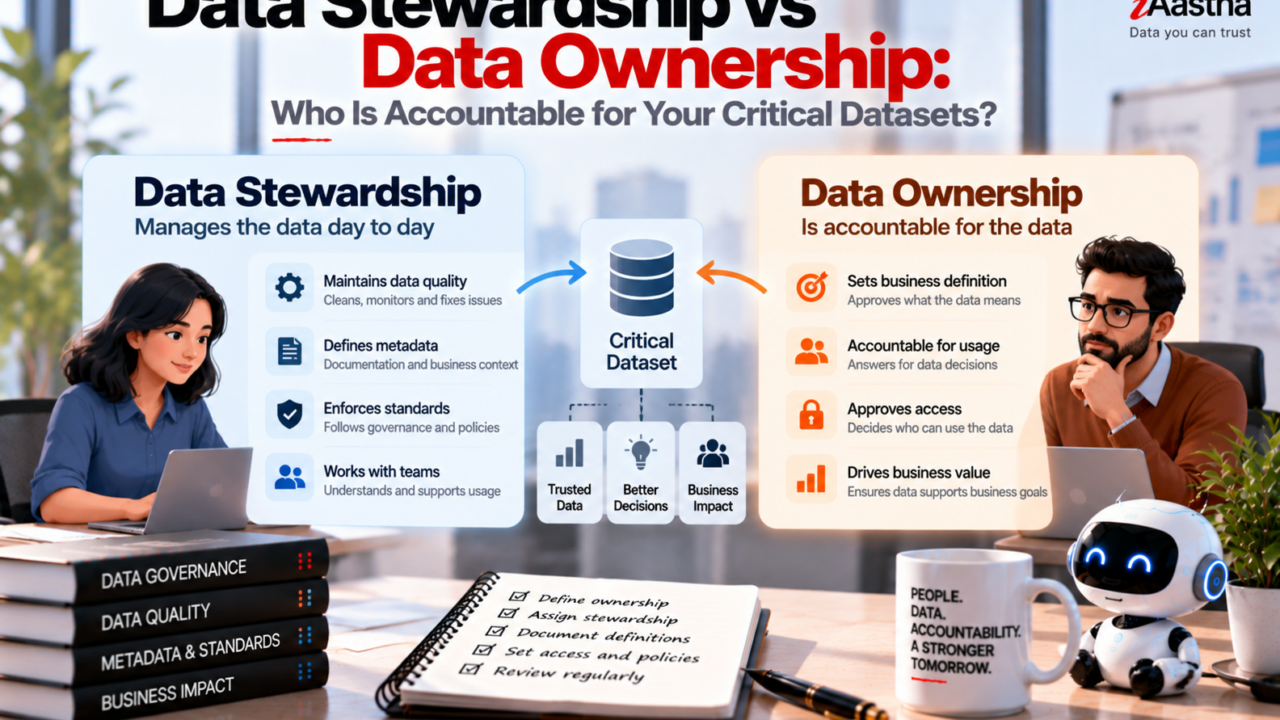
Data ownership is about accountability. The owner is one named person who answers for the dataset: what it means, how good it needs to be, and who may use it. The owner is usually a business or product leader close to the decision the data supports.
Data stewardship is about execution. Stewards maintain the definitions, document fields, monitor quality, and handle the day to day questions and fixes. A steward acts on behalf of the owner.
| Question | Data owner | Data steward |
| Nature of the role | Accountable | Responsible for daily work |
| Typical person | Business or product leader | Analyst, analytics engineer, domain specialist |
| Core output | Decisions on definition, quality bar, access | Documentation, monitoring, issue resolution |
| Number per dataset | One | One or more |
The practical rule: when data stewardship vs data ownership is unclear, escalations bounce between people. When it is clear, a question about a number reaches one person quickly.
Why every critical dataset needs an owner
Without a named owner, the same problems repeat:
- Two teams define the same field differently, and both are “right.”
- Quality problems are found by the person reading the dashboard, not the person producing the data.
- Nobody knows whether a schema change is safe to ship.
- Meetings begin with “which number is correct?” instead of “what should we do?”
Shared responsibility sounds collaborative, but in practice it often means no responsibility. Naming one owner does not remove collaboration. It gives collaboration a place to land.
Data owner responsibilities
Clear data owner responsibilities keep the role from becoming a title with no work attached. A useful owner does five things.
1. Defines the dataset
The owner approves what the dataset contains, what each key field means, and what is out of scope. If a metric has two definitions, the owner decides which one is official.
2. Sets the quality bar
Not every dataset needs perfect data. The owner states what “good enough” means for the decision it supports, such as acceptable completeness, accuracy and freshness.
3. Approves access
The owner decides who may see or use the data, guided by privacy, security and compliance rules set elsewhere in the company.
4. Approves change
Before a field is renamed, a source is swapped, or a calculation is edited, the owner confirms the impact on consumers.
5. Retires the dataset
Datasets that no longer support a decision should be archived. Owners are the people who can say so with authority.
These data owner responsibilities are small on any given day. Their value is that someone holds them.
Data ownership roles: who does what
Strong data ownership roles go beyond the owner and steward. Four roles cover most organizations.
Data owner
Accountable for definition, quality bar, access and change. One per dataset.
Data steward
Maintains documentation, monitors quality, and triages issues for the owner.
Data custodian
Usually engineering or platform. Runs the pipelines and storage, and applies the access and retention rules the owner approves.
Data consumer
Uses the dataset to make a decision. Consumers report problems and should be named, because their needs shape the quality bar and refresh schedule.
Notice what this does for engineering teams: custodians stop being blamed for definition questions, and owners stop being surprised by pipeline changes. Clean data ownership roles reduce friction on both sides.
Build a data ownership matrix
A data ownership matrix is a simple table that lists each critical dataset with its owner, steward, consumers and refresh expectation. It is the quickest way to see where accountability is missing. Here is a small example:
| Dataset | Owner | Steward | Consumer | Refresh |
| Weekly revenue | VP Finance | Finance analyst | Leadership team | Daily by 8 AM |
| Customer churn | Head of Customer Success | Analytics engineer | CS and Product | Weekly, Monday 6 AM |
| Pipeline report | Sales Director | RevOps analyst | Sales managers | Daily by 7 AM |
If you cannot fill in the owner column for a dataset that feeds a weekly decision, that is your starting point. The same three fields, Owner, Consumer and Refresh expectation, fit on a single dataset card. Try building one below.
A simple data ownership framework in five steps
You do not need a large program to begin. A lightweight data ownership framework is enough to prove value.
- Pick one dataset. Choose one that supports a weekly decision, not the largest or messiest one.
- Name the owner. One person, with a business stake in the decision. Confirm they accept the role.
- Fill the dataset card. Record the owner, consumers and refresh expectation.
- Add it to the data ownership matrix. Keep the matrix where people already look, such as your catalog or wiki.
- Review quarterly. Owners change roles. Check the matrix when they do, and extend the framework to the next dataset.
The aim of this data ownership framework is momentum. One dataset with a clear owner teaches the organization what good looks like, and the second one is easier.
Common mistakes to avoid
- Naming a team instead of a person. “The data team” cannot be asked a question or held to a standard.
- Making IT the owner of everything. Engineers run the pipelines, but business meaning belongs to the business. Strong data owner responsibilities sit with the people closest to the decision.
- Skipping the consumer. Without knowing who depends on the data, you cannot set a quality bar or plan changes.
- Treating it as a one time project. Ownership needs a review rhythm or it drifts.
Interactive: does your dataset pass the ownership test?
Think of one dataset behind a weekly decision. Tick what is true today.
I can name one person accountable for its definition.
That person knows they are the owner.
Its consumers are written down.
Its refresh expectation is written down.
Changes to it need the owner’s approval.
Check my score
Frequently asked questions
What is the difference between data stewardship vs data ownership?
The owner is accountable for definition, quality and access. The steward carries out the daily maintenance on the owner’s behalf.
What are the main data owner responsibilities?
Defining the dataset, setting the quality bar, approving access, approving change, and retiring the dataset when it is no longer useful.
What is a data ownership matrix?
A table listing each critical dataset with its owner, steward, consumers and refresh expectation.
How do I start a data ownership framework?
Start with one dataset behind a weekly decision, name the owner, fill in a dataset card, and add it to a shared matrix.
Who should hold data ownership roles?
Business or product leaders who rely on the data for decisions. Engineering usually acts as custodian, not owner.
Conclusion: start with one dataset
Understanding data stewardship vs data ownership is the first step. The second is acting on it. Pick one dataset that supports a weekly decision. Can its users name the person responsible for its definition and quality? If not, start the ownership conversation there.
If you want help designing a data ownership framework for your organization, talk to iAastha about a 20 minute call.