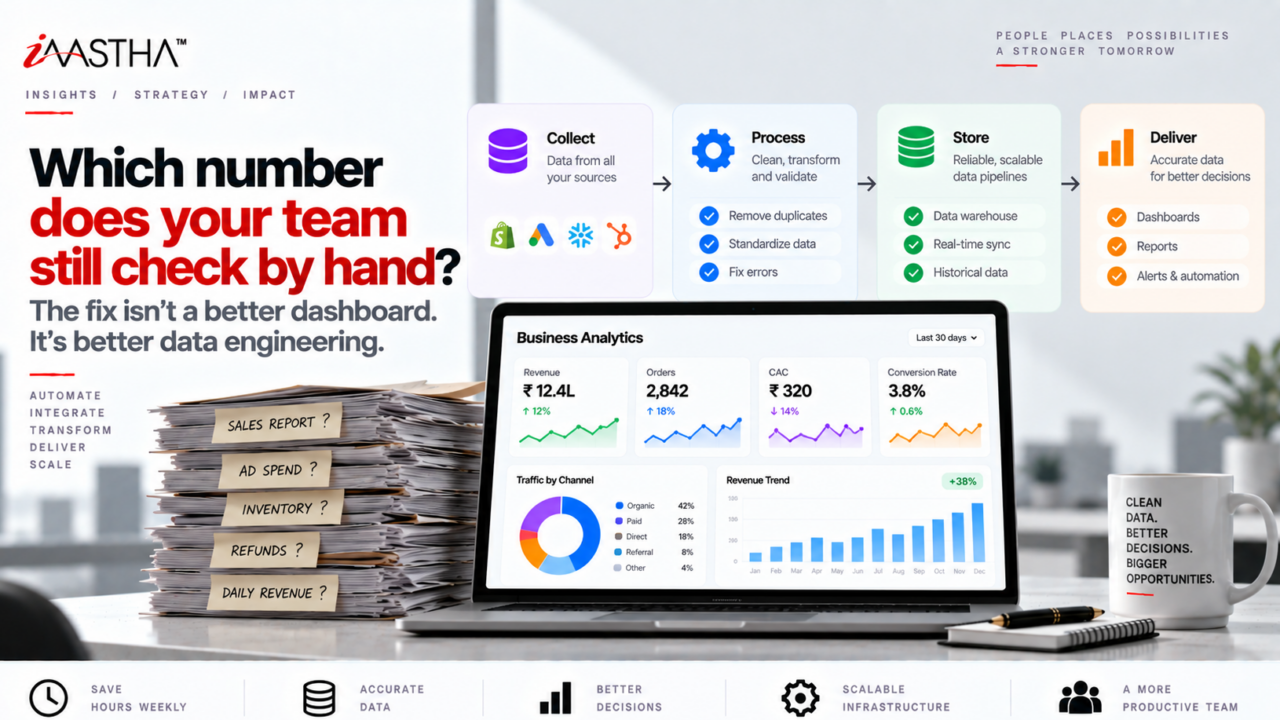
Picture the Monday morning meeting. Someone opens the revenue dashboard, someone else says “that doesn’t match finance,” and ten minutes later the meeting is about whose number is right instead of what to do next.
If that sounds familiar, you are in good company. Most growing companies in the US and UK have at least one figure that somebody still checks by hand before it goes anywhere important. It is rarely a dashboard problem. It is a data engineering problem.
In this guide we will talk through what data engineering consulting actually involves, what good looks like, and how to choose a partner. We will keep it practical and light on jargon. There is also a quick self check in the middle, so you can see where your own team stands.
Why does one number still get checked by hand?
Because the people who use the number do not trust the path it took to get there, and that distrust is usually earned. Data travels from a source system through exports, spreadsheets, scheduled jobs and transformations, and at every step something can change quietly. A source team renames a column. A file arrives late. A currency field gets converted twice. Nobody notices until a report looks odd, and by then the trail has gone cold.
We see three root causes again and again:
- The definition is unclear. “Active customer” means one thing to sales and another to finance.
- The pipeline is a black box. When it breaks, nobody finds out until a person spots a strange chart.
- Nobody owns the data product. Everyone uses it, so no one maintains it.
Adding more dashboards on top only makes the problem louder. The fix sits lower in the stack, in the pipelines and the platform underneath.
What good data engineering looks like
Good data engineering is mostly invisible. It looks like a morning where nobody argues about whose figure is right, because the pipeline flagged the late source file before anyone opened a dashboard, and the definition of the metric is written down where both teams can read it.
It is also usually what has to be true before analytics and AI work stops stalling. A forecasting model or an AI assistant is only as dependable as the data feeding it. Teams that skip this layer often end up rebuilding it later, under pressure.
Our approach: trace, build, observe
Trace: follow the numbers back to the source
Before rebuilding anything, we map your critical fields to their systems of record and write down what each one is meant to mean. It sounds basic, yet it is where most disagreements get settled, because for the first time sales, finance and operations are looking at the same definition on the same page.
Build: design the pipeline and platform together
Ingestion, storage and transformation are built as one thing. Everything is modeled, version controlled and tested, so a change in a source does not quietly turn into a change in a report. We handle both batch and streaming ingestion, depending on how fresh your data needs to be.
Observe: make every pipeline report on itself
Freshness, volume and schema checks run alongside the data. If something breaks, the alert reaches the data team before the report reaches the CEO. Each data product leaves with an owner, a definition and access rules.
Quick check: how much do you trust your data?
Tick everything that is true for your team right now. Be honest, nobody is watching.
A key report is still checked by hand before it is shared
Two teams give different answers to the same metric
You hear about broken pipelines from users, not from alerts
Nobody can say which source system a key number comes from
Metric definitions live in people’s heads or old slide decks
Access to sensitive data is granted ad hoc
If you ticked three or more, a short scoping conversation will probably save you months of firefighting.
Data pipeline monitoring and observability: what to actually check
Observability sounds heavy, but the starting point is simple. Three checks catch a surprising share of problems:
- Freshness: did the data arrive when it should have?
- Volume: did we get roughly the rows we expected, or did half of them go missing?
- Schema: did a column change its name, type or meaning?
Pair these with automated tests on your key transformations and lineage that shows which reports depend on which tables. When something fails, you can see what is affected in minutes instead of days. For mid-sized companies this is usually the best place to start, because it turns silent failures into visible ones.
Warehouse or lakehouse: how to choose
This comes up in almost every engagement, and the honest answer is that it depends on your data and your team.
- A warehouse suits you when most of your data is structured, your questions are mainly reporting and analytics, and you want governed, fast SQL access.
- A lakehouse suits you when you also handle large volumes of semi-structured or unstructured data, such as logs, events or documents, and want analytics and machine learning on one platform.
Many teams end up with a blend. The more important decision is not the brand of tool. It is whether the platform is designed with clear ownership, tested transformations and access rules from day one. A well designed warehouse beats a messy lakehouse every time. If you are a startup or a scaling firm weighing options, start with the questions you need to answer in the next twelve months, then pick the simplest platform that handles them.
Data governance and data contracts without the red tape
Governance has a reputation for slowing teams down. Done well, it does the opposite.
A data contract is simply an agreement between the team that produces data and the teams that use it: here is the shape of the data, here is what it means, and here is how early we will warn you before it changes. Add a catalogue where people can find and understand data products, plus clear access rules for sensitive fields, and you remove a huge amount of guesswork.
This matters especially for US and UK enterprises, where UK GDPR and a growing set of US state privacy laws raise the cost of not knowing where your data lives or who can see it. Keep it light, document the essentials, and give every data product a named owner.
How to choose a data engineering partner in the US or UK
Whether you are searching for data engineering consulting services in the USA or a data engineering company for UK enterprises, a few questions help separate strong partners from the rest:
- Do they start by tracing your numbers and definitions, or jump straight to tools?
- Do pipelines come with testing and monitoring built in, or as an extra?
- Does every data product leave with an owner, a definition and access rules?
- Can they show work in production, not only slides?
- Will they work alongside your team instead of disappearing after handover?
iAastha is a research led execution partner. We validate what is unproven, then build it until it works, embedded inside founder, enterprise, investor and GCC teams. You can read more on our data engineering service page or browse our case studies.