Walk into almost any operations meeting in the US or Europe right now and someone will bring up AI agents. Vendors are pitching them. Consultants are recommending them. LinkedIn is full of posts insisting your company is falling behind without one.
Here’s the part nobody says out loud: most businesses that ask “does my business need an AI agent” don’t actually need one yet. They need a clearer process, cleaner data, or a better piece of software that isn’t an agent at all.
This guide is written for operations leads, founders, and IT decision-makers in the US and EU who want a real answer, not a sales pitch. We’ll walk through what an AI agent actually is, how to decide if you need one, and what changes depending on whether you’re operating under US rules or the EU AI Act.
What an AI Agent Actually Is (and Isn’t)
An AI agent is software that can take a goal, break it into steps, use tools or systems on its own, and complete a task with minimal human input at each step. That’s different from a chatbot that answers questions, and different from a simple automation rule that triggers when X happens, then does Y.
A useful way to separate the three:
- Automation: if this happens, do that. Fixed, predictable, no reasoning.
- Chatbot or assistant: answers questions, drafts text, but a human still does the work.
- AI agent: given a goal, it plans, acts across multiple steps, and adjusts based on what it finds, often with limited human checking in real time.
Most companies that think they want an AI agent actually want the first one. That’s not a failure, it’s usually the cheaper, safer, faster answer.
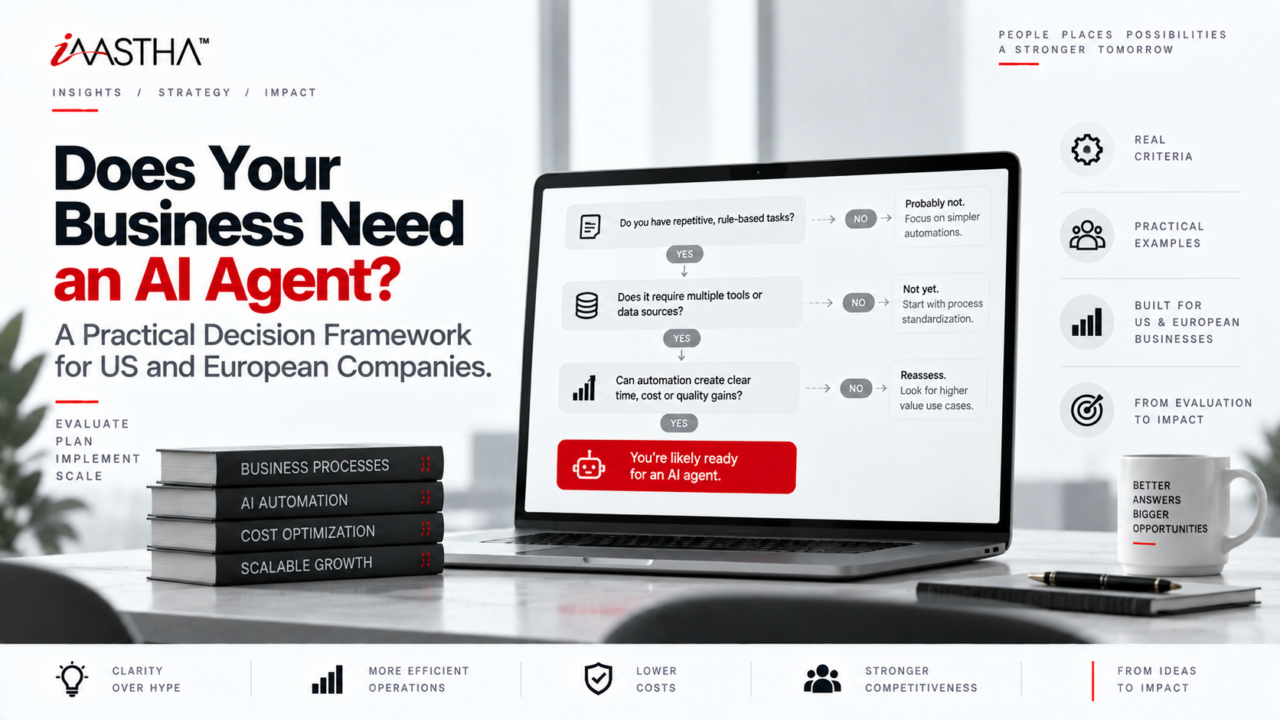
How to Know If Your Business Needs an AI Agent: 5 Questions
If you’re trying to figure out how to know if your business needs an AI agent, run through these five questions honestly before you buy anything or hire anyone to build one.
1. Is the task repetitive and rule based, or does it need judgment?
If a person on your team does the same ten step process fifty times a day, that’s a candidate. Think ticket triage, invoice matching, lead qualification, appointment scheduling. If every single case genuinely needs human judgment, an agent will slow you down and frustrate customers rather than help.
2. Is the volume actually large enough to justify the cost?
Building, testing, and maintaining an agent is not a one time cost. If your team handles twenty of these requests a week, a solid standard operating procedure and a trained person is cheaper and more reliable. If you’re handling two thousand a week, the math changes quickly.
3. Can your business tolerate occasional errors at this scale?
Agents get things wrong sometimes, the same way junior employees do. In low stakes work, like drafting a first pass of content or sorting inbound leads, that’s fine to manage. In regulated or high stakes work, like credit decisions, medical guidance, or hiring screens, you need much heavier guardrails and human review before anything ships.
4. Do you have clean data and clear systems for it to plug into?
An agent is only as good as the systems it connects to. If your CRM, support desk, and internal documentation are inconsistent or outdated, an agent won’t fix that. It will just automate the mess faster and with more confidence than it should have.
5. Is there a human in the loop for anything customer facing or compliance sensitive?
In the US this is mostly about liability, brand trust, and avoiding a bad customer experience going viral. In the EU, this is often a legal requirement, not just good practice, for certain categories of use.
AI Agent vs Automation for Enterprise: Which One Do You Actually Need
This is one of the most common points of confusion for larger organizations comparing AI agent vs automation for enterprise use cases.
Traditional enterprise automation (think workflow tools, robotic process automation, scripted integrations) is predictable. It does exactly what it’s told, every time, and it’s easy to audit. The tradeoff is that it can’t handle exceptions or ambiguity.
An AI agent can handle some ambiguity and make decisions along the way, which is powerful, but it introduces a new kind of risk: unpredictability. For enterprises with strict compliance needs, that unpredictability has to be managed with monitoring, logging, and clear escalation paths back to a human.
A simple rule of thumb: if the process has fewer than five decision branches and no edge cases that require judgment, automation is almost always the better and cheaper choice. If the process regularly hits situations nobody scripted for, an agent starts to make sense, as long as you can afford to build the guardrails around it.
The US Perspective: Speed, Liability, and Customer Trust
US businesses generally move faster on adopting new AI tools than their European counterparts, and the regulatory environment is currently lighter, though this is shifting at the state level with new AI transparency and employment related AI laws appearing in states like California, Colorado, and New York.
The bigger practical concern for US companies isn’t usually regulation yet, it’s liability and trust. If an AI agent gives a customer wrong information about pricing, a refund, or a medical or financial matter, your business is still the one responsible for the outcome. Courts and regulators have already shown they will hold companies accountable for what their automated systems say and do.
For US businesses, the practical takeaway is to treat AI agents the way you’d treat a new, unsupervised employee: give them narrow responsibilities first, monitor closely, and expand scope only once you trust the track record.
The European Perspective: EU AI Act and High Risk Categories
For businesses operating in the EU, the calculation includes a legal layer that US companies mostly don’t have yet: the EU AI Act.
Under EU AI Act high risk AI agent compliance rules, certain use cases (credit scoring, employment decisions, access to essential services, and several others) are classified as high risk. That classification comes with real obligations: documentation of how the system works, human oversight requirements, risk assessments, and audit trails that regulators can request.
This doesn’t mean European businesses can’t use AI agents in these areas. It means the decision to build one has to include compliance costs from the start, not bolted on afterward. A quote from an operations consultant working with mid-size EU manufacturers put it well:
“The companies that get burned aren’t the ones who avoid AI agents. They’re the ones who deploy first and figure out documentation later. In the EU, that order gets expensive fast.”
If your use case touches hiring, credit, healthcare, or anything the AI Act flags as high risk, get compliance and legal involved before the technical build starts, not after a pilot succeeds.
When to Build an AI Agent for Customer Service
Customer service is one of the most common places businesses ask when to build an AI agent for customer service, so it deserves its own section.
Good signals that you’re ready:
- You get a high volume of repetitive, well documented questions (order status, password resets, basic troubleshooting).
- Your existing help center or knowledge base is accurate and current.
- You have a clear, tested path for the agent to hand off to a human when it’s unsure or a customer is upset.
- Leadership is comfortable with the agent making mistakes occasionally, as long as they’re caught quickly.
Signals you’re not ready yet:
- Your documentation is outdated or contradicts itself across teams.
- Most support tickets require checking multiple systems or making judgment calls.
- You don’t yet track what percentage of tickets get resolved correctly, so you won’t be able to measure whether the agent is helping or hurting.
AI Agent Readiness Checklist for Businesses
Use this AI agent readiness checklist for businesses before you approve budget for a build or a vendor contract.
- The task is repetitive, well defined, and happens often enough to matter
- You can name the exact systems the agent needs to access
- Your underlying data and documentation are accurate and current
- You have a clear plan for human review and escalation
- You know what “success” looks like in a measurable way, not just a feeling
- Legal or compliance has reviewed the use case, especially in the EU
- You’re starting with one narrow workflow, not a full department overhaul
- You have a rollback plan if the agent underperforms
If you can’t check most of these boxes yet, that’s not a failure. It just means the answer to “does your business need an AI agent” is “not yet, but here’s what to fix first.”
Common Mistakes Businesses Make When Adopting AI Agents
- Starting with the hardest problem first. Pick the boring, high volume, low risk workflow, not the flashiest one.
- Skipping the data cleanup step. An agent built on messy data will produce confident, wrong answers.
- Treating it as a one time project instead of an ongoing system. Agents need monitoring and updates the same way any software does.
- Ignoring the compliance conversation until after launch, particularly costly for EU businesses under the AI Act.
- Measuring success by “it feels faster” instead of tracking real error rates and outcomes.
Final Thoughts
The honest answer to “does your business need an AI agent” is usually somewhere in between “yes, immediately” and “no, never.” Most businesses in both the US and Europe have at least one workflow that’s a genuinely good fit. Very few businesses are ready to hand over a whole department to autonomous software on day one, and trying to do that is where most expensive failures come from.
Start narrow, measure honestly, keep a human in the loop where it matters, and treat compliance (especially if you operate in the EU) as part of the build, not an afterthought.