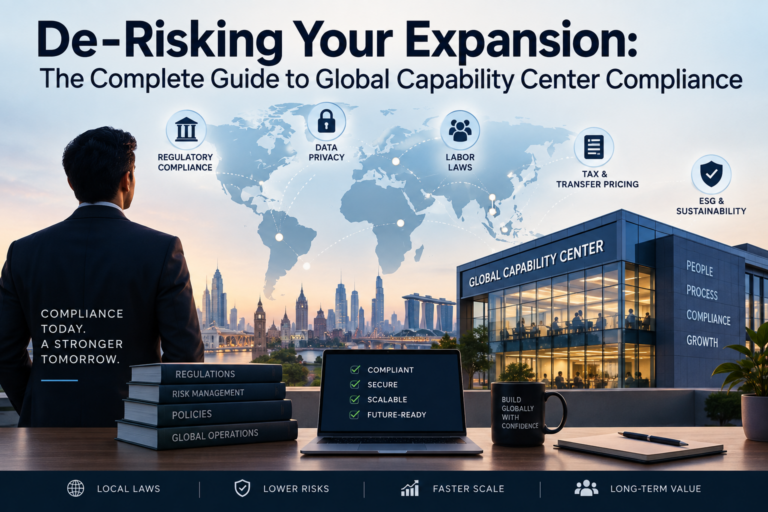
Opening a foreign capability center sounds great on paper. You get access to fresh talent pools, round-the-clock productivity, and operational scale. But let’s be honest: expanding your engineering footprint offshore introduces massive compliance risks if you aren’t careful.
Expanding across borders shouldn’t mean gambling with your corporate security or your regulatory standing. The reality is that navigating complex local data residency laws, transfer pricing regulations, and intellectual property protections takes a lot of upfront, deliberate planning. Our GCC advisory practice treats security as the absolute foundation of the operational model. We vet every single compliance checkpoint before the doors even open.
Why? Because building IT governance, legal pathways, and IP protection strategies directly into your blueprint protects your enterprise from liabilities you didn’t even know existed. It gets the red tape out of the way, allowing your leadership team to focus entirely on scaling strategic growth. Here is exactly how industry leaders are de-risking their expansion today.
The Shift to True GCCs
Ten years ago, “offshoring” usually meant handing low-level tasks to a third-party vendor, signing a service level agreement, and hoping for the best. That era is over. Today, organizations are building Global Capability Centers (GCCs)—fully integrated, wholly-owned extensions of their own parent companies.
Here is the catch: because a GCC is legally part of your enterprise, its regulatory footprint belongs entirely to you. You aren’t just managing a vendor anymore; you are running a foreign business entity. That means risk mitigation can no longer be an afterthought.
Mastering Transfer Pricing and Corporate Tax
If there is one thing tax authorities worldwide love to scrutinize, it’s transfer pricing. In simple terms, this dictates how much your headquarters “pays” its own offshore branch for the work it does. Regulators aren’t blind to corporate loopholes. They use highly sophisticated data-mining tools to make sure you aren’t just artificially shifting profits to lower-tax brackets.
So, how do you survive a tax audit?
- The Arm’s Length Price (ALP): Any transaction between HQ and the GCC has to reflect fair market value. You have to price internal services exactly as if you were buying them from an independent, third-party company.
- Serious Documentation: Forget basic spreadsheets. You need a Master File that maps out your global IP ownership, plus a highly detailed Local File for the specific GCC’s functional and economic data.
- Safe Harbour Regimes: If you are navigating GCC transfer pricing regulations 2026, look closely at Safe Harbour options. In markets like India, IT service GCCs can often opt for a standardized profit margin. You might trade a tiny bit of margin upside, but in return, you buy yourself years of guaranteed tax certainty and zero litigation. It is almost always worth the trade.
- Place of Effective Management (POEM): Regulators want to know where the real decisions happen. If headquarters calls all the shots and local offshore directors just rubber-stamp the paperwork, regulators will notice. Your board meeting minutes need to show genuine, independent local debate.
Navigating Local Data Residency Laws
Data sovereignty isn’t just a headache for your legal team anymore. Today, it dictates your actual IT architecture. Modern privacy laws get incredibly specific about how, where, and by whom sensitive information can be processed.
Look at the GDPR in Europe or India’s DPDP Act. Regulators are watching cross-border data movement closer than ever. A common trap is assuming data residency is simply about where you plug in your physical servers. In reality, the law cares just as much about who has permission to read that information on their monitor. Keeping your capability center out of trouble requires setting up serious encryption and strict access limits. You need eyes on your daily operations so a routine task doesn’t suddenly trigger an international privacy breach.
Embedding IT Governance from Day One
You cannot simply bolt a security system onto a capability center right before launch. IT governance in offshore models has to be baked in from the very beginning. When establishing a foreign capability center, your tech stack needs to match your headquarters’ security posture while dealing with local infrastructure realities.
Start with a Zero Trust Architecture. Just because an employee swiped their badge at the GCC building doesn’t mean their network access is safe. Verify every user and device, every single time. Endpoint security is just as critical. Offshore engineering teams usually have deep access to core backend systems. You need to secure those laptops with mobile device management (MDM) software, disable the USB ports, and rely on virtual desktop infrastructure (VDI) so data literally cannot leave the physical room.
Bulletproofing Your Source Code and IP
If your offshore team is building core algorithms, digital products, or proprietary software, fuzzy IP ownership is a ticking time bomb. You need an absolute guarantee that the brilliant code they write legally belongs to HQ.
Standard, boilerplate offer letters won’t cut it. Effective offshore engineering IP protection strategies require ironclad employment contracts with locally compliant assignment clauses. The second a piece of code is written, it belongs to the parent company. Period.
But it’s not just about legal paperwork; it’s about company culture. Run mandatory security training so your employees know how to spot phishing attempts and understand the heavy legal consequences of IP theft. Additionally, if you are using a Build-Operate-Transfer (BOT) model or bringing in temporary third-party teams to scale up fast, lock them down with strict NDAs and very clear exit clauses.
Building a Governance Framework That Lasts
Checking the compliance box during company registration and then forgetting about it is a rookie mistake. As your GCC adds headcount, expands service lines, and deals with shifting local laws, the regulatory overlap gets messy fast.
Stop working in silos. When HR, Legal, IT, and Finance manage their own distinct areas, things inevitably slip through the cracks. Instead, build a Centre of Excellence (CoE) for global capability centre governance. This team acts as the single source of truth, aligning your global corporate standards with local laws. Take advantage of modern RegTech to automate your compliance monitoring and statutory filings. Shift away from that frantic, once-a-year audit scramble and start running proactive quarterly assessments to catch vulnerabilities before regulators do.
The Bottom Line
Setting up a Global Capability Centre is a massive operational win for any enterprise, but keeping it running smoothly means treating compliance as a continuous commitment. When you proactively tackle transfer pricing, data residency, IT governance, and IP protection, compliance stops being a heavy administrative burden. Instead, it becomes a distinct competitive advantage. Get the foundation right, and your team is finally free to do what they actually showed up to do: innovate.