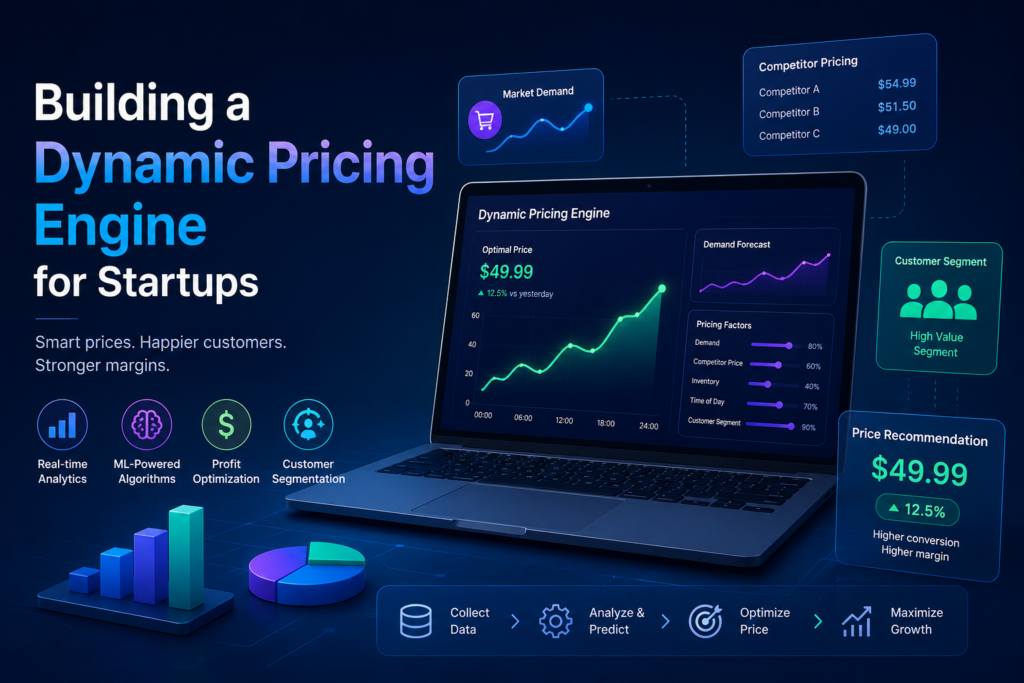
Every founder eventually hits the same wall: the price on the product page was set months ago, and the market has moved on without it.
Why Fixed Pricing Quietly Costs Startups Revenue
Most early-stage products launch with a single number on the price tag — decided once, in a spreadsheet, based on a competitor scan and a gut feeling about margins. For a while, that’s fine. There isn’t enough order volume to justify anything more sophisticated, and the team has bigger fires to fight.
But dynamic pricing software has moved from an enterprise luxury to table stakes. According to market research from The Business Research Company, the global dynamic pricing software market is projected to grow from roughly $4 billion in 2026 to about $6.9 billion by 2030, and small and mid-sized businesses already account for a meaningful share of that growth as cloud-based pricing tools become cheaper to adopt. Startups that stay on static pricing aren’t just leaving money on the table — they’re competing against rivals whose prices already move with demand, inventory, and the competitive set, several times a day.
The problem isn’t that founders don’t understand dynamic pricing conceptually. It’s that most dynamic pricing engine projects they’ve seen quoted are built for retailers with dedicated revenue management teams and seven-figure data platforms — not for a 12-person startup shipping features every sprint.
The Trigger: When Manual Pricing Breaks at Scale
The moment usually looks the same across the startups we work with. Order volume climbs, a competitor undercuts a bestseller overnight, or a flash spike in demand sells out inventory at yesterday’s price — and by the time someone notices in a dashboard and manually edits the price, the opportunity (or the loss) has already happened.
That lag is the real cost. It’s not that the team lacks pricing strategy; it’s that the strategy lives in someone’s head and a spreadsheet, disconnected from what’s actually happening in the market right now. Once a founder sees a competitor’s price move three times in a day while theirs hasn’t moved in three months, the question changes from “should we do dynamic pricing” to “how do we build this without hiring a pricing team we can’t afford yet.”
That’s the point at which we typically get pulled in.
Building the Data Foundation: From Scattered Signals to a Live Feature Store
A real-time pricing engine is only as good as the signals feeding it, and for most startups those signals are scattered: competitor prices sitting in a scraper’s CSV export, inventory counts in the store backend, and behavioral data (searches, cart adds, abandonment) trapped in analytics tools that don’t talk to each other.
The first engineering problem we solve isn’t the pricing model — it’s ingestion. We stream competitor feeds, inventory levels, and behavioral events into a governed data layer, then sit a lightweight feature store on top of it. The distinction matters: a feature store means that when the pricing model evaluates elasticity at the moment of a customer’s click, it’s reading the market as it actually looks right now, not a snapshot from last night’s batch job. For a startup, this is usually the single biggest jump in pricing accuracy — not a smarter algorithm, but fresher data reaching the algorithm at all.
Inside the Engine: Forecasting, Guardrails, and Explainable AI
With clean, current data in place, the next layer is the forecasting model itself. Rather than relying on rigid if-then rules that break the first time the market does something unexpected, we build AI pricing engine logic around probabilistic demand forecasting — estimating a range of likely outcomes with confidence levels, rather than a single fragile number.
This works better when it accounts for behavior, not just transactions. A customer who abandons a cart at a certain price point, browses discount-heavy categories, or responds to bundling is telling you something an average conversion rate can’t. Blending transactional history with these behavioral signals lets the model distinguish deal-sensitive buyers from convenience buyers, and price accordingly — an approach consistent with research showing that pricing models incorporating behavioral signals tend to outperform pure historical-demand models in live markets.
AI-powered pricing without limits is a liability, not a feature — one algorithm undercutting another in a live feedback loop can spiral a price to zero in minutes. So every engine we build has hard-coded guardrails: price floors, ceilings, and parity rules that no model output is allowed to violate, regardless of what the forecast suggests.
Trust is the harder problem, and it’s usually underestimated. A founder won’t approve a 20% price swing on their bestseller because a model said so — they’ll approve it once they can ask why and get a real answer. That’s why we treat explainability as a first-class feature, not an afterthought: surfacing the specific demand signal, competitor move, or elasticity threshold that triggered a price change, in plain language, so a non-technical founder can audit the decision in seconds instead of requesting a data pull.
Testing Before It Touches Revenue
Pricing logic that hasn’t been tested against real market reactions is a risk no startup can afford — a single bad price change can tank a bestseller’s conversion rate overnight. So before any new pricing rule reaches production, we run it through a simulation environment that models second-order effects: how a competitor might respond, how demand might shift, how a discount or bundle changes customer behavior before it’s live.
We treat every pricing strategy the way a good engineering team treats code: version it, test it, and keep a record of exactly which model and configuration produced which price. That discipline is what turns pricing from a one-off spreadsheet decision into something a lean team can run safely without a dedicated pricing analyst watching it around the clock.
What a Lean Dynamic Pricing Engine Looks Like in Practice
The startups that get the most value out of dynamic pricing for startups projects aren’t necessarily the biggest — they’re the ones with enough transaction and behavioral data to make the model worth building, and enough pricing volatility (marketplace competition, seasonal demand, limited inventory) that a manual process genuinely can’t keep up. E-commerce, D2C subscription products, and SaaS tools with usage-based components tend to see the fastest payback, since a dynamic pricing software for ecommerce setup can start delivering signal within the first pricing cycle rather than months into a rollout.
None of this requires an enterprise data platform on day one. What it requires is getting the ingestion layer right, keeping the forecasting model interpretable, wrapping it in guardrails a founder actually trusts, and testing every change before it touches a real customer. Build it in that order, and dynamic pricing stops being an enterprise feature you’ll “get to eventually” and becomes infrastructure a small team can run and understand.
Frequently Asked Questions
What is a dynamic pricing engine, in simple terms?
It’s a system that adjusts product prices automatically based on live signals — demand, competitor pricing, inventory levels, and customer behaviour — instead of relying on prices set manually and left unchanged for weeks or months.
Is dynamic pricing software only useful for large enterprises?
No. While early dynamic pricing tools were built for large retailers and airlines, cloud-based, modular versions are now accessible to startups and SMEs, which is a major driver behind the market’s projected growth toward $6.9 billion by 2030 (per The Business Research Company).
How is an AI pricing engine different from simple rule-based pricing?
Rule-based pricing follows fixed if-then logic (“drop price 5% if inventory exceeds X”) and breaks down in volatile markets. An AI pricing engine forecasts a range of likely demand outcomes and adjusts based on live data and behavioural patterns, which adapts better to conditions the original rules never anticipated.
Will a dynamic pricing engine set prices without human oversight?
It shouldn’t. A well-built engine includes guardrails — price floors, ceilings, and parity rules — plus explainability features so a founder or pricing lead can see exactly why a price changed before (or immediately after) it happens, rather than discovering it after the fact.
How long does it take to build a real-time pricing engine for a startup?
It depends heavily on how clean and centralised the underlying data already is. Startups with organised transaction and inventory data can often get a first working version live faster than those still consolidating data from multiple disconnected tools; the data foundation, not the pricing model, is usually the long pole.