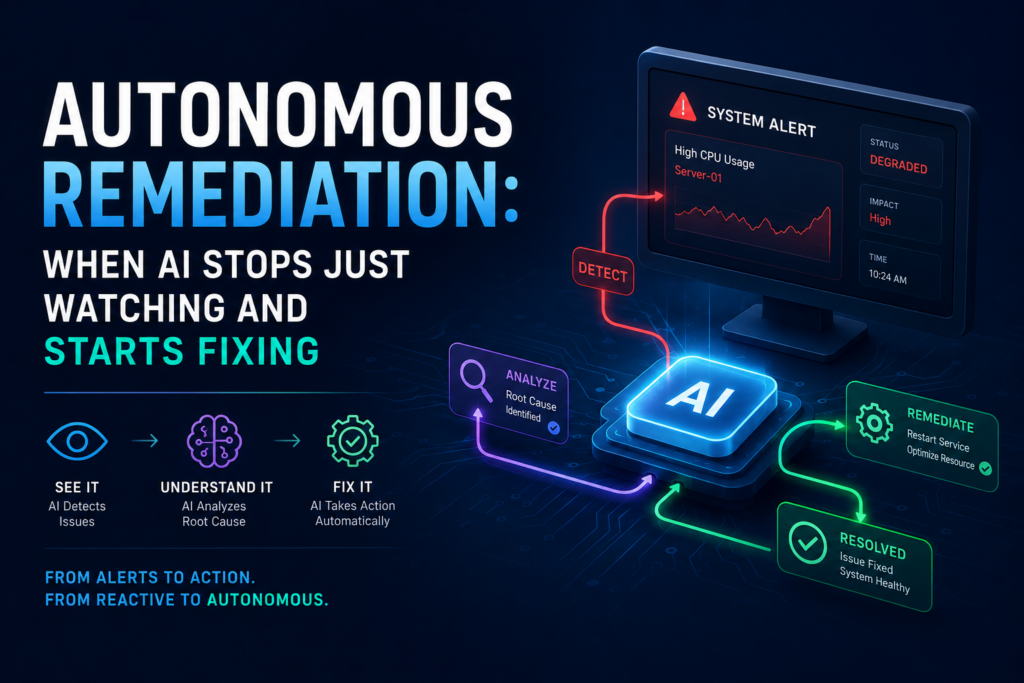
Most enterprise IT and data teams have spent the better part of a decade building extraordinary observability — dashboards that light up the instant something breaks, alerts that reach an engineer’s phone within seconds, lineage graphs that trace how one failure ripples through a dozen downstream systems. What almost none of them built is a system that closes the loop. Autonomous remediation is what closes it.
This isn’t a hypothetical shift. It’s already reshaping how analyst firms categorize the market, and it’s the question nearly every CTO we talk to across the GCC eventually asks: we can see the problem the moment it happens — why do we still need a person to fix it?
The Observability Boom Solved Half the Problem
Over the last decade, the market answered one question extremely well: how do we know something is wrong, fast? Datadog, Splunk, PagerDuty, ServiceNow, and a dozen category leaders built genuinely excellent tools for detection, correlation, and alerting. Gartner itself defines AIOps as the combination of big data and machine learning “to automate IT operations processes, including event correlation, anomaly detection, and causality determination.”
But detection was never the expensive part. The expensive part is everything that happens after the alert fires: an engineer is paged at 2am, opens a dashboard, traces the anomaly backward through a lineage graph that may already be stale, forms a hypothesis, tests it, applies a fix, and validates that the fix actually worked. That loop can take minutes for a simple restart or hours for a subtle data quality issue — and every minute is billable in the most literal sense. Industry research, including Splunk and Cisco’s Hidden Costs of Downtime report, puts average unplanned downtime at roughly $15,000 a minute across organizations of every size, with sector-specific studies showing that figure climbing past $1 million an hour once you’re inside banking or healthcare infrastructure.
For the fintech, healthtech, and government platforms we work with across Dubai and the wider GCC, that arithmetic isn’t abstract. A payments platform degraded for twenty minutes during a settlement window, or a hospital records system that lags during a shift change, has consequences that show up in regulator conversations, not just support tickets.
One Day, the Question Changed From “What Broke?” to “Why Isn’t It Fixed Yet?”
The market itself is signaling this shift. Some analysts have started moving away from the crowded “AIOps” label altogether: reporting suggests Gartner reframed its “AIOps Platforms” category in 2025 into a narrower “Event Intelligence Solutions” grouping, partly because the AIOps label had come to mean little more than detection-and-correlation tooling for so many vendors. Once an AI system is already good enough to detect an anomaly, correlate it with the right root cause, and produce a confident diagnosis, the next question answers itself: if the system already knows what’s wrong and how to fix it, why is a human still the one clicking the button?
That’s what autonomous remediation actually means: an AI system that completes the full loop — detect, investigate, diagnose, and act — without waiting for a person to authorize each individual step. It isn’t “smarter alerting.” It’s the difference between a system that tells you your payment queue is backing up and a system that clears the stuck queue, restarts the failed worker, and logs exactly what it did and why.
What Changes the Moment an Agent Can Act, Not Just Alert
This is where most autonomous remediation pitches quietly get harder than they sound. A monitoring tool that’s wrong is an annoyance — a false alert wastes ten minutes. An autonomous agent that’s wrong on production infrastructure is a different category of risk entirely. The moment a system moves from alerting to acting, three requirements move from nice-to-have to non-negotiable:
- Clear boundaries on exactly what the agent is allowed to touch, and what always escalates to a human.
- Transactional, auditable actions — every remediation has to be logged as it happens, not reconstructed afterward from scattered logs.
- A rollback path — if a fix doesn’t work, or makes things worse, the system needs a defined way back to a known-good state.
None of these are model problems. They’re architecture and governance problems, and they’re usually the real reason autonomous remediation projects stall — not because the AI can’t diagnose the issue, but because nobody has designed the guardrails around what it’s allowed to do next.
The Harder Problem Is Trust, Not Technology
The pattern holds even outside pure infrastructure remediation. When we helped BotSupply, a Copenhagen-based conversational AI platform, move from manual conversation triage to intelligent automated routing ahead of its Oracle and IBM enterprise rollout, resolution time dropped by 80%. The underlying models didn’t change dramatically — what changed was that the team built enough confidence in the automation’s boundaries to let it own a well-scoped decision end to end. That’s the pattern that shows up everywhere autonomous remediation succeeds: it isn’t adopted all at once. It’s earned, one narrow, low-risk, high-frequency decision at a time.
For regulated industries — banking, insurance, healthcare, government — that trust-building process is also a compliance conversation. A security or risk team won’t sign off on an AI agent that can touch production systems without first seeing exactly what it can and can’t do, and proof that every action it takes is logged to the same standard as a human operator’s. The sequencing that tends to work in practice — and the one we recommend to clients evaluating their first remediation use case — starts with a narrow, reversible action: clearing a stuck cache, restarting a known-safe worker, re-routing traffic away from a degraded node. Scope expands only after that first case has run clean, with a full audit trail, for a defined period.
Where to Start If You’re Considering Autonomous Remediation
- Audit your last quarter of incidents. How many were low-risk, repetitive, and already well understood by your team?
- Pick one or two candidates for full automation — not the whole backlog. The goal is a clean track record, not broad coverage on day one.
- Define the guardrails and rollback path before writing any remediation logic. This is a design exercise, not an afterthought.
- Instrument everything more thoroughly than feels necessary. The audit trail is what earns the next expansion of scope, especially with compliance and risk teams.
- Expand only after the first cases have run clean for a defined window — then repeat.
This is the kind of decision — where automation should sit in an operations stack, and how much autonomy to hand it — that tends to define whether a transformation program compounds or stalls. It’s the same territory we work in with clients across AI & Data Intelligence and Managed Services engagements: advising on the architecture first, then building and operating the system that has to run at 2am without anyone watching.
If you’re weighing where autonomous remediation fits in your own stack, talk to us — we’ll tell you candidly what’s worth automating now and what isn’t.
Frequently Asked Questions
What is autonomous remediation?
Autonomous remediation is when an AI system completes the full incident lifecycle — detecting an anomaly, investigating its cause, diagnosing the fix, and applying it — without a human approving each step. The system still logs what it did and why; a person simply isn’t required in the loop for routine cases.
How is autonomous remediation different from AIOps?
AIOps is the broader practice of applying machine learning to IT operations — mainly detection, correlation, and analysis. Autonomous remediation is the subset focused specifically on taking action: closing the incident rather than just surfacing it. It’s also why some analysts have started splitting “Event Intelligence” (detection and correlation) apart from remediation as a separate, more advanced capability.
Is autonomous remediation safe for regulated industries like banking or healthcare?
It can be, but it has to be designed for that from the start — with strict boundaries on what the agent can touch, transactional audit logging, and a rollback path for every action. Most regulated organizations start with a small number of low-risk, reversible remediations and expand scope only after building an audit trail that satisfies their compliance and risk teams.
What’s the first step to adopting autonomous remediation?
Start by auditing your last quarter of incidents to find the ones that are frequent, low-risk, and already well understood — a stuck queue, a known-safe service restart, a routine cache clear. Automate one or two of those first, prove the guardrails and audit trail work, and expand from there. Trying to automate the entire incident backlog on day one is the most common way these projects stall.
Does autonomous remediation replace DevOps or SRE teams?
No — it removes the repetitive, well-understood portion of their workload so they can spend more time on incidents that genuinely need human judgment, and on the architecture work that prevents incidents in the first place. Organizations that adopt it successfully tend to treat it as added capacity, not a headcount reduction.