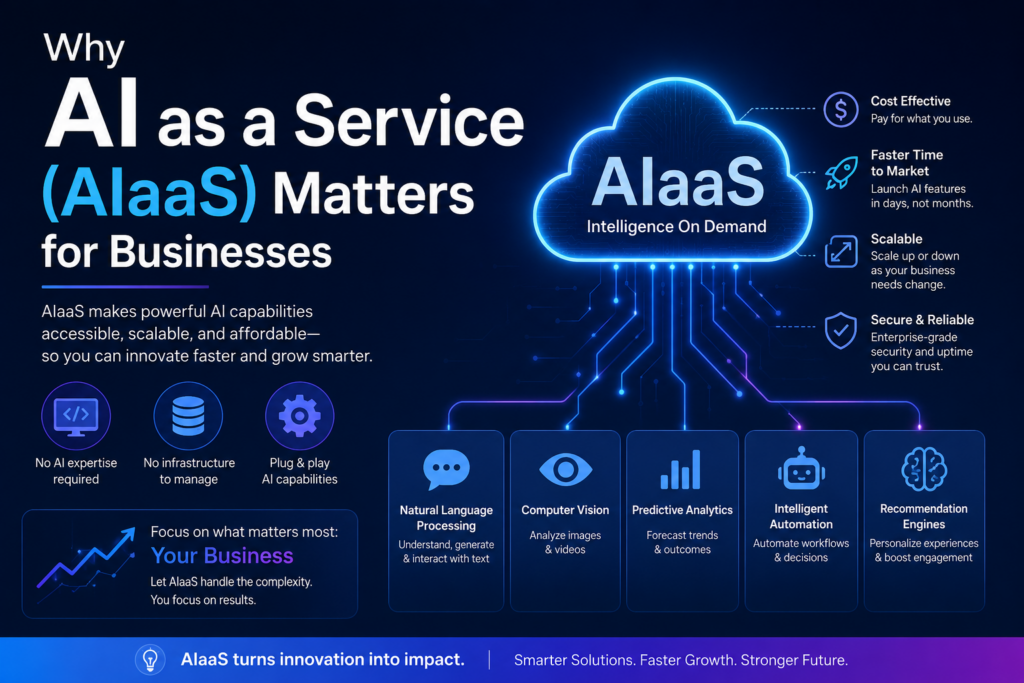
AI as a Service removes the biggest barriers to AI adoption. Discover how AIaaS helps businesses cut costs, move faster, and compete—without building everything from scratch.
The Old Reality Where Only Giants Could Play with AI
For many years, artificial intelligence existed as an exclusive club that only large corporations could join. These organisations had the money to buy powerful servers and hire teams of expert researchers who spent months building custom machine learning systems. Most smaller businesses watched from the sidelines, understanding the potential but lacking the capital and specialized talent needed to get started.
This situation created frustration for business leaders who saw competitors using AI for better customer experiences and smarter operations. They knew the technology could transform their companies, but found the costs and complexity far too high. Hiring even one data scientist often exceeded their entire technology budget, leaving innovation stuck in planning rather than becoming a reality.
The growing gap between large enterprises and everyone else became more obvious each year. While big companies automated processes and gained insights from data, smaller organisations continued using manual methods and basic tools. This divide limited growth opportunities and made it harder for ambitious businesses to compete in a technology-driven marketplace.
The Daily Frustrations That Slowed Business Innovation
Every day teams inside typical companies spent countless hours on repetitive tasks that added little real value. Staff members answered the same customer questions repeatedly, manually sorted through spreadsheets looking for patterns, and made decisions based on incomplete information or simple intuition. These outdated approaches led to mistakes, wasted resources, and slower responses to changing market conditions.
Business leaders felt constant pressure as they watched their teams work harder without achieving the efficiency gains they knew were possible with modern technology. Innovative ideas for improving products or services often remained on whiteboards because testing them required resources the company simply did not have. The daily reality involved doing more with less while knowing smarter solutions existed but stayed out of practical reach.
This ongoing struggle affected morale across departments and slowed overall progress. Marketing teams could not create truly personalized campaigns. Operations managers lacked accurate tools to predict demand and reduce waste. Customer support staff handled routine inquiries instead of focusing on complex problems that needed human judgment. The frustration built as opportunities slipped away quarter after quarter.
The Moment AI as a Service Opened New Doors
Cloud providers then introduced AI as a Service, a new model that changed everything for organizations of all sizes. Companies such as Microsoft Azure, AWS, and Google Cloud started offering pre-trained AI models and easy-to-use APIs through simple subscriptions. Businesses no longer needed to build expensive infrastructure or assemble large teams of specialists just to begin using intelligent capabilities in daily operations.
This development meant that powerful tools for understanding language, recognizing images, predicting outcomes, and generating content became available without massive upfront costs. A small retailer could add smart inventory tools. A service company could launch helpful chatbots that worked around the clock. The advanced technology that once required years of development now became accessible within days through well-managed cloud platforms.
The change represented a major shift toward making artificial intelligence available to everyone rather than keeping it reserved for only the largest players. Organizations that had previously watched AI progress from afar suddenly had a realistic way to participate. They could direct their energy toward solving specific business problems and integrating useful solutions instead of worrying about hardware or the difficult task of maintaining complex systems over time.
The Powerful Changes That Followed Easy AI Adoption
Companies that embraced AI as a Service began seeing meaningful improvements in their operations within a short period. Support teams handled more inquiries efficiently by using intelligent chatbots for common questions while directing difficult cases to human agents. Operations groups used predictive tools to forecast demand more accurately, which helped lower costs and improve service levels. Marketing departments delivered more relevant experiences that increased customer engagement and sales.
These positive results encouraged teams to explore additional applications across the organization. What started as limited tests often grew into larger initiatives as leaders gained confidence from seeing clear returns. The ability to try new approaches quickly and affordably shortened innovation cycles dramatically. Groups that once waited months for results could now test ideas and measure impact in days, then refine their strategy based on actual performance data.
At the same time, these changes required careful planning and active management to succeed over the long term. Businesses learned that simply connecting to an AI service was not enough. They needed to think about how outputs would fit into existing workflows, how to keep data accurate and secure, and how to ensure automated decisions matched company standards. The teams that approached AIaaS strategically achieved the most consistent and valuable outcomes.
How AIaaS Finally Made Advanced Intelligence Accessible to All
AI as a Service has now transformed what businesses of any size can achieve with intelligent technology. Organisations that once operated at a clear disadvantage have gained access to powerful capabilities that were previously available only to industry leaders. This shift allows smaller companies to compete more effectively, deliver better experiences to their customers, and pursue growth opportunities that would have been unrealistic without these tools.
The broader impact goes beyond individual features or use cases. Leaders have changed how they think about technology investments and innovation. Instead of asking whether they can afford to explore AI, they now focus on finding the best opportunities and selecting the right partners to help them succeed. The discussion has moved from basic feasibility to questions of smart strategy, responsible implementation, and long-term value creation.
For business leaders prepared to take action, the opportunity has never been more open or practical. Beginning with a focused pilot project in one key area lets teams build experience, demonstrate results, and develop confidence gradually. AI as a Service has removed the old obstacles and created real possibilities for any organisation ready to start building a more efficient and competitive future.
Frequently Asked Questions
What is AI as a Service (AIaaS)?
AI as a Service is a cloud delivery model that gives businesses access to advanced artificial intelligence tools through APIs and subscription plans. It provides pre-trained models for language processing, image recognition, predictive analytics, and generative AI without requiring companies to build their own infrastructure or maintain large teams of specialists.
How does AIaaS benefit small and medium-sized businesses specifically?
AIaaS gives smaller businesses access to the same high-quality AI capabilities used by large enterprises at a much lower cost. They can automate routine work, gain valuable insights from data, improve customer interactions, and test new ideas rapidly without needing expensive hardware or hard-to-find specialised talent.
What are the main benefits companies see after adopting AI as a Service?
Businesses commonly report faster results with lower upfront investment, improved efficiency through automation, better decision-making supported by advanced analytics, and the flexibility to scale AI usage according to changing needs. Many also see higher customer satisfaction from quicker responses and more personalized service.
What challenges should businesses consider before adopting AIaaS?
Important considerations include protecting data privacy when working with external providers, avoiding excessive dependence on a single vendor, ensuring AI recommendations are accurate and fair, and keeping appropriate human oversight on important decisions. Companies should also review how providers handle data and model transparency.
How should a company begin its journey with AI-as-a-Service?
Start by selecting one clear business challenge where AI could help, such as improving support response times or forecasting inventory needs. Then evaluate established providers like Microsoft Azure, AWS, or Google Cloud and run a small, measurable pilot project while tracking outcomes closely before expanding further.