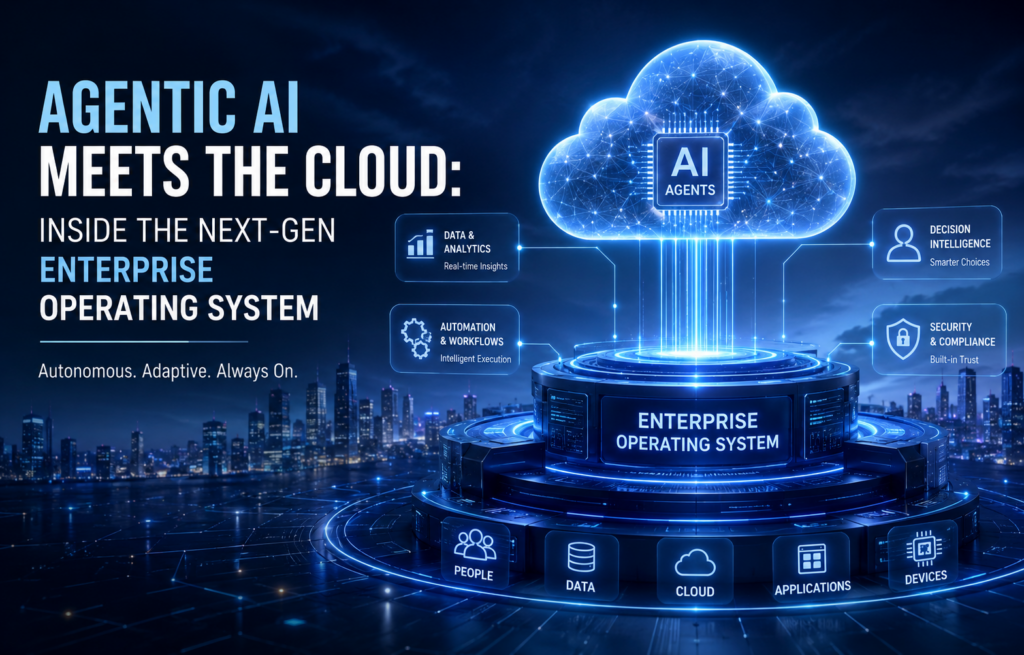
Every founder and CTO we talk to at iAastha is wrestling with some version of the same question right now: how much of the business can actually run itself? Not “automate a workflow here and there” — genuinely run itself, with software that plans, decides, and acts across the tools a company already relies on. The honest answer today is: less than most vendors are promising, but more than most teams have built. The gap between those two numbers is where the next-gen enterprise operating system is being built — one part agentic AI, one part cloud-native architecture, one part hard-won interoperability.
The Enterprise Stack Wasn’t Built to Talk to Itself
Most growing companies run on a patchwork: a CRM here, a billing tool there, a homegrown internal dashboard, a spreadsheet that “just works” until it doesn’t. Each system was chosen for a good reason at the time. None of them was chosen with the others in mind.
That patchwork isn’t a failure of planning — it’s just what happens when a business grows faster than its architecture. But it creates a quiet tax that compounds over time: data locked in silos, manual reconciliation between systems, and people spending real hours each week just moving information from one place to another so it can be acted on somewhere else.
Every Day, Teams Pay the Interoperability Tax
That tax shows up in familiar ways. A support ticket gets logged in one tool, but the context a rep needs lives in three others. A finance team closes the books by exporting CSVs and stitching them together by hand. An operations lead builds a “single source of truth” dashboard that’s stale the moment someone updates the underlying system it doesn’t sync with.
None of this is dramatic on any single day. That’s exactly why it’s dangerous — it becomes the accepted cost of doing business, absorbed into headcount and overtime rather than questioned as an architecture problem. Search interest in cloud interoperability has stayed steady for exactly this reason: it’s a persistent, unglamorous pain point, not a passing trend.
One Day, Agentic AI Changes What’s Actually Possible
The shift underway isn’t just “AI got better at writing text.” It’s that AI systems can now plan a multi-step task, call the right tool or API for each step, check their own work, and hand off to a person only when judgment is genuinely required. That’s the practical definition of agentic AI, and it’s why 2026 looks different from the chatbot-era hype of a few years ago.
The scale of the shift is real, but so is the gap between ambition and readiness. According to Gartner’s 2026 CIO and Technology Executive Survey, only 17% of organisations have deployed AI agents so far, even though more than 60% expect to do so within the next two years — among the most aggressive adoption curves Gartner tracks for any emerging technology. Separately, Gartner has projected that roughly 40% of enterprise applications will be integrated with task-specific AI agents by the end of 2026, up from less than 5% in 2025.
What’s making this possible isn’t just smarter models — it’s the emergence of open standards like the Model Context Protocol, which let agents connect securely to a company’s existing data and tools instead of requiring a rebuild from scratch. That’s the “interoperability” half of the equation, and it’s arguably the less-discussed but more decisive one.
What an Agentic, Cloud-Native Operating Model Actually Looks Like
Because of that convergence, the shape of a modern enterprise “operating system” is becoming clearer. It sits in the layer between the systems a company already runs (its ERP, its CRM, its data warehouse) and the interfaces its people and customers actually touch. In that middle layer, agents:
- Pull real-time, unified context from systems that used to sit in silos
- Execute multi-step tasks — reconciling records, routing approvals, drafting responses — without needing a human to babysit each step
- Escalate to a person for the exceptions and judgment calls that genuinely need one, rather than routing everything through a human by default
This is a meaningfully different design than the “RPA with a chatbot on top” approach many companies tried a few years ago. It’s built cloud-native from the start, so it scales with usage instead of requiring new infrastructure every time a workflow changes.
Where Most Agentic AI Rollouts Actually Stall
Because of that same complexity, scaling agentic AI is proving much harder than piloting it. The gap between the 17% who’ve deployed agents and the majority still experimenting isn’t mainly a technology problem — it’s an operating model problem. Three patterns show up repeatedly:
Fragmented data undermines even good agents. An agent is only as reliable as the context it can pull. If customer data lives in four disconnected tools with three different definitions of “active customer,” no amount of agent intelligence fixes that at the source.
Governance gets bolted on late. Analysts have flagged agent projects being deployed faster than organisations can build the guardrails to manage them safely — a direct contributor to Gartner’s widely cited estimate that more than 40% of agent projects will fail by 2027, often due to unclear ownership, unproven ROI, or inadequate risk controls rather than the underlying model failing to perform.
Use case selection is too broad, too soon. Teams that try to “agentify everything” at once tend to lose the plot on measurable value. The rollouts that hold up are the ones that start with a narrow, high-friction, well-understood process — and expand only once that one is genuinely working end to end.
Building Your Own Path to an Agentic Operating Model
Until finally, the businesses that get ahead here aren’t necessarily the ones with the biggest AI budgets — they’re the ones treating this as an architecture and operating-model decision, not just a tooling purchase. In practice, that means:
- Start with the data layer. Unify and clean the context agents will actually draw on before layering intelligence on top of it.
- Pick one narrow, painful workflow first. Prove the pattern — plan, execute, escalate — on something small enough to fully understand and measure.
- Design for human oversight from day one, not as an afterthought once something goes wrong.
- Build on interoperable, cloud-native foundations so the system can absorb new tools and workflows without a rebuild each time.
This is the kind of work iAastha does with founders and growth-stage teams every day: pairing hands-on engineering with a clear-eyed view of which agentic use case actually deserves to go first. [Add a specific iAastha client outcome or engagement example here, with real, verifiable numbers, once available.]
The convergence of agentic AI, cloud infrastructure, and interoperability isn’t a future trend to prepare for — it’s already reshaping how competitive companies operate today. The question worth sitting with isn’t whether to adopt it, but which single workflow you’d trust an agent to own first.
Frequently Asked Questions
What is agentic AI, in plain terms?
Agentic AI refers to AI systems that can plan a multi-step task, choose and use the right tools or data sources for each step, and adapt when something doesn’t go as expected — rather than simply responding to a single prompt. The key difference from a chatbot or basic automation is the ability to pursue a goal across several steps with minimal human input at each one.
How is agentic AI different from traditional automation or RPA?
Traditional robotic process automation (RPA) follows fixed, pre-programmed rules and breaks when the underlying process changes even slightly. Agentic AI is designed to reason about a task, adapt its approach, and handle variation — though it still needs well-governed data and clear boundaries to do that reliably.
What does “enterprise operating system” mean in an AI and cloud context?
It describes the connective layer that lets a company’s core systems (like its ERP or CRM), its AI agents, and its human teams work from the same real-time context — rather than each operating on its own island of data. Cloud-native infrastructure and interoperability standards are what make that shared layer possible at scale.
What’s the biggest risk in scaling agentic AI too quickly?
The most common failure pattern isn’t the AI underperforming — it’s organisations deploying agents faster than they build the governance, oversight, and clear ownership needed to manage them safely, which analysts point to as a leading cause of stalled or abandoned agentic AI projects.
How should a growing company start building toward this, without a massive budget?
Start narrow: unify the data behind one specific, painful workflow, pilot an agent on that single process with clear human oversight, measure the result, and only then expand. This is generally more effective — and far less risky — than trying to “agentify” the whole business at once.