Every founder building software right now has heard the same pitch twice this month: “add an AI agent to your product.” Half the time, what gets shipped is a chatbot with a new name. The other half, teams stall out entirely, assuming agentic AI is an enterprise-budget problem they can revisit later.
Neither instinct is wrong, exactly — it’s just early. Two threads have been running through every software product for years: how the work gets done (automation, workflows, RPA) and how decisions get made (analytics, then gen AI). Agentic AI is what happens when those two threads finally tie together — a system that doesn’t just answer a prompt, but takes the next action inside your actual product or workflow. For a founder, that’s a genuinely different build than “add a chat window.”
At iAastha, we sit inside this decision with founders constantly, because we’re usually the team actually building the thing — not just advising on it. That proximity has taught us where agentic AI projects go right, and far more often, where they quietly go wrong before a single line of code gets written.
Every founder’s product roadmap now has an “AI agent” line item
Walk through most seed-to-Series-B roadmaps today and you’ll find some version of “AI agent” or “AI copilot” penciled in, usually without a clear owner for what it actually does. It’s become the default line item the way “add mobile app” was a decade ago — expected, under-specified, and rarely tied to a number anyone will be held to.
The result is a familiar split. One group of teams ships a wrapper around a language model, calls it agentic, and watches usage flatline because it never took a real action on the user’s behalf. The other group waits, assuming multi-agent systems are something you build after you have enterprise-scale data and a platform team — not something a 12-person startup should touch yet.
Both groups are reacting to the same hype cycle from opposite directions, and both are missing the more useful question: not should we build an agent, but where in our product does a decision-and-action loop already exist, badly, today?
The moment it stops being theoretical: a founder asks for “an agent”
This is usually where our actual engagements start. A founder or product lead comes to iAastha wanting “an AI agent” for their platform — sometimes a support agent, sometimes something that manages a workflow for their end users. The instinct is right. The starting point almost never is.
The first real conversation isn’t about which agent framework to use. It’s about whether the workflow they want to automate has clean enough data behind it, and whether the “agent” would actually be making a decision worth automating — or just fetching an answer a static FAQ could already give. More than one kickoff call has ended with the founder realising the AI-agent request was really a data-plumbing problem wearing an AI costume.
Because of that: value and speed to outcome, sized for a startup
Once the real problem surfaces, we’ve learned to filter every candidate use case through two questions before writing a spec:
Does this hold real value? Not “would AI be cool here,” but: is this a workflow your users hit constantly, is it currently manual or semi-manual, and does getting it right actually move a metric you report to investors or care about at 2am? Agentic AI earns its complexity in workflows with real branching decisions and real volume — a support queue, an onboarding flow with conditional steps, a pricing or matching decision made hundreds of times a week. It’s a poor fit for something that happens twice a month and can be handled by a person in ten minutes.
How fast can we actually get to a working version? This is where startup reality diverges hardest from the enterprise version of this conversation. A large enterprise can spend two quarters on data governance before touching a pilot. A startup usually can’t, and shouldn’t try to. The practical version of “speed to outcome” for an early-stage team is: is the data for this workflow already sitting in one place, is it reasonably clean, and can we ship a narrow, human-in-the-loop version in weeks rather than months?
That second question does the most work in keeping projects from stalling. Startups that skip it end up with an ambitious multi-agent architecture and no usable data to feed it — the agentic-AI equivalent of building the airport before there’s a single runway.
Because of that, the data foundation is the unglamorous part that decides everything
This is the part of the pitch that never makes it into the marketing deck, and it’s the part that actually determines whether the project ships. Before any agent framework, model choice, or orchestration layer matters, the underlying data — structured and unstructured — needs to live somewhere the system can actually reach it, cleanly and consistently.
For most startups we work with, this means consolidating data that’s currently scattered across a database, a support tool, a spreadsheet someone maintains manually, and a founder’s memory. It’s not a glamorous engineering task, and it’s the one most likely to get skipped in the rush to “have an agent.” Skip it, and the agent you eventually ship will be confidently wrong in ways that are hard to debug, because the failure isn’t in the model — it’s in what the model was fed.
Only once that foundation is real does it make sense to pick a pilot, keep a human in the loop on the decisions that matter, and start measuring the agent against a business outcome instead of a demo.
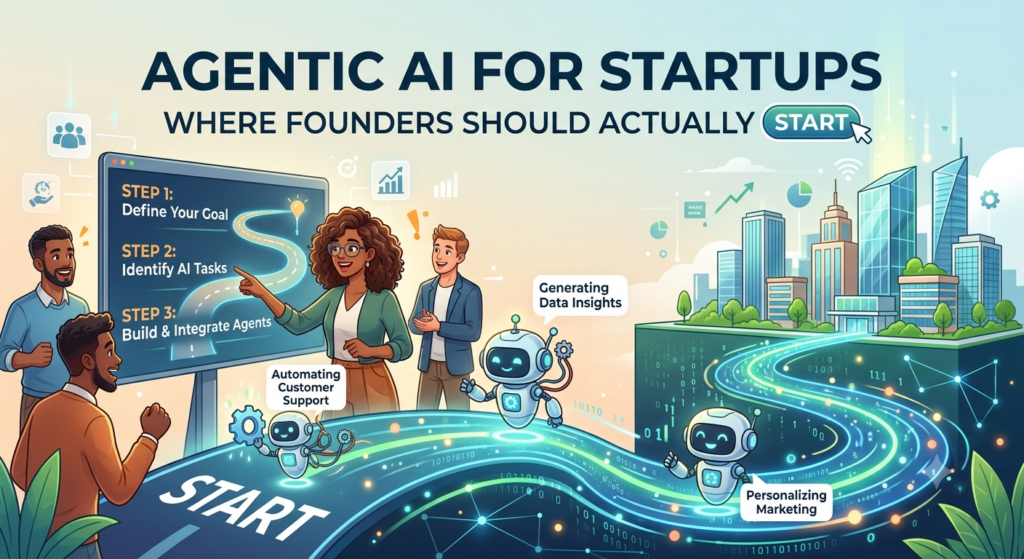
Until finally: a framework you can actually run this quarter
Strip the theory out and this is the sequence we walk founders through, adapted for a team that doesn’t have a data science org to lean on:
- Name the workflow, not the technology. Pick one recurring, decision-heavy process your users or team touch weekly — not “we want an AI feature.”
- Check the data before you check the model. If the information that workflow depends on isn’t in one accessible, reasonably clean place, that’s the actual first project.
- Ship narrow, with a human still in the loop. A pilot that handles one decision well, with a person able to override it, beats a broad multi-agent system that no one trusts yet.
- Measure it against the metric you already report. Support resolution time, conversion on a specific step, hours saved on a manual task — not “the agent responded correctly.”
Agentic AI is a real shift in what software can do on a user’s behalf, not just what it can say. For founders, the winning move isn’t waiting for enterprise-scale budgets, and it isn’t bolting a chat window onto version one and calling it done. It’s picking the one workflow that’s actually worth automating, getting honest about whether the data behind it can support that, and building outward from there.