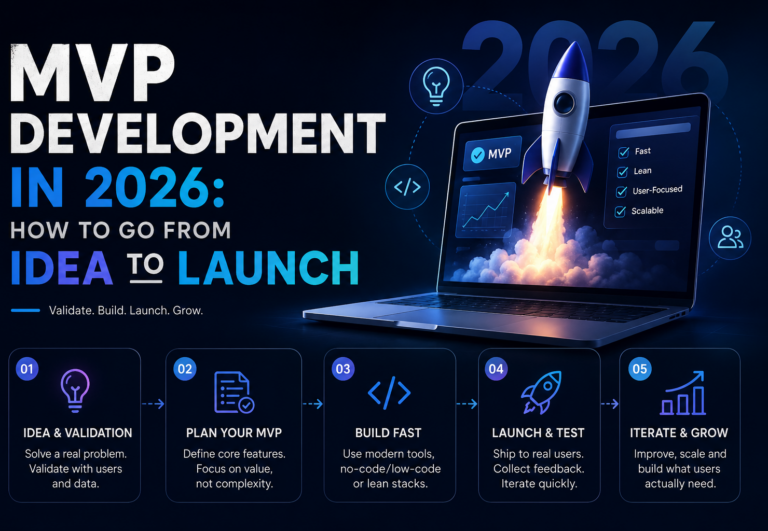
If you’re sitting on a product idea right now, you’re building in a genuinely different world than founders were even three years ago. In 2022, a clickable prototype and a good pitch deck were often enough to open doors. In 2026, users expect a working product to feel intelligent from day one — smart suggestions, automated summaries, personalized onboarding — even in a niche tool built for a few hundred people. At the same time, AI-assisted coding tools have compressed build timelines dramatically: work that used to take three to six months can now realistically move in six to ten weeks when AI tooling is combined with experienced engineering judgment.
That combination — higher user expectations, faster build tools — sounds like it should make MVP development easier. In practice, it’s made the thinking part harder. Speed is no longer the bottleneck. Deciding what to build, and why, is.
The Trap: Building Fast While Learning Nothing
Here’s the trap most founders fall into before they’ve written a single line of code: they mistake motion for progress.
The tooling landscape in 2026 gives you dozens of legitimate paths — no-code platforms like Bubble and FlutterFlow, AI coding copilots, low-code backends, or a traditional development team. Each one is genuinely capable of getting something live. But that abundance creates its own kind of paralysis. Founders spend weeks comparing stacks instead of testing assumptions. Or they swing the other way: they grab the fastest tool available, ship a feature-packed app in two weeks, and still have no idea whether anyone actually wants it.
This is the everyday reality of minimum viable product development right now — not a shortage of ways to build, but a shortage of discipline about what’s worth building first. An MVP was never supposed to be a smaller version of your full product. It was supposed to be the fastest, cheapest way to test the one assumption that could kill your idea.
The Moment Speed Stops Being the Point
For most founders, the realization arrives the same way: they’ve shipped something — a working prototype, a polished demo, sometimes a fully built product — and it lands with a shrug. Signups trickle in. Nobody upgrades. Investors ask a question about retention that nobody on the team can answer with data.
This is usually the moment it becomes clear that building fast and learning fast are not the same thing. Research on unvalidated IT projects backs this up starkly: projects that skip proper validation tend to run dramatically over budget and behind schedule, while ultimately delivering far less real value than predicted. AI-assisted development doesn’t fix this problem — it just lets you arrive at it faster. A beautifully built product nobody wants is still a product nobody wants; you’ve just gotten there in six weeks instead of six months.
The MVP Development Process That Actually Works in 2026
Because of that gap between building and learning, the MVP development process itself needs to change — not the tools you use, but the order of operations and the discipline around each step.
1. Validate the riskiest assumption first
Before any code gets written, name the single assumption that, if wrong, kills the whole idea. Not “will people like this,” but the specific, falsifiable version: will a busy operations manager actually change how they log inventory, will a parent pay a recurring fee for this, will a clinic integrate this into an existing workflow. Test that assumption as cheaply as possible — a landing page, a concierge MVP, five real conversations — before it becomes a scoping document.
2. Scope like your runway depends on it — because it does
Every feature added to an MVP is a hypothesis you’re choosing to test now instead of later. In 2026, users expect at least one intelligent feature — smart defaults, an AI-generated summary, automated matching — but the goal isn’t to add AI everywhere. Pick one AI-backed capability tied to a real pain point, and cut everything that doesn’t serve the core hypothesis, no matter how reasonable it sounds in a roadmap meeting.
3. Build with AI-assisted speed, but keep human judgment in the loop
AI coding assistants and no-code AI platforms can meaningfully cut development hours, but they don’t replace architectural decisions. Teams that treat AI-generated code as a first draft — not a finished product — avoid the most common 2026 failure mode: a fast, fragile build that can’t survive its first real traffic spike or its first messy edge case.
4. Launch to real users, not a demo audience
A launch to friends, family, and LinkedIn connections will almost always look successful. It tells you very little. The MVP development process only works if the people using it are the people you actually built it for, in the context they’d actually use it — even if that means a smaller, slower, less flattering launch.
5. Measure honestly, and be willing to be wrong
Define your success metric before launch, not after you see the numbers. Then give yourself permission to be wrong about the idea, not just the execution — the hardest and most valuable discipline in MVP development.
How Much Does MVP Development Cost in 2026?
MVP development cost in 2026 typically ranges from around $10,000 for a lean, single-feature product built on no-code or AI-assisted tools, up to $150,000 or more for a complex, AI-native build with multiple platforms or compliance requirements. Most mid-complexity MVPs — a real use case, clean UI, a handful of core integrations — land somewhere between $25,000 and $80,000. The biggest cost drivers are feature scope, number of platforms, and how much of the build genuinely needs custom engineering versus what no-code or AI tooling can responsibly handle. Hidden costs — infrastructure, third-party tools, and post-launch iteration — commonly add another 20–40% on top of the initial build, so budgeting for iteration isn’t optional; it’s part of the plan.
How long does MVP development take in 2026? With AI-assisted workflows, a straightforward MVP can realistically move from kickoff to launch in six to ten weeks, compared to three to six months a few years ago — though complex or compliance-heavy products still take longer.
From Idea to Launch: What to Do Next
The tools available for MVP development in 2026 are faster and more capable than they’ve ever been. That’s an advantage — but only for founders who use the extra speed to test more assumptions, not to skip testing altogether. The teams that go from idea to launch successfully this year won’t be the ones with the flashiest AI features. They’ll be the ones who could tell you, with real user data, exactly what they learned from version one and exactly what they’re changing because of it.
If you’re starting that process now, the highest-leverage move isn’t picking a tech stack. It’s writing down the one assumption that would end your idea if it’s wrong — and figuring out the cheapest possible way to test it this week.