If you’ve ever searched “best CRM for small business” or “flights from Delhi to Mumbai” and landed on a page that felt oddly specific to your query, you’ve probably met programmatic SEO without realizing it.
Programmatic SEO (often shortened to pSEO) has quietly become one of the most efficient ways for businesses — from SaaS startups to local service providers — to show up in search for hundreds or thousands of relevant queries at once, instead of one blog post at a time. Done well, it doesn’t just drive traffic. It drives the kind of high-intent, specific traffic that turns into leads.
This guide breaks down what programmatic SEO actually is, how it works, real examples of it in action, and — most importantly — how it can become a genuine lead-generation engine for your business.
What Is Programmatic SEO?
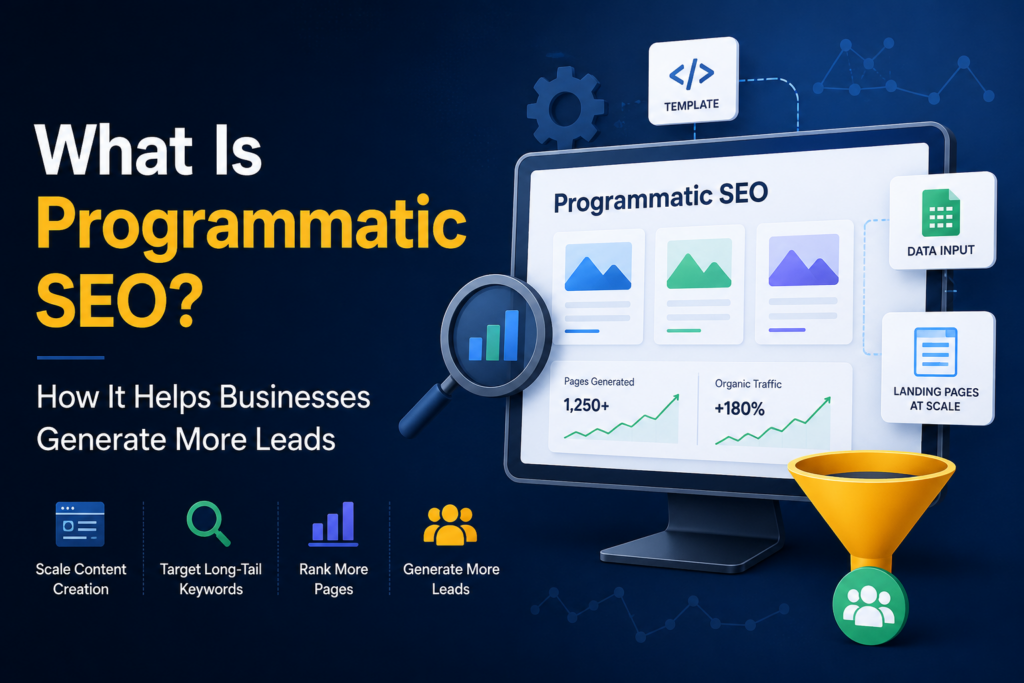
Programmatic SEO is the practice of using a dataset, a page template, and automation to generate a large number of individually optimized landing pages, each targeting a specific keyword variation, rather than writing every page by hand.
Instead of creating one article for “project management software,” a company using programmatic SEO might generate:
- “Project management software for construction teams”
- “Project management software for remote teams”
- “Project management software for agencies”
- “Project management software for architects”
Same core topic, same page structure — but each page is populated with different, genuinely useful data (features, pricing comparisons, use cases, testimonials) relevant to that specific audience segment.
The formula is simple in concept:
Head term + Modifier + Structured Data + Template = A page that ranks for a specific search
What separates good programmatic SEO from spam is that last part — structured data. If every page just swaps out a word with no real difference in substance, search engines (and users) notice. If each page genuinely answers a different question with different information, it earns its place in search results.
How Does Programmatic SEO Work?
Building a programmatic SEO system generally follows five stages:
1. Find a repeatable search pattern. Look for keywords that follow a “head term + modifier” structure with real search volume across many variations — for example, “[software] for [industry]” or “[service] in [city].” A keyword research tool is essential here to confirm the pattern actually has demand before you build anything.
2. Build or source a structured dataset. This is the part most businesses underestimate. You need real data to fill each page — product specs, pricing, integrations, reviews, location data, or industry benchmarks. Without unique data behind each page, you’re just generating duplicate content with different titles.
3. Design one strong template. Rather than writing thousands of pages, you design a single page layout with placeholders that pull from your dataset — headline, intro, comparison table, FAQs, testimonials, and a clear call to action.
4. Automate generation and publishing. Using a CMS (WordPress, Webflow) connected to a database (Airtable, a spreadsheet, or your own product database) via tools like Zapier or Whalesync, pages are generated and published at scale.
5. Monitor, prune, and improve. Not every page will perform. Track indexing, rankings, and conversions in Google Search Console and your analytics tool, then update or remove low-performing pages so they don’t drag down the rest of the site.
Real Programmatic SEO Examples
Programmatic SEO isn’t theoretical — some of the most recognizable companies online run on it:
- Zapier built thousands of “Connect [App A] to [App B]” integration pages pulled directly from its integration database, turning a niche automation tool into a search engine presence covering thousands of app combinations.
- Nomad List, built largely by a solo founder, generates individual city pages populated with structured data like cost of living, internet speed, and safety scores — proving this approach isn’t just for enterprise teams.
- Wise (formerly TransferWise) created a page for essentially every currency pair conversion, matching the exact way people search for exchange rates.
- G2 and Capterra generate comparison and review pages for thousands of software combinations, capturing highly specific “X vs Y” buyer-intent searches.
- Booking.com and Tripadvisor dominate “hotels in [city]” searches across virtually every city on the planet using templated, data-driven location pages.
The common thread: each business had a dataset that competitors couldn’t easily replicate, and they built pages around real user intent instead of generic keyword stuffing.
How Programmatic SEO Helps Businesses Generate More Leads
Traffic is nice. Leads pay the bills. Here’s where programmatic SEO earns its place in a lead-generation strategy, not just a traffic strategy:
It captures high-intent, long-tail searches. Someone searching “accounting software for freelancers in the UK” is far closer to a decision than someone searching “accounting software.” Programmatic SEO lets you show up specifically for these narrower, more qualified searches — exactly the kind of terms found under SEO for lead generation, a category of keywords with strong volume and comparatively low competition.
It multiplies your entry points into the funnel. Instead of one landing page trying to rank for everything, you have hundreds of doors into your site — each one relevant to a specific segment, each one able to carry its own tailored CTA (a demo request, a quote form, a free trial).
It lowers cost per lead over time. Once built, programmatic pages keep working without ongoing ad spend. Unlike paid campaigns that stop the moment the budget does, organic pages compound — continuing to attract and convert visitors months and years later.
It builds relevance for niche and local audiences. A landing page built specifically for “[your service] for dentists” or “[your product] in Indore” speaks directly to that visitor’s context, which typically converts better than a generic homepage.
It supports sales with better-qualified inbound. Because visitors self-select by clicking a page matched to their specific need, the leads that fill out your form arrive with clearer context — shortening sales cycles and improving close rates.
Programmatic SEO Tools and Best Practices
Getting this right requires the right stack and some discipline:
Keyword research tools — to validate that your head term + modifier pattern actually has search demand before you build a single page.
A structured database — Airtable, Google Sheets, or your existing product/CRM database to hold the unique data for each page.
A CMS with dynamic templating — WordPress (with a plugin like WP All Import), Webflow CMS, or a custom-built site that can pull from your database automatically.
Automation/sync tools — Zapier, Make, or Whalesync to keep your CMS and database in sync as data updates.
Monitoring tools — Google Search Console and analytics software to track which pages index, rank, and convert.
A word of caution: Google’s Search Advocate John Mueller has warned that programmatic SEO can become “a fancy banner for spam” when done poorly. The businesses that succeed with this approach treat each page as genuinely useful — not a keyword-stuffed shell. That means real data, honest content, working functionality, and enough uniqueness that a page could stand on its own even without the “programmatic” label. This is also where E-E-A-T matters most: search engines and users both reward pages with visible expertise (accurate, specific data), clear authorship or brand accountability, and evidence the content was built to help, not just to rank.
Frequently Asked Questions
Is programmatic SEO still effective, or is it dead in 2026?
It’s very much alive, but the bar has risen. Google has gotten better at identifying thin, templated pages with no real differentiation. Programmatic SEO built on genuine structured data and useful content still performs well; low-effort, spun content increasingly gets filtered out or deindexed.
What’s the difference between programmatic SEO and technical SEO?
Technical SEO refers to the site-wide foundations that help search engines crawl and index your site properly — site speed, mobile-friendliness, structured data markup, sitemaps, and crawlability. Programmatic SEO is a content strategy that happens to rely heavily on solid technical SEO to work at scale, but the two are not the same thing.
How long does it take to see leads from programmatic SEO?
Most programmatic pages get indexed within two to four weeks, with rankings typically improving over the following two to three months. Meaningful traffic and lead growth usually shows up between months four and six, though this varies by competition, domain authority, and content quality.
Do I need to know how to code to do programmatic SEO?
Not necessarily. No-code stacks combining Airtable, Webflow or WordPress, and sync tools like Whalesync or Zapier let non-developers build and launch programmatic pages. That said, some technical setup (data structuring, template design, QA) is still required to do it well.
Is programmatic SEO only for large companies?
No. Some of the best-known examples, like Nomad List, were built by solo founders or small teams. What matters more than company size is having (or being able to build) a structured dataset and a genuine, repeatable search pattern worth targeting.