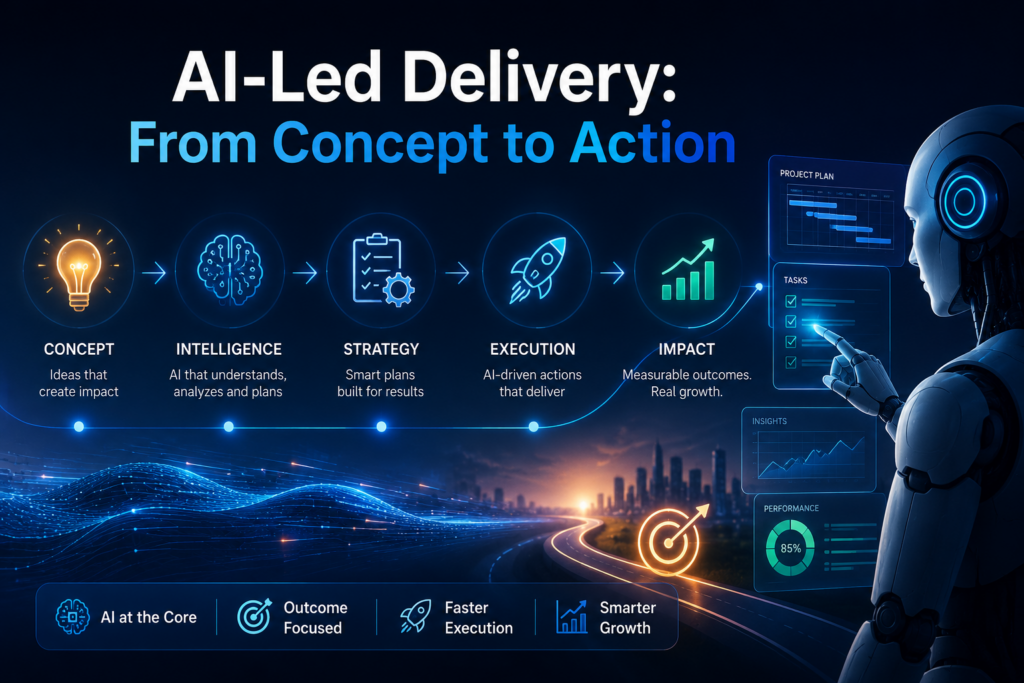
There is no shortage of AI ambition in the region. Boardrooms from Dubai to Riyadh are full of roadmaps, pilots, and proof-of-concepts. What is in short supply is delivery — the messy, disciplined work of taking an AI idea from a slide deck into a system that actually runs, scales, and generates returns.
That gap between concept and action is where most organisations lose. Not because the vision was wrong, but because the path from strategy to working software is harder than any vendor made it sound.
At iAastha, delivery is our only product. We do not hand off a blueprint and wish you luck. We own the outcome — from the first architecture decision to the day your users log in. Here is how we think about AI-led delivery, and why getting it right demands more than good intentions.
The delivery problem nobody talks about
Ask any founder who has run a failed tech initiative where it broke down. Rarely is the answer “we had the wrong idea.” Far more often it is: requirements were vague, the build team was disconnected from the business, testing was an afterthought, or the system went live and nobody knew how to maintain it.
AI introduces new complexity on top of every one of those existing failure modes. Models need clean data. Integrations have to handle edge cases that nobody anticipated. User trust has to be earned, not assumed. And in the GCC market specifically — where enterprise buyers expect formal procurement rigour and founder clients expect speed — the margin for a slow or messy delivery is close to zero.
The organisations winning with AI are not the ones with the largest budgets. They are the ones that have closed the gap between the people who set the strategy and the people who write the code.
How AI changes what delivery looks like
When AI is built into the delivery process itself — not just the end product — the results are measurably different. Here is what that means in practice.
1. Requirements that reflect reality
The most expensive mistake in any software project is building the wrong thing with precision. AI-powered discovery tools, combined with structured workshops, allow us to surface what users actually need — not just what stakeholders think they need. Natural language processing can parse existing documentation, support tickets, and user interviews to extract requirements that would otherwise take weeks of manual analysis.
The output is a requirements baseline grounded in evidence, not assumption. For GCC enterprise clients where scope creep is a budget and timeline killer, this discipline at the start saves significantly more than it costs.
2. Faster, higher-quality builds
AI code generation tools — used properly, by engineers who understand what they are generating — accelerate development without sacrificing quality. The distinction matters. An AI-generated code snippet reviewed by a senior engineer is faster and often cleaner than code written from scratch under deadline pressure. An AI-generated snippet shipped without review is a different kind of risk entirely.
Our standard is AI-assisted generation with human engineering judgement. Tools like GitHub Copilot and SonarQube integrate into our development workflow to catch vulnerabilities early and maintain code quality standards from the first commit, not the last.
3. Testing that scales with your ambition
Manual testing is the silent killer of fast delivery. As systems grow more complex — and AI-driven systems are inherently more complex — the volume of test scenarios grows exponentially. Automated testing with intelligent test generation allows coverage that no manual process can match.
We use test automation frameworks that generate scenario suites from specifications, run them continuously, and flag regressions before they reach production. For clients in financial services and healthcare — sectors where a missed edge case is a regulatory event — this is not optional.
4. Deployment and operations that hold
Shipping is not the finish line. An AI system that degrades silently, drifts from its training data, or fails under load is worse than no system at all — because it creates the illusion of capability without the substance.
AI-led delivery includes observability from day one: monitoring pipelines, drift detection, performance baselines, and escalation paths. When something changes in production — and it will — you know before your users do.
5. Intelligent automation where it earns its keep
Not every workflow should be automated. But the ones that should be — document processing, data extraction, compliance checks, routine customer interactions — can be transformed by AI agents that learn from patterns, handle exceptions gracefully, and free your team for work that actually requires human judgement.
The principle we apply: automate what is repetitive and rule-bound, augment what requires context and nuance. The line between those two categories is where the real design work happens.
What AI-led delivery looks like in practice
A regional fintech operator came to us with a core banking system processing transactions across three markets through a patchwork of manual reconciliations and overnight batch jobs. The risk was real, the inefficiency was expensive, and the engineering team was spending more time firefighting than building.
We redesigned the data pipeline with an AI-assisted reconciliation layer that flagged anomalies in real time, automated routine matches, and escalated only genuine exceptions for human review. Processing time dropped by over 70%. The risk team, for the first time, had a live view of exposure rather than a T+1 report.
A B2C founder building a marketplace product needed to move from MVP to a system that could handle Series A transaction volumes — in under four months, before a competitor moved into the same space. We built the core platform, integrated AI-powered fraud detection and personalisation, and delivered on time. The business hit its growth targets. The competitor launched six weeks later into a market that already had a clear leader.
These outcomes are not accidental. They are the result of treating delivery as a discipline — one that requires the right process, the right people, and the right accountability from start to finish.
The GCC context changes the calculus
AI-led delivery in this region is not the same as delivery anywhere else. Sun-to-Thu business cycles, Arabic-language product requirements, VAT compliance across multiple jurisdictions, data residency considerations under UAE and KSA regulations — these are not edge cases. They are the baseline.
Firms that adapt global delivery frameworks to the region as an afterthought consistently underestimate the rework this creates. We build for the GCC from the first line of architecture. That is not a marketing claim; it is a decision that touches everything from database schema to UI copy to go-live timelines.
Closing the gap
AI-led delivery is not about replacing engineers with models. It is about compressing the distance between what you decide and what you ship — and doing it in a way that holds up when real users, real data, and real scale arrive.
The gap between concept and action has always been where value is created or destroyed. AI makes the best teams faster and more accurate. It also exposes the weaknesses in teams that were already struggling.
The question is not whether to adopt AI in your delivery process. The question is whether the people accountable for your outcomes have done this before, understand where it fails, and are willing to own the result.
That is the standard we hold ourselves to. If it is the standard you are looking for, let’s talk.