For decades, the path from “we need to buy this” to “we’ve bought this” has been one of the slowest, most manual processes in business. A procurement manager spots a need, drafts a request for quote, emails it to a handful of suppliers, waits days for responses, builds a comparison spreadsheet, routes it for approval, and finally cuts a purchase order — a cycle that can stretch from days to weeks.
Agentic AI is compressing that timeline dramatically. Instead of software that simply displays data or sends alerts, a new generation of AI agents can actually do the work: issuing RFQs, evaluating supplier responses, applying contract pricing, checking inventory, and routing the resulting purchase order for approval — often without a human touching a single email. This isn’t a distant vision; it’s already reshaping procurement and sales teams inside B2B organizations in 2026.
Why B2B Buying Is a Different Problem Than Retail Checkout
Much of the public conversation about “agentic commerce” is dominated by consumer retail — AI shopping assistants that find a pair of running shoes and check out on a buyer’s behalf. B2B purchasing is a fundamentally different problem, and copying retail playbooks into procurement creates more friction than it solves.
B2B purchasing starts with relationships, contracts, and approved supplier lists, where the buyer already knows who they’re ordering from, and AI’s job is executing purchases within those existing agreements rather than discovering new ones in an open marketplace. A $50,000 component order has to pass through procurement and finance review; governance in B2B requires human approval and audit trails rather than fully autonomous transactions.
This distinction defines what “agentic” actually means here. It isn’t about agents roaming the open web to find the best deal — it’s about agents operating inside a defined set of contracts, catalogs, and rules, executing the repetitive parts of that workflow far faster than a human team could.
From Manual RFQ to Autonomous Sourcing
The clearest illustration of this shift is the RFQ process itself. Traditionally, sourcing a new component or service involves a procurement specialist manually identifying eligible suppliers, drafting quote requests, chasing responses, and building a comparison matrix by hand.
Agentic procurement systems now handle much of this end-to-end. An agent can issue RFQs automatically, collect supplier responses, score them against weighted criteria, draft summary comparisons, and recommend a shortlist for human approval. These systems also run continuously in the background, monitoring supplier financial health and performance metrics, and alerting procurement leadership with alternative suppliers if risk crosses a set threshold.
The cumulative effect across the sourcing lifecycle is significant — demand signal aggregation, supplier discovery, RFQ generation, bid comparison, and PO approval routing are each automatable, and together they eliminate weeks of manual cycle time. One dependency makes or breaks this capability, though: system integration. An agent that cannot read and write to systems like SAP, Oracle, or Coupa in real time cannot actually close the approval loop or execute a purchase order — without that connection, it can only generate insight, not take action.
What “RFQ to PO in Minutes” Actually Looks Like
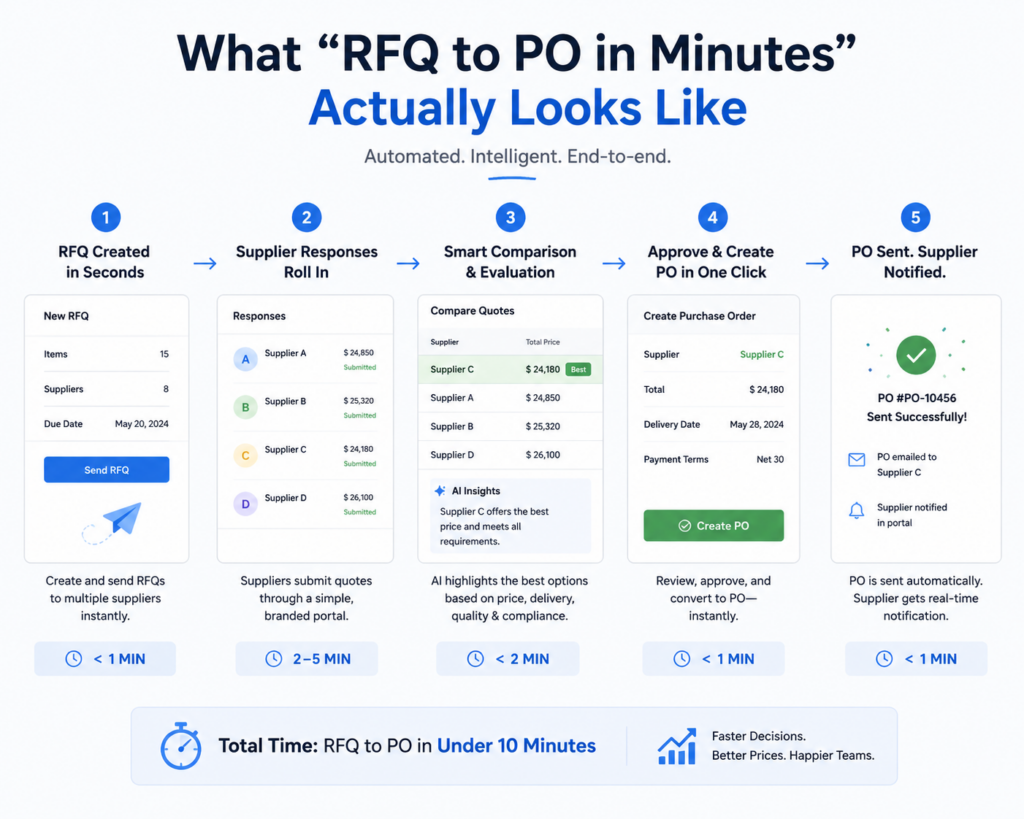
It’s worth grounding this in a concrete scenario, since “agentic AI” can sound abstract until you see the workflow it replaces.
Consider a routine reorder of components a manufacturer already buys regularly. Today, that might involve several emails, a phone call, and manual system entry — tedious, even though nothing about the purchase is new. An agentic version looks very different: the agent references order history to confirm part numbers, checks real-time inventory across approved distributors, applies contract pricing and payment terms, calculates delivery estimates, and routes the order for fulfillment — with the buyer simply confirming at the end. No emails, no phone tag, no manual re-entry of data that already exists somewhere in the system.
This logic extends into more dynamic sourcing decisions, too. Where a rigid automated workflow might always reorder from the same supplier, an AI agent monitoring inventory might instead order from a different one because it detected a lead-time change, or split an order across two suppliers to optimize delivery and cost. That adaptability, applied within pre-approved contracts and guardrails, is what separates genuine agentic behavior from simple automation.
On the sales side, the shift runs in reverse. Modern commerce platforms let a buyer configure a complex order and submit it directly as an RFQ — the sales rep receives the exact context within the CRM, eliminating the back-and-forth once needed just to establish what was being requested. Guided agents on the seller’s side can enforce pre-negotiated contract pricing and support product discovery based on technical specifications, acting as a digital sales assistant that can execute transactions rather than merely answer questions.
The Numbers Behind the Shift
This isn’t a niche efficiency play — the scale of projected adoption suggests a structural change in how B2B trade happens. By 2028, an estimated 90% of all B2B purchases are expected to be handled by AI agents, with roughly $15 trillion in spending flowing through automated exchanges. Adoption intent already reflects that trajectory, with 74% of B2B companies planning to deploy agentic AI within the next two years, according to Deloitte’s 2026 research.
The benefits aren’t purely speculative. Broader supply-chain AI adoption is already showing measurable results — a McKinsey study found that advanced analytics and AI in supply chain operations can reduce forecasting errors by up to 50% and cut lost sales by up to 65%. Procurement teams piloting agentic systems report similar gains: higher conversion as agents complete transactions without friction, fewer service calls as agents handle routine inquiries, and better order accuracy as agents validate compatibility before an order is placed.
There’s an important corrective here, though: agentic AI isn’t a license to remove human oversight altogether. Companies sometimes buy autonomous systems and constrain them with so many rigid rules that the autonomy is effectively programmed out, leaving expensive automation with a higher cloud bill and more complex failure modes. The more useful question isn’t “how autonomous can we make this,” but “which decisions genuinely benefit from adaptive judgment, versus reliable automation.”
Building Toward Readiness: Discoverability, APIs, and Trust
None of this works without infrastructure, and B2B organizations need to build toward it deliberately. Readiness generally comes in layers. The foundation is discoverability — making sure AI agents acting on a buyer’s behalf can find and understand a supplier’s catalog, through structured product data, schema markup, and clear product and category summaries.
The next layer is transactional access, which requires real integration rather than agents scraping web pages. Read-only APIs let agents access product information, inventory, and pricing; transactional APIs let agents build carts and create orders; post-purchase APIs give visibility into order status and returns. Without this layer, agents can research a supplier’s products but can’t close the loop and complete the purchase.
Catalog quality matters just as much as the plumbing. Detailed, unambiguous product data helps agents make accurate recommendations confidently — gaps in a catalog mean agents simply can’t use it reliably. This has competitive consequences: protocol compliance is becoming a qualification criterion for vendor discovery, much as EDI compliance became a precondition for retailer vendor onboarding in the 1990s. Sellers who gate pricing behind contact forms risk becoming invisible to procurement workflows that increasingly decide before a human opens an email.
Trust and governance round things out. As agents gain more autonomy, trust is becoming the ultimate competitive advantage — buyers will let agents act on their behalf only if confident decisions are reliable and data is protected. The risks are real: unauthorized purchases, opaque decision paths, and errors in cross-agent communication. Organizations moving fastest pair autonomy with transparent consent flows, granular permissions, and policy-driven guardrails.
Conclusion
The journey from RFQ to purchase order has been one of B2B’s most stubbornly manual processes — full of emails, spreadsheets, and waiting. Agentic AI is dismantling that bottleneck not by replacing human judgment, but by absorbing the repetitive, rules-based work that never needed a human in the first place: drafting quote requests, comparing bids, checking inventory, applying contract pricing, and routing approvals.
What separates organizations getting real value from this shift isn’t how aggressively they’ve automated, but how deliberately they’ve built the foundation underneath it — clean product data, real API access into ERP systems, and clear guardrails that keep humans in control of meaningful decisions. The B2B companies investing in that groundwork now are positioning themselves to be the “preferred supplier” when their buyers’ agents come calling — and that future is arriving faster than most procurement teams expected.
Frequently Asked Questions
1. What does “agentic AI” mean in B2B commerce, versus a regular chatbot?
A chatbot follows fixed, predefined steps and mostly provides information. An agentic AI system can plan, decide, and act across a multi-step workflow — issuing an RFQ, evaluating supplier responses, and routing the order for approval — adapting based on real-time conditions rather than following one rigid script.
2. Can AI agents really create a purchase order without any human involvement?
In most B2B environments today, no — by design. Governance typically requires human approval and audit trails, especially for larger purchases. The more accurate picture is an agent that handles research, comparison, and drafting automatically, then presents a near-finished order for a human to confirm.
3. Is agentic AI in B2B commerce the same as the AI shopping agents used in retail?
No. Retail-style agentic commerce assumes agents can discover and compare products across open marketplaces independently. B2B purchasing is built around negotiated contracts and approved supplier lists, so the agent’s job is executing efficiently within existing agreements rather than shopping the open market.
4. What does a company need in place before it can support agentic buying from its customers? Three things, roughly in order: discoverability (structured product data agents can read), transactional access (APIs that let agents check inventory and place real orders), and governance (permissions and logging that keep the process auditable). Skipping straight to a chatbot without these foundations tends to disappoint.
5. Does adopting agentic AI mean B2B companies should automate as much of procurement as possible?
Not necessarily. Pushing for maximum autonomy on processes that don’t need adaptive judgment often just produces expensive automation without real benefit. The better approach is identifying which decisions genuinely benefit from adaptive judgment, and applying autonomy selectively there